
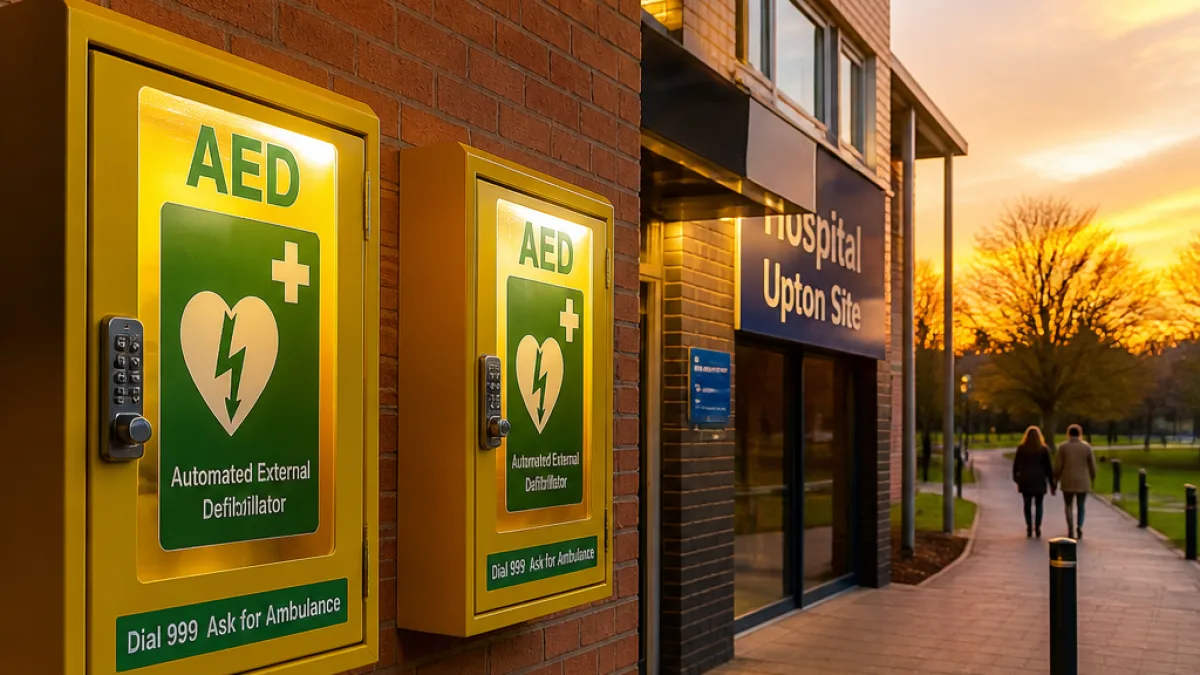
Immediate access to life‑saving kit now available in Chester
Two public access Automated External Defibrillators (AEDs) have been installed in secure external cabinets at the Countess of Chester Hospital’s Upton site, meaning people in Chester can now reach the devices at any hour.
The units are located outside the Education and Training Centre and Moston Lodge, and have been relocated from inside those buildings where they were previously only available during opening hours. Hospital leaders say the move ensures the defibrillators are available 24 hours a day, seven days a week for staff, visitors and members of the public using nearby parks and routes.
"Making these defibrillators publicly accessible 24 hours a day is an important step in improving emergency response for both our hospital site and the wider community,"
The comment came from Sue Pemberton, director of nursing and quality and deputy chief executive officer at the Countess of Chester Hospital, who added that relocating the devices into externally accessible cabinets "ensures life‑saving equipment is available whenever it is needed."
Why this matters in Chester
Every year thousands of people suffer cardiac arrest outside hospitals, and immediate action can be the difference between life and death. The Resuscitation Council UK advises that a person’s chance of survival falls with every minute without cardiopulmonary resuscitation (CPR) and defibrillation; early use of a defibrillator within a few minutes can significantly improve outcomes.
By moving two AEDs to external cabinets and registering them with the North West Ambulance Service, the hospital aims to shorten the time to treatment if a cardiac arrest happens nearby. Although the cabinets are locked to protect the equipment, the devices are part of the wider Public Access Defibrillator (PAD) network for the area.
What residents need to know
- Location: Countess of Chester Hospital, Upton site — outside the Education and Training Centre and Moston Lodge.
- Availability: 24/7 — accessible day and night.
- Security: Cabinets are locked but devices are registered with the North West Ambulance Service to be deployed in emergencies.
The hospital said charitable funds helped support the initiative, highlighting collaboration between the NHS site and the community. The relocation is intended to strengthen patient safety, support community wellbeing and improve timely access to life‑saving treatment for everyone passing through the area.
Practical impact and next steps
For people in Chester and visitors to the nearby green spaces, the change is straightforward: two more AEDs are now reachable at any time. That increases the number of PADs available locally and gives ambulance control rooms another resource to direct members of the public to, when needed.
Hospital staff emphasise that while the cabinets are secured to protect the equipment, registering each AED with the ambulance service means callers to 999 can be told the exact location and how to access the device quickly. Training in CPR and defibrillator use remains vital, but the presence of the machines reduces one of the main barriers to early defibrillation — access outside normal building hours.
| Feature | Detail |
|---|---|
| Number of new 24/7 AEDs | 2 |
| Site | Countess of Chester Hospital, Upton |
| Registered with | North West Ambulance Service |
For local residents, this is a tangible improvement to emergency preparedness on the Upton site. While the best outcome is always prevention, more ready availability of defibrillators is one of the simplest, evidence‑backed measures to improve survival after an out‑of‑hospital cardiac arrest.
People wishing to know where other PADs are located in Chester should consult the North West Ambulance Service or local charity registries that map public access defibrillators across the area.














