
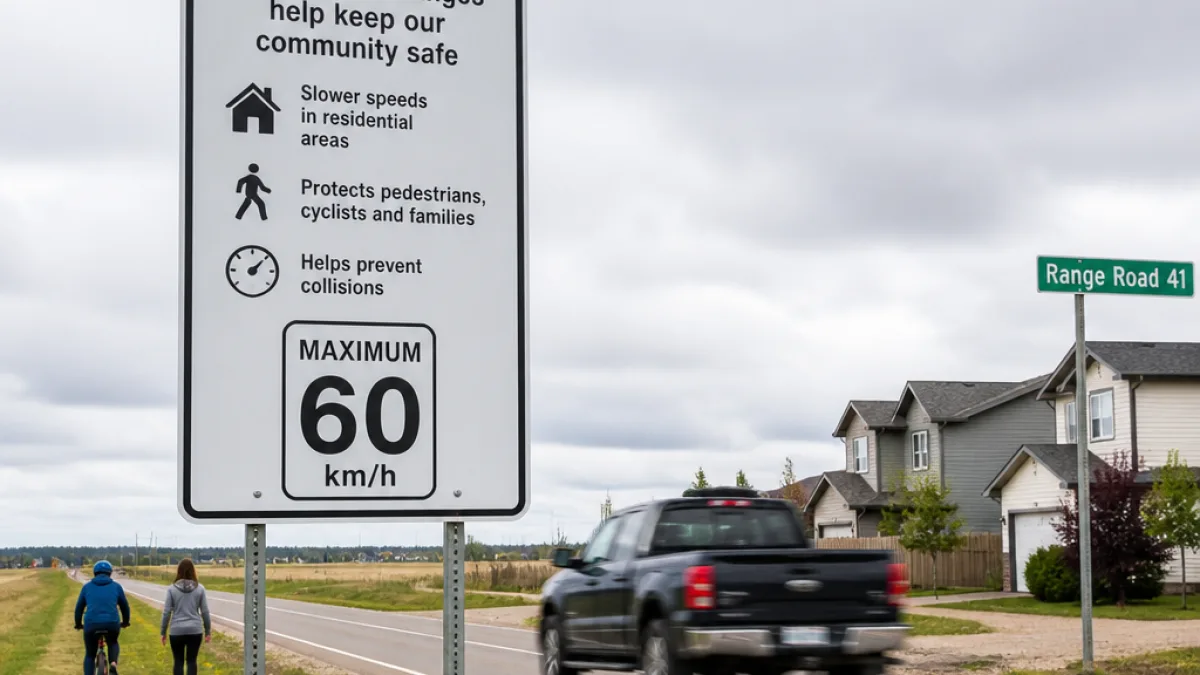
Council orders explanatory signs after short safety study in Bloomsbury
County of Barrhead councillors have resolved to install pedestrian and cyclist explanation signs in the Bloomsbury subdivision on Township Road 601, near Range Road 41, following concerns raised by residents about road safety.
The decision, taken at the council meeting on Tuesday 15 September, follows a traffic and pedestrian safety study carried out by Enforcement Services in early August. County manager Debbie Oyarzun told councillors the study was commissioned after local residents expressed worries about people walking and cycling along the stretch of road, which serves roughly a dozen households.
Community peace officers Joel Flemmer and Dana Butler gathered observational and interview data over a four‑day period. Flemmer said the field work combined stationary speed observation using lidar and radar with quiet roadside positioning to reduce visibility when appropriate, while Butler carried out door‑to‑door interviews to gauge residents' concerns and experiences.
- Study duration: approximately 4.5 hours of observation spread over four days
- Observed vehicles: 80
- Pedestrians/cyclists observed: 14
The officers recorded a mixed picture of driver behaviour. Half the vehicles were at or below the posted limit, while 85% were travelling at or below 70 km/h on the road where the speed limit is 60 km/h. At the same time, a minority of drivers were travelling well in excess of the limit: 6% exceeded the limit by more than 30 km/h.
“When I'm set up on the side of the road, front‑ and rear‑facing radar, I’m much more visible than with lidar, where I can park my vehicle off the road, and be more discreet,”
— Community peace officer Joel Flemmer
Heavy vehicles and exposure of vulnerable road users
Officers also noted that around 16% of the traffic consisted of heavy vehicles, chiefly farm equipment. That proportion, combined with the presence of walkers and cyclists using the carriageway, was a central factor in councillors' debate about appropriate interventions.
| Measure | Data |
|---|---|
| Vehicles observed | 80 |
| Pedestrians/cyclists observed | 14 |
| Vehicles ≤ speed limit (60 km/h) | 50% |
| Vehicles ≤ 70 km/h | 85% |
| Vehicles > limit by >30 km/h | 6% |
| Heavy vehicles | 16% |
Given the snapshot nature of the observations, Enforcement Services recommended retaining the current speed limit for now while introducing explanatory signage aimed at informing drivers why speeds change and to highlight the likelihood of encountering pedestrians and cyclists.
Councillors accepted the recommendation to install the signs, instructing administration to proceed with the measure. The move reflects a cautious approach: the council is opting for targeted, low‑cost interventions that aim to influence driver behaviour through information rather than immediate regulatory change.
What this means for residents
For residents of Bloomsbury, the immediate effect will be the appearance of new roadside signage that explains the presence of pedestrians and cyclists and reinforces the rationale behind the existing 60 km/h limit. The council has not yet committed to further physical road changes or an alteration of the speed limit; such steps would require additional data or evidence of persistent non‑compliance and risk.
Officers and councillors emphasised the limited scope of the initial study: observations covered a small sample of vehicles and times of day. Further monitoring would be necessary to establish longer‑term trends or to justify more intrusive measures such as speed humps, additional enforcement or a formal speed limit review.
The decision offers a pragmatic, incremental response to local concern — prioritising awareness and community engagement while leaving open the possibility of further action should future data indicate the need.
Local residents who wish to see further enforcement or who can provide additional information about traffic patterns have been encouraged to contact County administration so that any future decision is informed by a broader evidence base.













