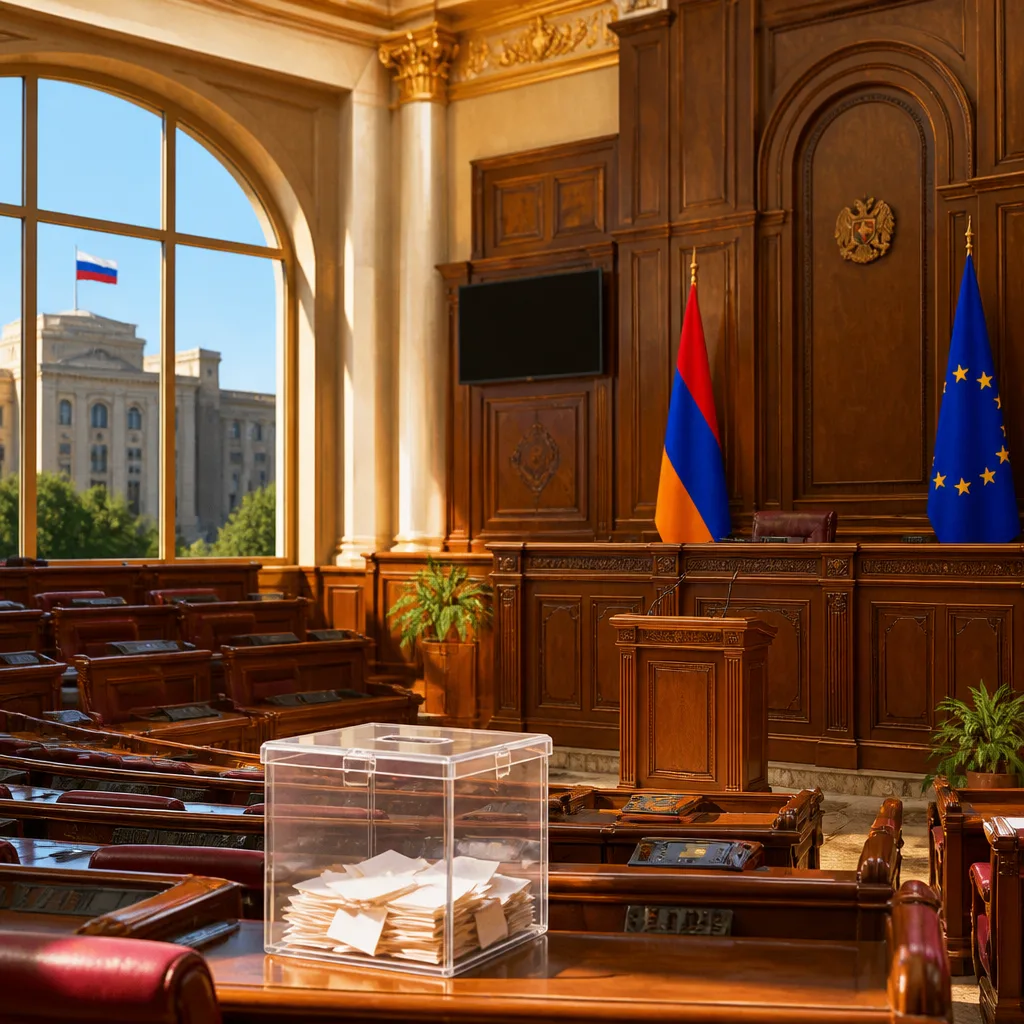
Armenia will shortly start preparations to submit an application to join the European Union, Prime Minister Nikol Pashinyan told parliament on Monday, setting out a course that could deepen the Caucasus republic’s engagement with Brussels and further complicate its relations with Moscow.
Decision framed as a formal process
Pashinyan told deputies that Armenia must first lodge an official application and that the government “may begin this process in the near future.” He added that, if the bid is submitted, the country would hold a referendum on EU membership.
“Armenia must first submit an official application for EU membership,” Pashinyan told deputies. “We may begin this process in the near future.”
The announcement follows a period of closer ties between Yerevan and European capitals. Pashinyan was re-elected in June and has recently hosted high-level visits, including EU leaders and Ukraine’s president. Those contacts come against a backdrop of frustration in Yerevan over what many officials describe as Moscow’s insufficient protection during clashes with neighbouring Azerbaijan.
Moscow’s response and the wider context
Russia maintains a military base in Armenia and includes the country within its Eurasian Economic Union (EAEU). The Kremlin has repeatedly warned that membership of Western and Russian-led blocs is incompatible. On Monday, Kremlin spokesman Dmitry Peskov emphasised differences in trade and customs rules between the two spheres and pointed to long-running EU applicants as cautionary examples.
Peskov said the differing trade, sanitary and customs rules of the blocs do not match, and referred to countries that have waited decades in their applications as a warning. The Kremlin’s broader messaging has also linked EU aspirations with risks, with President Vladimir Putin earlier this year likening such moves to a path that began with Ukraine’s decisions and sparked far-reaching tension.
Economic and political pressures
Moscow has stepped up pressure on Yerevan as relations with Brussels have warmed, including by introducing import curbs. The Russian response underscores the leverage it still holds over Armenia’s economy and security architecture, even as Armenian leaders pursue a European trajectory.
- Domestic validation: Pashinyan proposes a referendum should an application be made.
- Security ties: Russia retains a military base in Armenia and is a dominant security partner.
- Economic linkage: Armenia is a member of the Eurasian Economic Union, complicating integration with EU rules.
The statement from Yerevan did not set a firm timetable for lodging the application, nor did it outline the specific legal and administrative steps to be taken. EU accession is a lengthy process that requires alignment with a broad set of political, economic and legal standards. Pashinyan’s pledge to consult the public via referendum, however, signals an intent to secure domestic legitimacy for any profound realignment.
Implications for Europe
For Brussels, a formal approach from Armenia would pose both opportunities and dilemmas. On one hand, it would mark a further enlargement of the EU’s neighbourhood engagement. On the other, it would raise complex questions about how to reconcile accession talks with existing commitments Armenia has to Russian-led institutions.
| Actor | Position/Influence |
|---|---|
| Armenia | Announced preparations to apply; plans referendum if bid lodged |
| European Union | Recipient of a potential accession bid; engaged with Yerevan through recent visits |
| Russia | Holds military presence, economic ties via EAEU; has warned against EU integration |
How Brussels and member states respond — whether by offering incentives, technical support, or cautious political encouragement — will be closely watched in Moscow. Equally, developments in Yerevan will be monitored by regional capitals and international partners concerned with stability in the South Caucasus.
The prime minister’s announcement is the latest episode in a gradual reorientation of Armenian foreign policy since 2018, when mass protests brought Pashinyan to power. It underscores the tension between long-standing security arrangements with Russia and a growing desire among some Armenian leaders to secure deeper ties with the EU.