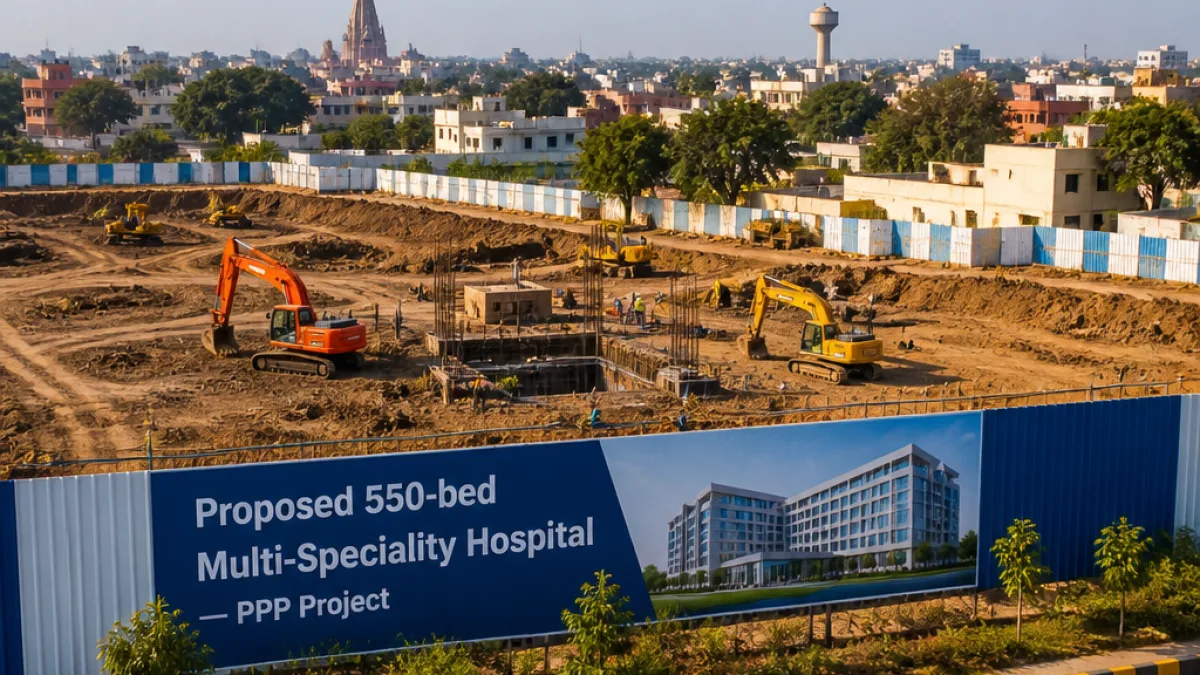
Park Medi World awarded 550‑bed hospital mandate by Prayagraj Municipal Corporation
Prayagraj: Park Medi World Limited has been awarded a Public–Private Partnership (PPP) mandate by the Prayagraj Municipal Corporation to develop and operate a 550‑bed multi‑super‑speciality hospital in the city, the company said in a disclosure on Wednesday.
Under the concession, Park Group will construct the hospital over a period of two years from the appointed date and operate the facility under a long‑term lease of 45 years. The project entails an estimated investment of approximately ₹200 crore, and will receive ₹76.52 crore in concessionary support from the State Government to help de‑risk a significant portion of the capital outlay, the disclosure added.
Site, land and expansion option
The hospital is planned on a 3.22‑acre plot allotted by the Municipal Corporation at a site behind Arail Ghat in Prayagraj. The concession provides an option to acquire an additional 2.47 acres from the fifth year after commercial operations date (COD) for future expansion, according to the company statement.
| Parameter | Detail |
|---|---|
| Planned bed capacity | 550 beds |
| Estimated investment | ₹200 crore |
| State support | ₹76.52 crore |
| Land allotted | 3.22 acres (option for 2.47 acres after year 5) |
| Construction timeline | 2 years from appointed date |
| Concession period | 45 years |
Company strategy and regional context
The Prayagraj project forms part of Park Group's broader expansion in Uttar Pradesh. When combined with an existing 360‑bed hospital in Agra and an upcoming 400‑bed facility in Gorakhpur, Park Group's total capacity in the State will reach 1,260 beds on completion, the company said.
Park Medi World said the new capacity in Prayagraj aims to strengthen access to tertiary care across North India. The company also disclosed that the project will be financed through internal accruals.
“the additional capacity is intended to address the healthcare requirements of communities in and around the Prayagraj region.”
Local implications
The new hospital will add a significant number of tertiary‑care beds to Prayagraj’s healthcare ecosystem, which could affect patient flows, referral patterns and private‑public service balance in the city and surrounding districts. A 550‑bed multi‑super‑speciality facility can potentially absorb referrals for specialised services that previously required travel to larger centres.
- Contractual term: Park Group will operate the facility under a 45‑year lease, aligning private operation with long‑term municipal planning.
- Financial de‑risking: State concession of ₹76.52 crore reduces upfront private capital exposure, a common PPP feature intended to make large health projects viable.
- Employment and downstream services: A hospital of this scale is likely to create substantial local employment in clinical, administrative and support roles, and generate demand for allied services such as diagnostics, pharmacies and housing for staff.
Officials from the Municipal Corporation and the State Government have not been quoted in the company disclosure published publicly; the details above are drawn from Park Medi World’s official announcement to the market and related reporting. The project will proceed subject to the usual municipal clearances, construction milestones and any regulatory approvals required for a medical facility of this scale.
Next steps and timeframe
According to the concession terms released by the company, construction is expected to be completed within two years from the appointed date, after which the hospital will commence commercial operations. The concession also allows capacity expansion beyond the initial 3.22‑acre allotment from the fifth year, giving the operator scope to grow services in response to demand.
For residents of Prayagraj, the project represents a substantial private investment in local healthcare infrastructure. How the new facility will interact with existing public hospitals, the pricing and availability of specialised services, and the pace of project implementation will determine its ultimate impact on healthcare access in the region.