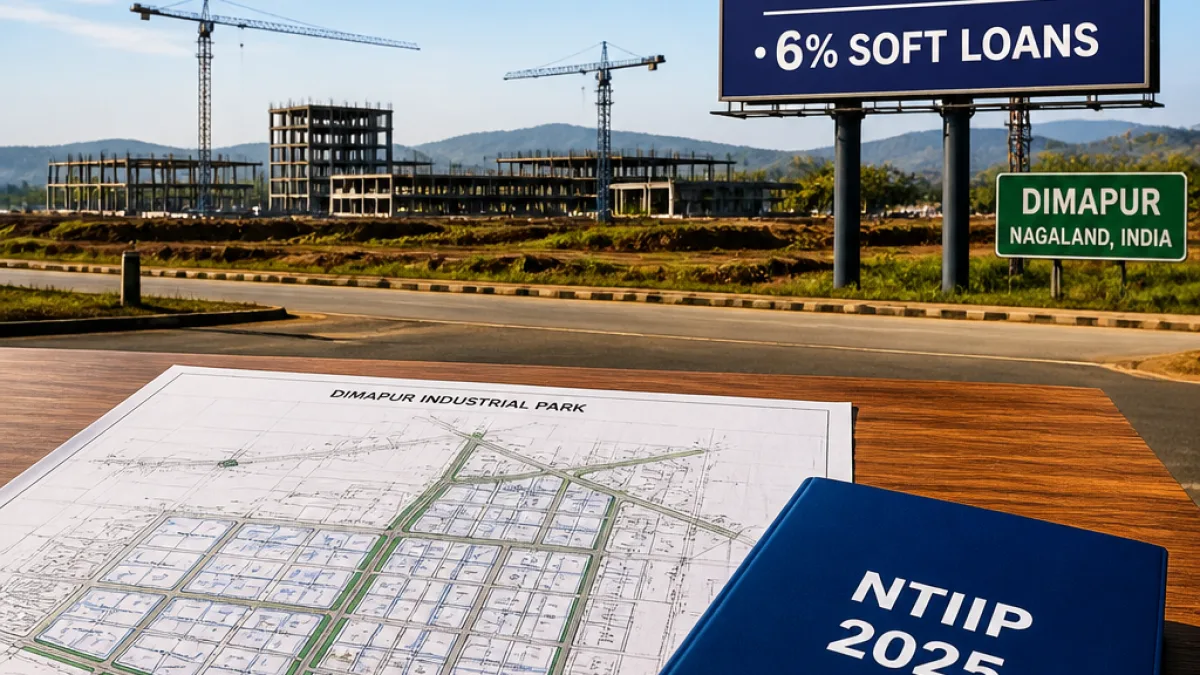
DIMAPUR: Nagaland has rolled out a new industrial blueprint, the Nagaland Trade, Investment and Industrial Policy (NTIIP) 2025, aiming to replace the State Industrial Policy of 2000 and to jump-start manufacturing, services and entrepreneurship across the state. Notified on 8 May 2025, the policy pledges fiscal incentives and structural measures intended to attract investment and generate employment.
Policy goals and headline incentives
The NTIIP 2025 sets out an overarching mission to create a business-friendly environment through simpler procedures and upgraded infrastructure, with the stated aim of fostering competitive industrial growth and expanding employment. Key fiscal measures highlighted in the policy include a 30% capital subsidy and access to 6% soft loans for eligible projects — provisions intended to lower the initial cost burden for investors and local entrepreneurs.
“To create a business friendly environment with simplified procedures and improved infrastructures so as to encourage innovative entrepreneurial skills fostering competitive industrial growth and investment, thereby creating employment opportunities and enhancing the State’s economic status resulting in better living standards.”
The policy document frames these measures as part of a broader strategy to transition Nagaland’s economic base by supporting micro, small and medium enterprises (MSMEs), startups and value-added local units.
Strategic pillars and implementation approach
NTIIP 2025 identifies several strategic pillars: nurturing entrepreneurship and innovation, strengthening MSMEs, developing industrial clusters, improving logistics and skilling the workforce. The policy also emphasises support for women entrepreneurs and the promotion of tourism and exports as complementary areas for growth.
Among implementation ideas flagged by the policy are the creation of industrial "land banks" to provide ready-to-use sites for investors, and leveraging national initiatives such as UNNATI 2024 along with sustainable finance mechanisms to draw capital into the State.
Who stands to gain — and what this means locally
- Existing MSMEs and prospective startups may access capital subsidies and cheaper loan finance, lowering entry and expansion costs.
- Industrial clusters and land banks aim to reduce lead time for setting up units, potentially attracting outside investors and improving job prospects in towns such as Dimapur and Kohima.
- Skills development and logistics improvements are intended to make local manufacturing more competitive for inter-state and export markets.
Officials framing the policy as a "decisive economic reset" argue that simplified procedures and targeted incentives will help unlock entrepreneurship and local value addition. The policy text positions these interventions as means to reduce poverty and balance regional growth within Nagaland.
Details that remain to be clarified
While the NTIIP 2025 sets out ambitions and headline incentives, the notification and available summaries do not yet specify detailed eligibility criteria, ceilings or sectoral priority lists for the 30% capital subsidy and 6% soft loans. Precise timelines for operationalising industrial land banks, governance arrangements for implementation, and the expected fiscal outlay from the State budget were not detailed in the material reviewed.
Stakeholders — including existing manufacturers, entrepreneurs and financial institutions in Nagaland — will be looking for implementing guidelines that clarify procedural steps, application modalities and monitoring mechanisms.
What to watch next
Policy implementation milestones to monitor in the coming months include the release of operational guidelines, notification of eligible sectors and subsidy ceilings, formation of any single-window clearances, and announcements on the availability and location of industrial land banks. Progress on skilling programmes linked to the policy and partnerships under UNNATI 2024 will also be important to assess early traction.
| Item | Detail |
|---|---|
| Policy name | Nagaland Trade, Investment and Industrial Policy (NTIIP) 2025 |
| Notification date | 8 May 2025 |
| Replaces | State Industrial Policy, 2000 |
| Key incentives | 30% capital subsidy, 6% soft loans |
The NTIIP 2025 represents a substantive policy shift for Nagaland after nearly a quarter-century. Its success will depend on the clarity and speed of follow-up notifications, the State’s fiscal capacity to fund incentives, and the ability to translate incentives into durable private investment and productive employment across the State.