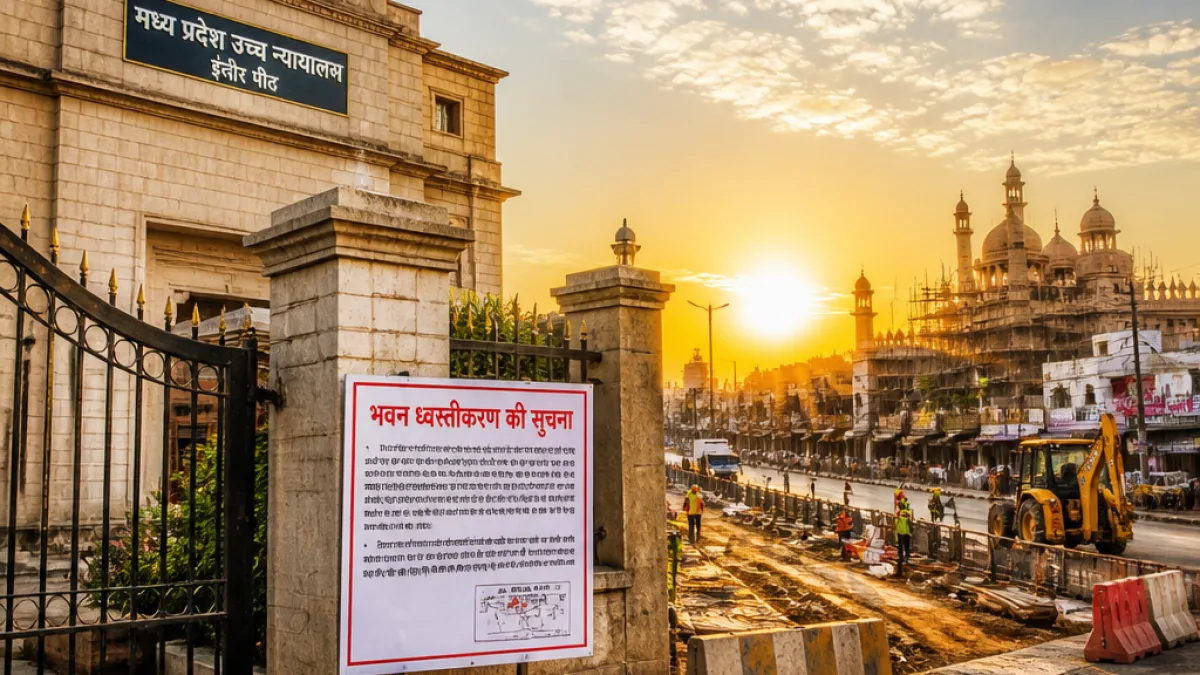
The Indore Bench of the Madhya Pradesh High Court on Thursday dismissed two writ petitions that sought to halt notices issued by the Ujjain Municipal Corporation to demolish a portion of the Shahi Masjid at Chatri Chowk for a road-widening project. The bench held the municipal action formed part of a planned public-interest exercise under the Ujjain Development Plan, 2035.
Court finding and legal challenge
Justice Sandeep N. Bhatt heard the petitions filed by representatives of the mosque's management — Shahi Masjid Waqf Panchayat Mochiyaan and Shahi Masjid Waqf Panch Mochiyan — and ruled that "no case is made out for interference under Article 226 of the Constitution of India."
"no case is made out for interference under Article 226 of the Constitution of India."
The petitions arose from a sequence of municipal notices dated 14, 25 and 27 August and a final order dated 1 September 2026 that directed demolition of part of the mosque to accommodate a 15-metre road alignment. Petitioners argued the exercise would result in removal of a section of the prayer hall (Jamat Khana), a 120-foot minaret and the Mazhar Chouk Shahi.
Contentions raised by petitioners
Petitioners contended the mosque is registered as waqf property and therefore enjoys constitutional protections under Articles 25 and 26 regarding freedom of religion and management of religious affairs. They pleaded discrimination, noting that adjacent structures of historical significance were reportedly spared while the mosque faced demolition.
Advocates Jagdish Baheti, Aaditya Dubey and Prabuddha Singh appeared for one petitioner (WP-37147-2026). In the connected petition (WP-37128-2026), advocate Syed Ashhar Ali Warsi adopted similar submissions. They relied on precedents that stress procedural safeguards before removing encroachments and argued the Madhya Pradesh Waqf Board had not been served notice.
Municipal response and court's view
Counsel for the Ujjain Municipal Corporation, advocate Rishi Tiwari, raised a preliminary objection on maintainability, indicating a dispute over the current leadership of the mosque committee after its reconstitution by the waqf. The court, however, did not find grounds to interfere at this interlocutory stage.
The bench underlined that the road-widening work is part of a broader civic plan and characterised the municipal action as an exercise of public authority for urban improvement. The court therefore refused to stay the demolition notices.
Administrative context and local stakes
The contested alignment forms part of the Ujjain Development Plan, 2035, which aims to reconfigure road widths and circulation in the city. The exercise has taken on added salience because Ujjain is preparing to host Simhastha 2028, a large religious congregation that increases demand for improved civic infrastructure and traffic management.
The decision affects devotees, residents and shopkeepers around Chatri Chowk, a central locality in Ujjain that intermingles heritage structures and dense urban activity. The case also raises procedural questions on consultations and notices for waqf properties when municipal plans require partial land acquisition or demolition.
Case details
| Item | Particulars |
|---|---|
| Petitions | WP-37147-2026; WP-37128-2026 |
| Notices issued | 14 August, 25 August, 27 August 2026 |
| Final municipal order | 1 September 2026 |
| Project | 15-metre road widening under Ujjain Development Plan, 2035 |
What remains
The High Court's refusal to stay demolition does not decide the ultimate merits of the petitions. Petitioners may pursue the writs on the merits for a final adjudication. The ruling at present only permits the municipal process to proceed without interim judicial restraint.
- Immediate effect: Notices remain operative and municipal works may continue.
- Legal posture: Court found no prima facie violation of fundamental rights warranting interim relief under Article 226.
- Broader issue: Balancing urban development and protection of waqf/heritage properties remains contested.
The case will be watched closely in Ujjain, where civic planning pressures and heritage sensitivities intersect ahead of a major religious event. Any further orders from the High Court or actions by the Municipal Corporation or the Madhya Pradesh Waqf Board will determine the next phase of this dispute.