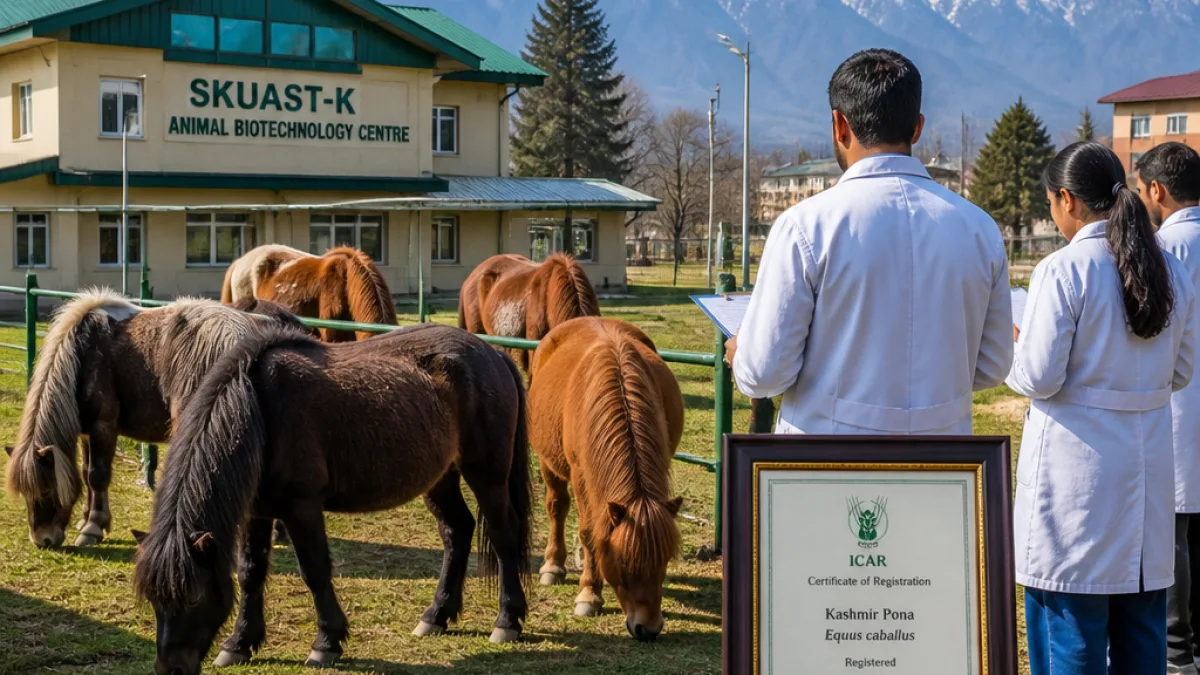
Srinagar: Scientists at Sher-e-Kashmir University of Agricultural Sciences and Technology of Kashmir (SKUAST-K) have secured national recognition and formal registration of the Kashmir Pony as an indigenous horse breed with the ICAR–National Bureau of Animal Genetic Resources (ICAR-NBAGR), Karnal. The registration was approved by the ICAR Breed Registration Committee at its 14th meeting on 7 August 2026.
Official recognition and accession details
The ICAR committee has assigned the breed the accession number INDIA_HORSE_0700_KASHMIRI_07009 and recorded Jammu & Kashmir as the breed's home tract. The move formalises long-standing scientific documentation and opens institutional avenues for conservation and utilisation of the animal genetic resource.
Research team and collaborators
The SKUAST-K project was led by Dr Syed Shanaz, Head of the Division of Animal Genetics & Breeding, Faculty of Veterinary Sciences. The core research team included Dr Muzamil Abdullah (Assistant Professor, MRCSG), Dr Akeel Yousuf Wani (MVSc scholar, LPM), Dr Nazish Rizwan (MVSc scholar, LPM) and Dr Khushboo Javaid (MVSc scholar, AGB).
ICAR-NBAGR, Karnal, provided scientific collaboration and guidance to the SKUAST-K team. The bureau's involvement included inputs from Dr A.K. Mishra, Principal Scientist and project in-charge, according to SKUAST-K officials. The Animal Husbandry Department in Jammu & Kashmir also supported fieldwork and facilitation.
What the registration means
Experts said the formal inscription of the breed in the national registry is a significant step towards:
- Systematic conservation — documented breed parameters can guide in situ and ex situ conservation efforts.
- Sustainable utilisation — recognised breeds are better placed for breeding programmes and livelihood projects.
- Research and development — national recognition typically facilitates access to technical and institutional support for further characterisation.
Background and local impact
The Kashmir Pony has been an element of the region's rural and transport history for generations. While the breed has featured in local culture and everyday use, its formal recognition provides an institutional basis for protecting genetic purity and for planning targeted interventions such as breeder registries, veterinary extension and targeted livelihood schemes.
Conservationists and livestock specialists view breed registration as a precursor for policy interventions — including identification of priority populations, training for local breeders, and possible entitlements under state or central schemes aimed at conserving animal genetic resources. Registration also improves the prospects for pedigreed breeding and value-addition through niche tourism or cultural promotion.
Next steps signalled by stakeholders
SKUAST-K said the documentation and registration will facilitate follow-up actions, including dissemination of breed descriptors, development of standardised breeding protocols and potential pilot conservation programmes. Inputs from ICAR-NBAGR are expected to shape evidence-based strategies for both conservation and utilisation.
| Item | Detail |
|---|---|
| Breed | Kashmir Pony |
| Lead institution | SKUAST-K, Faculty of Veterinary Sciences |
| ICAR accession number | INDIA_HORSE_0700_KASHMIRI_07009 |
| ICAR body | ICAR–National Bureau of Animal Genetic Resources, Karnal |
| Key project collaborators | ICAR-NBAGR (including Dr A.K. Mishra); Jammu & Kashmir Animal Husbandry Department |
"The recognition marks a significant milestone in the scientific documentation, characterization and conservation of Kashmir’s unique animal genetic heritage," SKUAST-K reported.
Broader significance
Registration of indigenous breeds helps preserve biodiversity while creating potential livelihood options for rural communities. When combined with extension support and market linkages, breed recognition can lead to schemes that sustain breeders financially while preserving genetic resources for future generations.
For Jammu & Kashmir, where animal husbandry remains an important rural occupation alongside agriculture, formalising the status of regionally adapted livestock can strengthen efforts to protect local breeds from genetic dilution and neglect.
The SKUAST-K announcement underscores a growing policy focus on cataloguing and preserving India's animal genetic resources. With the Kashmir Pony now on the national registry, attention will turn to how conservation actions are prioritised and funded at the state and district levels to translate recognition into tangible benefits on the ground.