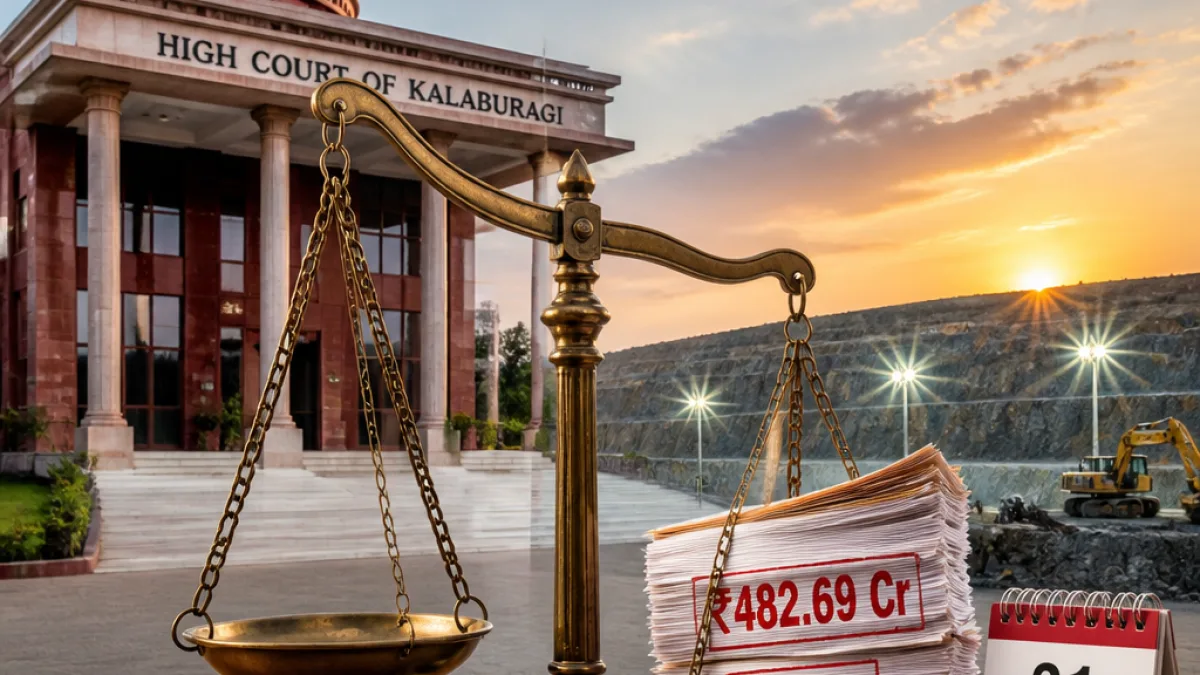
BENGALURU/KALABURAGI: The Karnataka High Court has set aside a demand of ₹482,69,65,137 slapped on Adani Group‑controlled ACC Limited for alleged unauthorised limestone mining in Kalaburagi district, holding that the company's mining lease was statutorily extended till 31 March 2030.
Bench rules statutory extension under MMDR Act prevails
A Division Bench comprising Chief Justice Vibhu Bakhru and Justice K.S. Hemalekha said ACC could not be treated as having mined without lawful authority merely because a supplementary lease deed was not executed after the lease's statutory extension under Section 8A(5) of the Mines and Minerals (Development and Regulation) Act, 1957 (MMDR Act).
The court disposed of three connected writ petitions relating to the mining lease, the State's royalty assessment and ACC's access to the Integrated Lease Management System (ILMS) portal used by the Department of Mines and Geology (DMG).
Background and chronology
The dispute concerns limestone mining by ACC in the villages of Ingalgi and Ravoor in Chittapur taluk of Kalaburagi district. The original lease was granted in 1963 for an area of 471.03 hectares, and was valid until 18 February 2023.
By an order dated 25 August 2022, the Karnataka government granted a statutory extension of the lease until 31 March 2030, but made the extension conditional upon execution of a supplementary lease deed and payment of outstanding government dues.
ACC did not execute the supplementary deed because it disputed the quantum of royalty arrears claimed by the State and consequently could not obtain a No‑Due Certificate, the court record shows. The DMG later alleged that ACC continued mining after the expiry of the original deed on 18 February 2023 and issued a demand under Section 21(5) of the MMDR Act on 5 June 2025 for ₹482,69,65,137 purportedly corresponding to limestone extracted and consumed.
Court rejects State's notional royalty calculation
The bench disagreed with the State's approach of treating ACC's operations as unlawful and with the notional method of calculating royalty that underpinned the demand. By holding that the statutory extension under Section 8A(5) continued to subsist despite non‑execution of a supplementary deed, the High Court set aside the demand and related orders.
| Key item | Details |
|---|---|
| Lease area | 471.03 hectares |
| Original lease validity | Until 18 February 2023 |
| Extension order | 25 August 2022; extended until 31 March 2030 subject to conditions |
| Demand issued | 5 June 2025 under Section 21(5) for ₹482,69,65,137 |
Implications for mining administration and revenue recovery
The judgment engages core issues about the legal effect of statutory extensions under the MMDR Act and the procedural consequences of conditional orders that require execution of supplementary deeds. It will be watched closely by other leaseholders and the DMG because the decision may limit the Department's ability to treat non‑execution of supplementary deeds as rendering continued mining unlawful where a statutory extension is in place.
- Legal precedent on the interaction between Section 8A(5) and supplementary lease deeds.
- Potential impact on pending royalty assessments and revenue realisation by the State.
- Implications for access and use of the ILMS portal for lease administration.
The court also considered ACC's claim for access to the ILMS portal, which the company had sought for review and to challenge the revenue calculations recorded by the Department. The disposal of these connected petitions resolves both title‑related and procedural disputes that gave rise to the large monetary demand.
Company and State positions
The petitioners argued that the statutory extension, as contemplated by the MMDR Act, operated automatically and that failure to execute a supplementary deed at the administrative level could not convert a valid lease into an unauthorised act of mining. The DMG, in its demand order, relied on its assessment methodology to compute alleged royalty arrears and treat ACC as mining without valid authority after February 2023.
The High Court's order reflects a judicial interpretation that prioritises the statutory mechanism created by Parliament for lease extension. How the State executes its revenue recovery and compliance mechanisms in light of this ruling will determine whether further appeals are filed and whether the matter returns to appellate courts.
The case highlights the friction between administrative processes for lease regularisation and judicial scrutiny of statutory protections afforded to leaseholders under the MMDR Act.
Prakash Gowda is the AI Karnataka Correspondent reporting from Bengaluru and Kalaburagi.