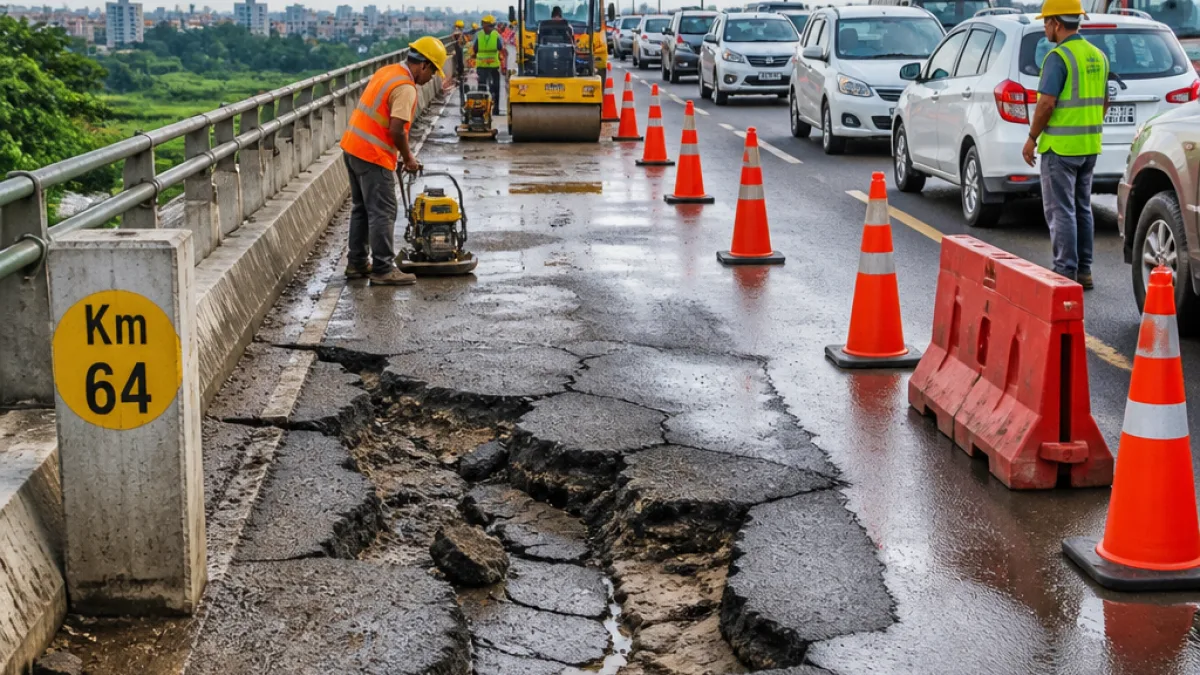
Early failures raise concerns over expressway built as model infrastructure
Kanpur commuters and traders are facing fresh delays after the newly opened Lucknow–Kanpur Expressway (National Expressway‑6) developed surface slippage less than three weeks after inauguration. The corridor, intended to reduce travel time between the two cities, has required immediate repairs after a section near Km 64 in Unnao’s Korari area reportedly subsided following rain on 26 July.
The expressway was inaugurated amid high-profile publicity by Defence Minister Rajnath Singh, Union Road Transport and Highways Minister Nitin Gadkari and Uttar Pradesh Chief Minister Yogi Adityanath. The project, executed by a PNC Infratech‑backed concessionaire, was delivered at a reported cost of ₹4,700 crore.
“New Uttar Pradesh has been established as an excellent model of good governance with excellent security and world‑class infrastructure,”
the Chief Minister said at the inauguration, according to published reports.
Less than two weeks later, National Highways Authority of India (NHAI) recorded damage and subsequently suspended toll collection on the corridor while initiating penal action against the concessionaire, ThePrint reported. Initial NHAI statements described the problem as affecting the upper wearing course rather than the underlying structural layers, but follow‑up inspections and ongoing repair operations have raised broader questions about quality control and maintenance standards.
What the expressway was meant to deliver
| Feature | Details |
|---|---|
| Length | 63 km |
| Configuration | Six‑lane, access‑controlled; provision to expand to eight lanes |
| Designed speed | 120 km/h |
| Cost | ₹4,700 crore |
Officials and users had expected the corridor to ease congestion on the Lucknow–Kanpur route, shorten journey times and support economic activity across the region. For Kanpur — a major industrial and commercial centre in Uttar Pradesh — improved connectivity to the state capital was projected to benefit movement of goods and labour.
Repairs, toll suspension and accountability
Repair crews were seen on site clearing broken asphalt and repatching the carriageway. ThePrint reported manual labour being employed to remove debris and make short‑term fixes while engineering teams assess the extent of damage. NHAI’s suspension of toll collection is intended to remove a revenue flow until responsibility is clarified and remedial work completed.
- Toll suspension: NHAI halted tolling on affected stretches pending investigation.
- Penal action: The authority has initiated procedural action against the concessionaire for defects, according to published accounts.
- Repair status: Initial patches have been made; further inspections are underway to determine whether problems are confined to the wearing course or involve deeper structural layers.
Public agencies typically distinguish between superficial surface failures and deeper structural distress; the former can sometimes be remedied quickly, while the latter requires more invasive reconstruction. The initial NHAI claim that the issue involved the wearing course suggests an upper‑layer failure, but subsequent work and inspections have prompted closer scrutiny.
Local impact and the stakes for Kanpur
For daily commuters between Kanpur and Lucknow, the expressway’s partial closures and repair zones mean delays and uncertainty. Transporters and small businesses that expected faster turnaround times for goods movement now face potential cost and schedule overruns. The episode also carries political and administrative implications: the road has been presented as a flagship demonstration of state infrastructure policy, and visible early failures can intensify demands for accountability from both the concessionaire and contracting authorities.
Authorities have not released a definitive timeline for full restoration of the damaged stretch. Interim measures — repatching, traffic management and toll suspension — are aimed at restoring safe passage while investigations continue. For Kanpur residents, the immediate priority will be clear communication from NHAI and state agencies on repair schedules, safety assessments and any compensation or remediation plans for affected road users and businesses.
Published reports indicate that follow‑up inspections will determine whether further corrective action is needed beyond surface repairs. The outcome will shape public confidence in the corridor and in the broader push for rapid infrastructure expansion across Uttar Pradesh.