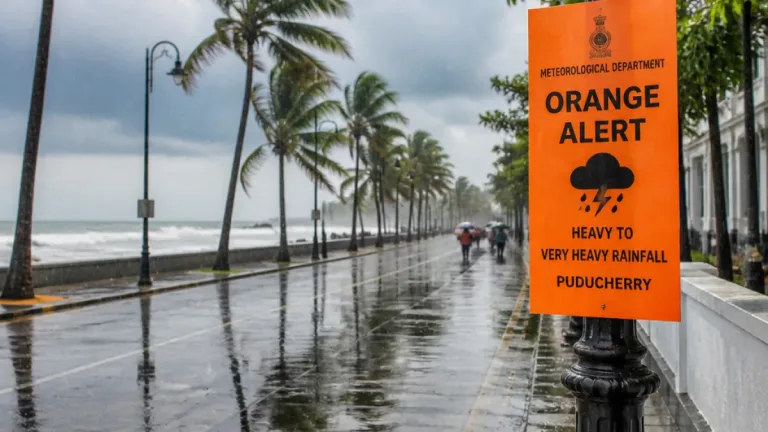

Chennai, 25 October: Cyclone warning signals have been hoisted at nine ports along the Tamil Nadu and Puducherry coasts after a low‑pressure area over the east‑central Bay of Bengal intensified into a depression, the India Meteorological Department (IMD) said on Sunday.
System expected to strengthen, landfall forecast on Oct 28
The IMD has forecast that the system will continue to intensify as it moves northwestwards and is likely to cross the Andhra Pradesh and Yanam coasts forenoon on 28 October. The agency said the depression could develop into a very severe cyclonic storm by the morning of October 28 and would lie over the west‑central Bay of Bengal off the Andhra Pradesh coast at that time.
“The system is very likely to cross the Andhra Pradesh and Yanam coasts between Bapatla and Visakhapatnam around forenoon on October 28, with wind speeds of 115–125 km/h and gusts up to 140 km/h at landfall.”
The IMD’s advisory, issued as part of its Special Message updates, warned of heavy to very heavy rainfall along parts of the eastern coast and urged coastal administrations to take precautions.
Ports under warnings and local rainfall
Port authorities raised cyclone warning signals at nine locations; government bulletins and media reporting specifically named the following ports where signals are up:
- Chennai
- Nagapattinam
- Cuddalore
- Karaikal
- Pamban
- Thoothukudi
Officials said the total number of ports placed under warning is nine; local authorities did not list the remaining locations in the initial communiqués made public on Sunday.
Puducherry and neighbouring coastal areas of Tamil Nadu reported continuous rainfall from the night of Saturday, with several urban localities experiencing waterlogging. The IMD has cautioned that heavy to very heavy showers are likely to persist over Puducherry, Karaikal and adjoining districts.
Impact on communities, fisheries and transport
Coastal communities have been advised to remain alert, particularly fishing families and those living in low‑lying areas. Port signal hoisting typically triggers restrictions on small‑boat movements and the suspension of certain port operations until the system weakens.
Fisheries department sources said they were monitoring weather bulletins and preparing to issue directives to fisherfolk to remain ashore. Harbour masters at the named ports have been asked to secure vessels and cargo and to coordinate with district administrations for rescue readiness.
Preparedness steps and public advisory
District administrations along the coast have been instructed to keep evacuation plans and relief resources ready. The IMD advisory also called for continuous monitoring of the system and timely dissemination of updates to the public and to frontline agencies.
Residents in low‑lying and flood‑prone areas were urged to prepare for waterlogging and to follow instructions from local authorities. Persons travelling along the east coast in the coming days were advised to check weather forecasts and transport advisories before planning journeys.
Schedule and forecast summary
| Item | Details |
|---|---|
| Current status | Depression over east‑central & adjoining southeast Bay of Bengal (as of 24 Oct observations) |
| Likely intensification | To a very severe cyclonic storm by morning of 28 Oct |
| Expected landfall | Andhra Pradesh / Yanam coast between Bapatla and Visakhapatnam on forenoon, 28 Oct |
| Wind speeds at landfall | 115–125 km/h with gusts up to 140 km/h |
Officials urged citizens to rely on verified IMD bulletins and district disaster management channels for the latest information. The IMD routinely issues updated messages as the system evolves and close monitoring continues through the week.
State and district administrations were directed to maintain liaison with the Coast Guard, navy, fisheries department and port authorities as part of contingency planning. Further advisories and operational directives are expected as the system approaches the coast and its intensity becomes clearer.
For now, coastal residents and harbour communities are advised to take precautions, secure movable property and be prepared to follow evacuation orders if issued by local authorities.