Week-long HADR exercise staged at Air Force Station Agra
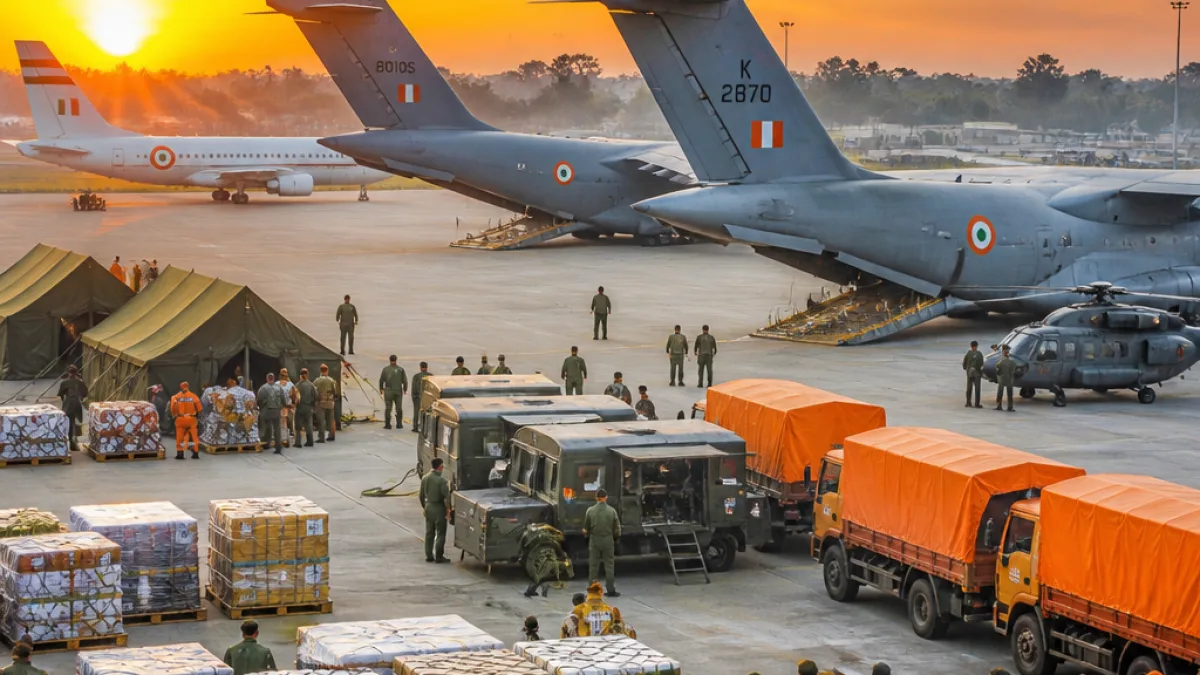
Agra — The Indian Air Force and the Royal Thai Air Force conducted Exercise Siam Bharat 2026, a week-long Humanitarian Assistance and Disaster Relief (HADR) engagement, at Air Force Station Agra from 23 to 29 August 2026, aimed at improving bilateral preparedness and inter-agency coordination for large-scale disaster operations, sources reported.
The exercise brought together air assets and personnel from both nations to practise joint planning, command-and-control and tactical air operations that would be required during floods, cyclones or other major emergencies. Officials said the programme combined tabletop planning, capability exchanges and practical flying tasks to simulate time-sensitive relief missions.
- Dates: 23–29 August 2026
- Primary hosts: Indian Air Force and Royal Thai Air Force
- Indian participants: Indian Army, National Disaster Response Force (NDRF), National Disaster Management Authority (NDMA), Directorate General of Research & Development Establishment
- Focus areas: interoperability, planning, tactical air operations, multi-agency coordination
Integrated approach to disaster response emphasised
Exercise activities included tabletop exercises designed to assess responses to varied disaster scenarios, capability-sharing sessions and tactical sorties to replicate coordination of aviation assets during relief operations. The involvement of the Indian Army and key national disaster-management bodies reflected a deliberate effort to rehearse beyond the air domain and to build a cohesive civil–military response framework.
“The engagement enabled personnel to exchange operational knowledge, assess capabilities and develop an improved understanding of procedures involved in coordinated HADR missions,” the exercise brief said, according to reports.
Participants used the tabletop discussions to examine planning, coordination and decision-making requirements that arise during complex humanitarian emergencies. Capability exchanges allowed teams to compare operational practices and disaster-response approaches, officials said, with the stated aim of improving mutual understanding and operational interoperability between the two air forces.
Practical drills to test time-sensitive response
Practical components of the drill focused on tactical air operations, including the coordination of aircraft for evacuation, aerial delivery of relief material and reconnaissance to assess damage. Such tasks are critical in the immediate aftermath of a disaster when rapid situational awareness and timely delivery of aid can significantly reduce casualties.
| Exercise element | Objective |
|---|---|
| Tabletop exercises | Examine planning and decision-making across agencies |
| Capability exchanges | Share operational practices and build interoperability |
| Tactical air operations | Practise coordination of aviation assets in time-sensitive missions |
Officials also highlighted the value of multinational drills in exposing participants to varied operational methods and technologies used by partner nations, which can be adapted to national procedures during actual emergencies. The exercise underlined the need for integrated planning between military and civilian disaster-response agencies in densely populated states such as Uttar Pradesh.
Implications for Agra and the region
For Agra, hosting such an exercise places local response mechanisms in a rehearsal environment and strengthens links between central agencies based in the city and national security actors. Improved civil–military coordination can aid evacuation planning, distribution of relief supplies and quicker restoration of critical services following a catastrophic event.
Officials indicated that lessons from the exercise will be assessed and incorporated into standard operating procedures to refine joint response timelines and resource allocation during future emergencies. The exercise also serves a diplomatic purpose, reinforcing defence and humanitarian cooperation between India and Thailand.
Exercise Siam Bharat 2026 concluded on 29 August after a series of evaluations and debriefs, with participating contingents reporting on identified gaps and best practices to guide future bilateral HADR collaborations, according to reports.