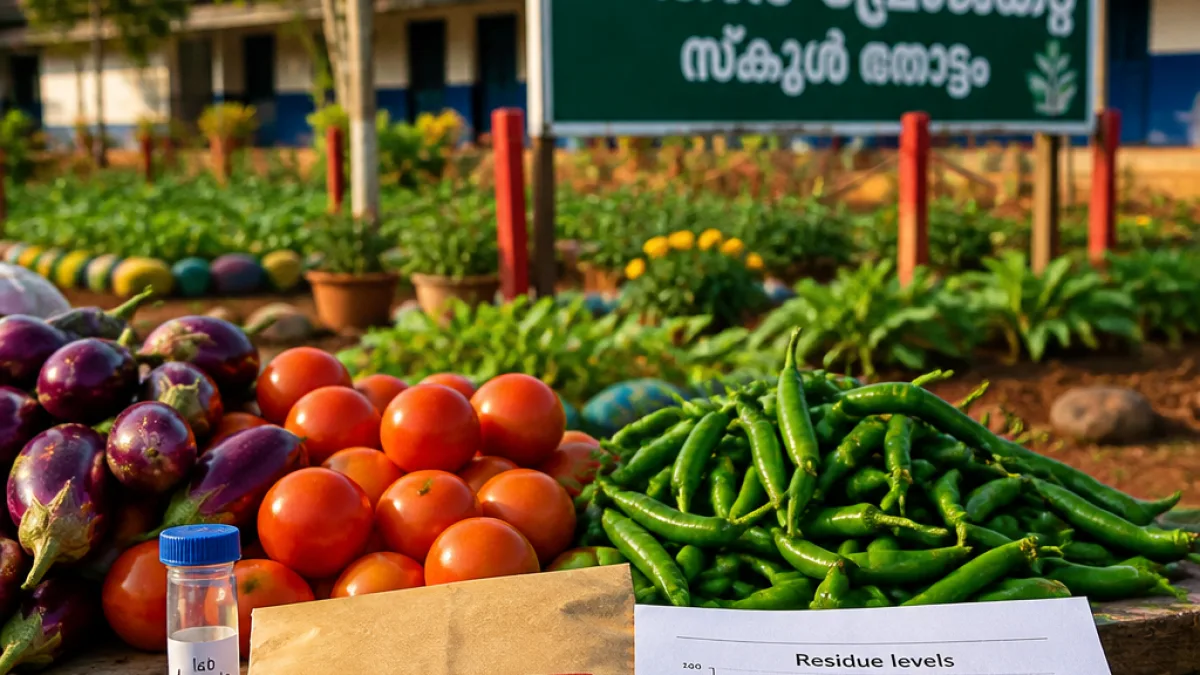
Kozhikode: Kerala Agriculture Minister T Siddique on Monday disclosed that excessive pesticide residues and other toxic substances were detected in 58 of 1,262 food samples analysed at official Agriculture Department laboratories across the state, including the Vellayani and Mannuthy centres.
Scope of the laboratory findings
According to the minister, routine tests carried out at state-run facilities found chemical traces at levels the department characterised as excessive in the 58 samples. The announcement prompted immediate discussion of policy measures aimed at reducing dependence on chemical inputs and promoting safer food production.
Siddique described the finding as a serious public-health concern, saying that consumers purchasing vegetables and other produce risked inadvertent exposure to toxic substances. He said the government would take steps to expand organic vegetable cultivation and encourage households to engage in small-scale farming.
"When 1,262 food samples were tested in official labs across Kerala — including Vellayani and Mannuthy — excessive traces of pesticide residues and toxic substances were found in 58 of them. This means when we buy vegetables from a shop, we are essentially buying toxic substances for our family members. It is extremely serious," Siddique said.
Policy responses: organic farming and Kathir
As part of the response, the minister highlighted the Kathir project — an initiative to reintroduce farming in educational institutions. Siddique said the scheme will be implemented in 500 schools in the current year, with the Agriculture Department providing ₹10,000 per school to support on-campus cultivation.
Under Kathir, Siddique said, each participating school will have a nodal teacher and a backup committee. Students will receive training and Kathir clubs will be formed to build sustained engagement. The minister indicated the government intends to widen the programme in future academic years.
He also said the Education Department had responded positively in discussions and that the government was considering academic incentives — including possible weightage marks — for students who take part in agricultural activities through Kathir clubs.
Practical implications for consumers
Public-health experts often point out that pesticide residues on vegetables and fruits can arise from overuse, improper application close to harvest or use of unauthorised chemicals. While the minister did not release a detailed breakdown of the compounds detected or the commodity-wise results, the laboratory count underscores the need for enhanced testing, traceability and farmer outreach.
- Samples tested: 1,262 at official Agriculture Department laboratories
- Samples with excessive residues: 58
- Laboratories mentioned: Vellayani and Mannuthy
- Kathir rollout: 500 schools this year; ₹10,000 per school support
Data table: headline figures
| Parameter | Figure |
|---|---|
| Total samples tested | 1,262 |
| Samples with excessive residues | 58 |
| Schools in Kathir rollout (current year) | 500 |
| Funds per school (Agriculture Department) | ₹10,000 |
What remains to be disclosed
The minister's statement did not provide a commodity-wise or district-wise breakdown of the contaminated samples, nor did it specify the names and concentrations of the pesticides or toxic substances identified. Detailed laboratory reports, which would be necessary to assess risk to consumers and inform recalls or advisories, were not released at the time of the announcement.
Officials in the Agriculture Department may be expected to share full test results, permissible limits referenced and proposed follow-up measures such as expanded surveillance, farmer training on integrated pest management, and market-level testing. Consumer groups and health authorities typically seek clarity on whether contaminated batches remain in circulation.
Longer-term objectives and civic context
The minister framed the response as twofold: scaling up organic vegetable farming and reviving a culture of household cultivation. Kerala has a long tradition of kitchen gardens and small-holder cultivation; policymakers see Kathir as a vehicle for reconnecting youth with agriculture while addressing food-safety concerns.
Further updates are likely as the Agriculture Department completes its review and as participating schools and education authorities begin implementing Kathir activities.
Reporting from Kozhikode.