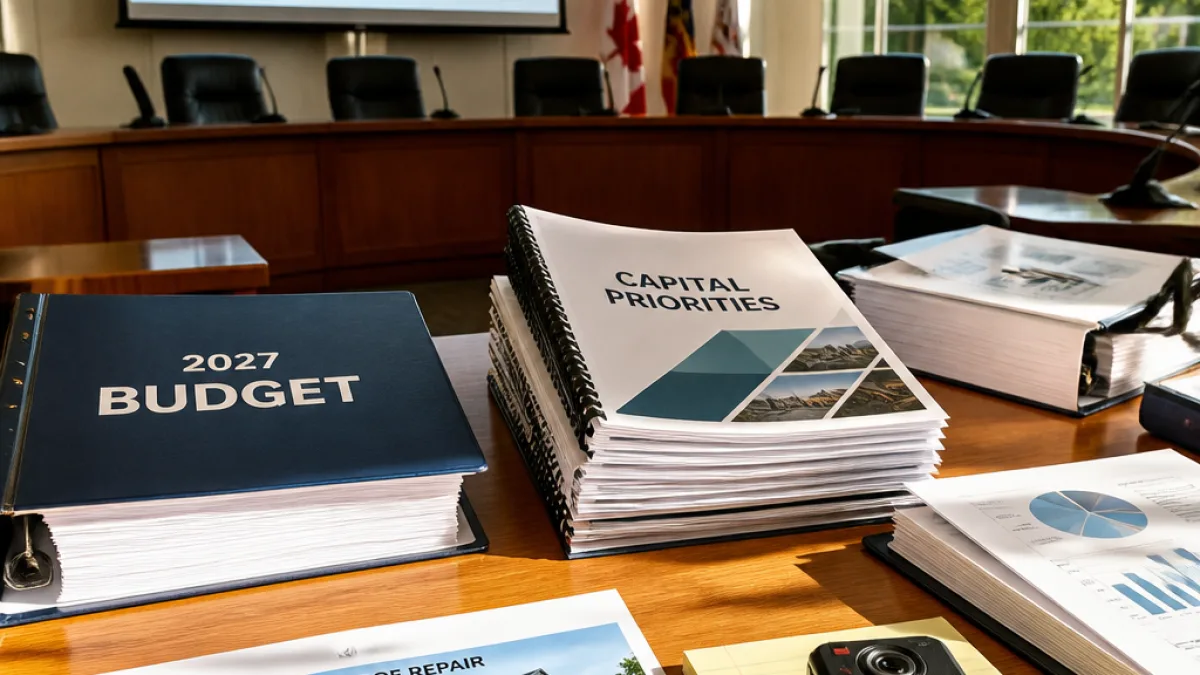
The Waterloo finance committee opened preliminary work for the 2027 municipal budget on Aug. 5, signalling a tighter planning year after the city carried a deficit into 2026 and expects lower provincial aid estimates than a year ago.
Committee Chair Charles Kuhl told members the city approved a deficit budget in 2026 and used the fund balance to cover the shortfall. With revenue outlooks unchanged, he warned the room: “We won’t be seeing any new revenue, so the budget is going to be tight.”
Departments asked to prioritise and defer
City department heads provided an initial review of capital requests, and the committee asked them to search for savings within their submissions. More in-depth meetings are scheduled over the coming weeks as staff and councillors refine choices ahead of fall budget approval.
Several departments said they would try to defer or stagger work where feasible to keep the near-term budget lean while still addressing critical needs.
- Police highlighted the need for body-worn cameras, a costly but important accountability tool;
- Parks staff moved some projects, including a pavilion roof replacement that needs upgraded insulation, forward to 2027 while delaying other items to later years;
- Public works indicated vehicle replacements — a pickup and another truck — are required;
- The fire service has applied for a grant to replace air tanks, with councillors keeping the request as a placeholder until grant decisions are known.
Public safety and deferred maintenance dominate requests
Police Chief David Warner told the committee the most pressing question was body wearable cameras. He described them as “really expensive,” but said they are very important for public accountability and officer safety. Warner also flagged potential needs for a new squad car and updated computers but indicated the department could try to postpone those purchases for a few years and continue the conversation during budget deliberations.
Parks Coordinator Gabe Haberkorn said the upper pavilion roof must be replaced and that costs are higher than initially expected because the work also needs new insulation. Haberkorn said he moved that project into the 2027 year and pushed several other items — such as replacing baseball field lights and lower pavilion counters — into later years to keep the forthcoming budget leaner.
For public works, Supervisor Chad Yerges said the department needs both a new pickup truck and another vehicle replacement.
At the fire department, Chief Chad Butzine reported the city has applied for a grant to replace air tanks. Finance Committee Member Rich Weihert recommended keeping that request in the draft budget as a placeholder until the grant outcome is known at the end of the month.
| Department | Noted need | Timing noted |
|---|---|---|
| Police | Body-worn cameras; possible squad car; computer upgrades | Camera decision for 2027; vehicle/computer possibly delayed |
| Parks | Upper pavilion roof with insulation; field lights; counters | Roof moved to 2027; lights delayed; counters to 2028 |
| Public Works | Pickup and another truck replacement | Included in capital requests |
| Fire | New air tanks (grant application submitted) | Placeholder until grant decision |
Kuhl also said the city is meeting with financial adviser Ehlers Associates to pursue a more strategic approach to budget planning and potentially minimise impacts on reserves and taxpayers. No detailed fiscal plan or tax-impact projections were released at the committee’s initial review.
“We won’t be seeing any new revenue, so the budget is going to be tight,”
The committee’s early-stage work reflects a familiar tension for mid-sized Ontario cities: balancing pressing equipment and infrastructure needs with constrained operating revenues and lower-than-expected provincial transfers. For Waterloo residents, the choices councillors and staff make in the coming months will determine whether service levels can be maintained without drawing further on reserves or increasing the tax burden.
Committee members plan more detailed conversations with department heads in the weeks ahead, and councillors are expected to consider the refined budget before a formal vote this autumn.
Residents who follow municipal finances will want to watch the committee’s meetings and any updates from Ehlers Associates for analysis of longer-term fiscal options and the potential implications for property tax rates and capital spending in Waterloo.