Virtual reality may help students learn foundational science practices in ways that observation alone cannot fully match, according to a University of Georgia study involving 85 seventh graders.
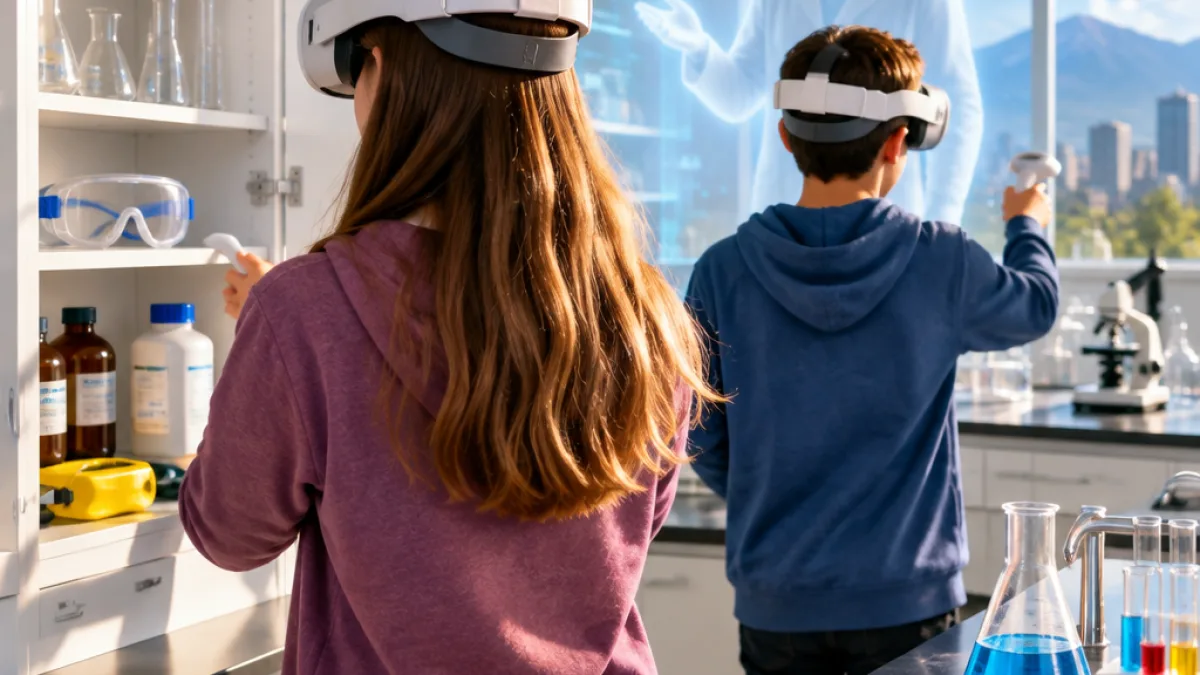
In the learning activity, Albert Einstein’s ghost is trapped inside a virtual science laboratory and needs the students’ help to escape. Wearing virtual-reality headsets, students search cabinets, examine laboratory equipment and work through scientific puzzles. The game is designed to teach the scientific method, laboratory safety and the basics of conducting experiments.
The unusual setting is part of a larger research question examined by Ai-Chu Elisha Ding, an associate professor in the university’s Mary Frances Early College of Education. Ding studied how students learned when virtual-reality activities were combined with conventional reading. Some pupils actively manipulated objects and solved problems inside the digital laboratory. Others watched classmates play through a shared screen.
Direct interaction produced the stronger gains
The researchers had expected that students who watched their peers might benefit from the social nature of the activity. Observation could, in theory, encourage discussion and collaboration, including communication that might support students who speak more than one language. The results pointed in a different direction.
Students who took part directly in the virtual environment showed significantly greater gains in laboratory safety and equipment knowledge than those who observed the play. The difference was described as relatively small, but it was still measurable.
“We were very surprised by that because, through the literature, we know that collaborative learning should be beneficial to students,” Ding said.
| Study element | What students did |
|---|---|
| Direct participation | Used the virtual environment, handled digital objects and solved puzzles |
| Observation | Watched classmates’ virtual-reality activity on a shared screen |
| Learning focus | Laboratory safety and equipment knowledge |
Learning beyond language
For Ding, the findings underline the importance of giving learners more than written or spoken explanations when they are beginning to understand a scientific idea. Interaction with a virtual environment can place students inside a sequence of actions: they investigate a setting, make choices, test possibilities and respond to the results. Watching the same process may provide useful information, but it does not necessarily reproduce the experience of carrying out those actions.
That distinction matters in a classroom where students are still developing confidence with scientific vocabulary. Ding’s interest in the issue is informed by her earlier work teaching English in Taiwan, before she became a researcher in instructional technology. Her background in language education helped shape her interest in how multilingual students approach scientific concepts.
What the study suggests for classrooms
The study does not show that virtual reality should replace reading, discussion or collaborative learning. Instead, it indicates that the mode of participation can affect what students take away from the same educational activity. A student who moves through a virtual laboratory may develop a stronger grasp of equipment and safety procedures than one who only observes, even when both are exposed to the same scenario.
- Virtual activities can give students opportunities to manipulate objects and investigate problems.
- Direct participation may be particularly important when learning depends on procedures, equipment and safe practices.
- Observation remains a different learning experience from physical interaction with a virtual setting.
- The findings add to questions about how technology can support multilingual science learners.
The Einstein escape-room scenario also illustrates how science instruction can connect concepts with a memorable task. Students are not simply asked to recall a definition of laboratory safety; they encounter equipment and puzzles within a problem that asks them to act. The study’s results suggest that this active encounter can offer learning opportunities that a shared screen does not completely reproduce.
As schools consider digital tools, Ding’s work points to a practical issue: access to technology is only one part of the design. Educators must also decide whether learners will control the activity, watch others or combine both approaches. In this study, direct engagement with the virtual laboratory was linked to the stronger gains in the specific areas measured, offering a reason to look beyond the novelty of headsets and examine how students actually participate.