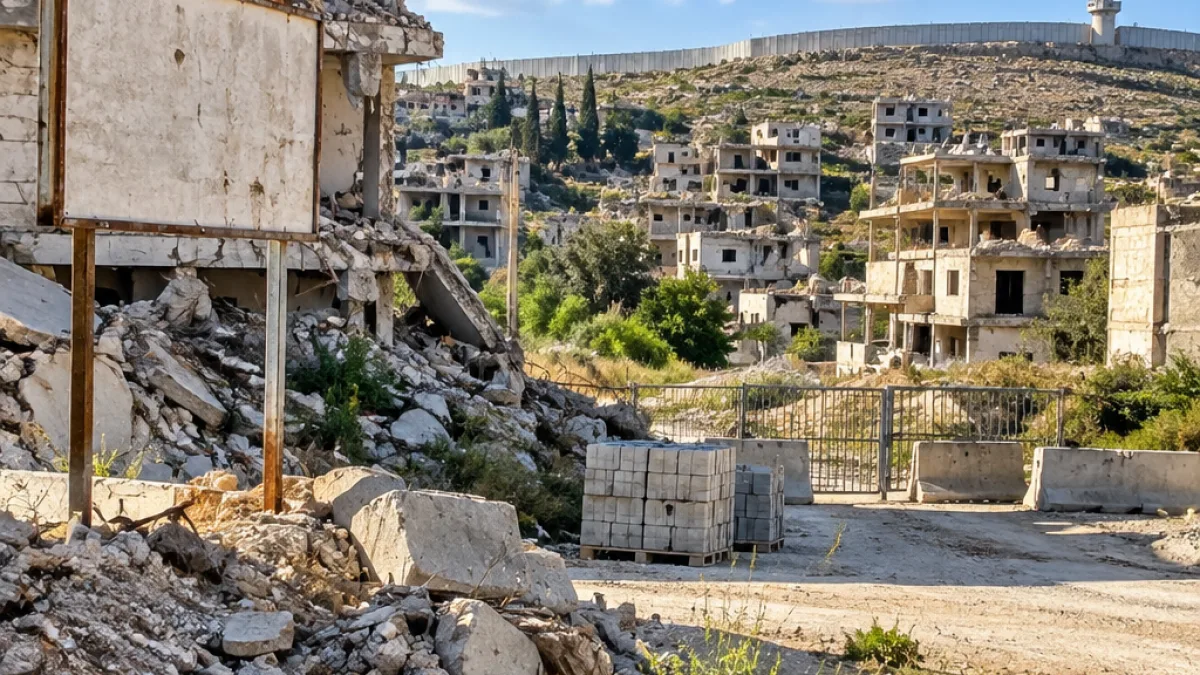
Lebanon’s recovery from war is barely moving forward, with only a small portion of international reconstruction financing released more than a year after the World Bank approved a major aid package, a senior official said during a visit to the country.
Anna Bjerde, the World Bank’s managing director of operations, said she wanted to be candid about the slow pace of rebuilding during a visit to southern Lebanon on Tuesday. The institution approved $250 million in June 2025 to help remove rubble and restore essential public infrastructure damaged during the 2024 Israel-Hezbollah war.
Yet a progress report issued in September showed that just $4.2 million had been disbursed. That was a fraction of the roughly $100 million the World Bank had expected to release by July 2026. The bank has estimated the total cost of rebuilding after the 2024 war at approximately $11 billion, a figure that underscores the scale of the gap between need and delivery.
“Parliament ratification of the said loan experienced considerable delays.”
That explanation came from the office of Prime Minister Nawaf Salam, which also pointed to what it described as a deteriorating security environment. The prime minister’s office said Israel’s continuing presence in southern Lebanon had delayed the start of project activities, while Beirut has blamed Israel’s occupation and attacks for obstructing reconstruction.
Security conditions continue to shape recovery
Israel has maintained forces in and attacked parts of southern Lebanon as far north as the Litani River since March, saying its operations are aimed at destroying Hezbollah infrastructure. The conflict has also involved the demolition of civilian homes, making it more difficult for residents to return and for reconstruction agencies to assess and repair damaged areas.
Lebanon’s National News Agency reported that Israeli artillery fire on Wednesday struck toward the towns of Baraachit and Beit Yahoun in the Bint Jbeil district. It said the areas of Rashaf and Sarbine, extending toward Wadi al-Hujair, were also targeted. Israeli earth-moving machinery was reported to have demolished residential homes in Zawtar ash-Sharqiyah and Haddatha.
The reported attacks illustrate the practical obstacles facing any rebuilding effort. Infrastructure work requires access, security and reliable administrative approval. Continued military activity can damage sites again, prevent engineers and contractors from reaching them, and leave displaced families uncertain about whether repaired homes and public services will remain safe.
A widening humanitarian burden
The United Nations estimates that at least 304,500 Lebanese people remain internally displaced. Their displacement adds pressure to communities and institutions already struggling to provide shelter and basic services, while also increasing the urgency of restoring roads, public facilities and other critical infrastructure in affected areas.
| Reconstruction measure | Amount or estimate |
|---|---|
| World Bank financing approved | $250 million |
| Funds paid out by September report | $4.2 million |
| Expected disbursement by July 2026 | $100 million |
| Estimated postwar rebuilding cost | $11 billion |
The difference between the approved loan and the money actually delivered is central to Lebanon’s reconstruction challenge. International support has been committed, but financing cannot translate into repaired homes and services while political procedures remain incomplete and violence continues. The World Bank’s assessment therefore points not only to a shortage of resources, but also to the conditions required for those resources to reach communities.
- Reconstruction funding: only $4.2 million of the World Bank’s $250-million package had been paid out by September.
- Security risk: fighting and reported demolitions continue in parts of southern Lebanon.
- Displacement: the UN estimates that at least 304,500 people remain displaced inside the country.
For Lebanon, the consequences extend beyond rebuilding physical structures. The longer homes and public infrastructure remain damaged, the harder it becomes for displaced people to return and for local communities to regain stability. The country’s recovery is now tied to two unresolved questions: whether aid can be released through Lebanon’s political system, and whether the security environment will permit reconstruction to proceed.