
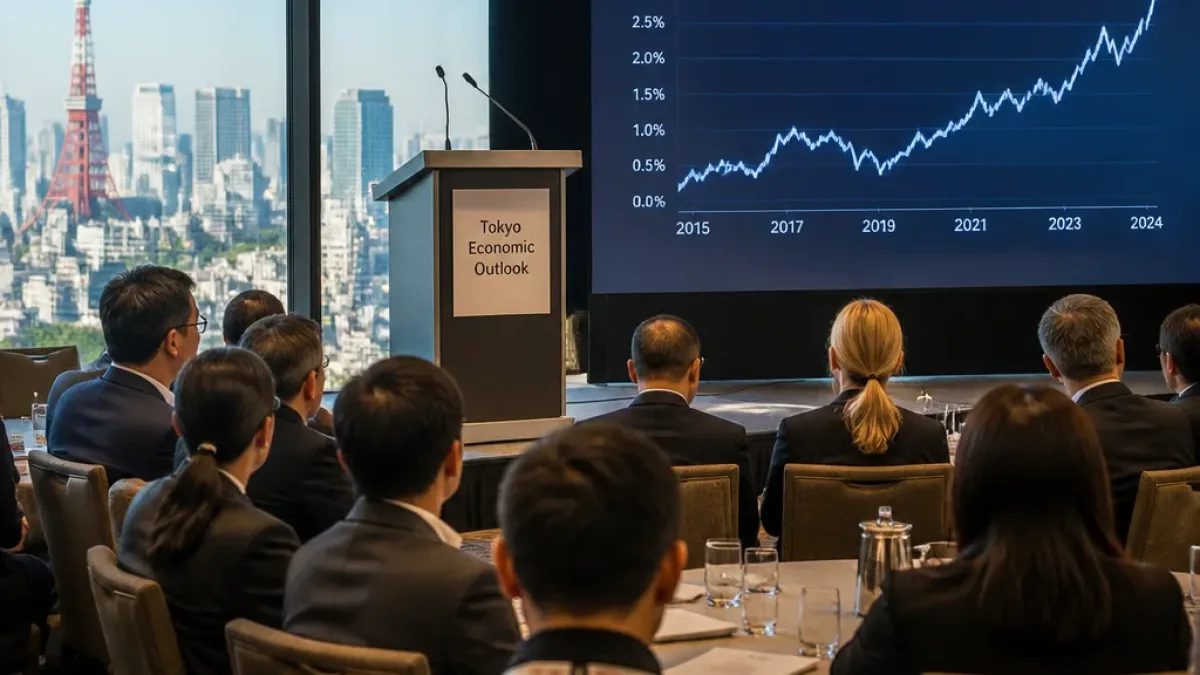
Japan’s government has begun a concerted campaign to communicate fiscal plans directly to foreign investors in English as it seeks to ease anxiety over how planned tax cuts and increased defence spending will be financed. The move comes as global markets scrutinize Tokyo’s strategy to manage its substantial public debt without sparking further volatility.
Outreach aimed at international investors
Growth Strategy Minister Minoru Kiuchi delivered remarks in English at a London Stock Exchange Group event in Tokyo on Thursday — a conspicuous symbol of a broader push by Prime Minister Sanae Takaichi’s administration to make its messaging more accessible to non‑Japanese market participants.
Officials say the outreach seeks to address "persistent market reservations" about how the government will fund a planned sales tax cut alongside higher defence spending, while avoiding further expansion of the nation’s already large public debt. Investors have kept a close watch on policy signals since Ms. Takaichi took office a year ago.
Market response and stakes
Market nerves were underscored when Japan’s 10‑year government bond yield surpassed 3 per cent last month — a level not seen in about three decades. That rapid ascent in yields has fed concern among foreign investors over the sustainability of Japan’s fiscal policies and the potential for higher borrowing costs.
For a nation whose sovereign debt is measured in the tens of trillions of yen, shifts in investor confidence can have wide-ranging implications for borrowing costs, currency moves and financial stability. Tokyo’s English‑language outreach is therefore as much about signalling competence and transparency as it is about explaining technical policy choices.
- Objective: Provide more information to foreign investors in English.
- Focus: How to fund a planned sales tax cut and higher defence spending without enlarging public debt.
- Immediate trigger: 10‑year government bond yield topping 3% for the first time in three decades.
Why language matters to markets
Global investors rely on timely, clear and credible information. When central facts about policy choices — such as the scale and timing of fiscal measures, or the government’s financing plans — are available only in a local language or filtered through translators, the risk of misinterpretation rises. By speaking directly in English, Tokyo is attempting to shorten the information chain and reduce the scope for confusion.
That approach reflects a familiar reality in international finance: perception and clarity can be as important as the underlying policy. English‑language briefings are a practical tool for reaching international asset managers, bond investors and analysts who may have limited access to Japanese‑language sources or official channels.
| Metric | Recent reading |
|---|---|
| 10‑year government bond yield | Above 3% (first time in ~30 years) |
What remains uncertain
Officials in Tokyo are attempting to persuade global market participants that fiscal adjustments can be made without destabilizing debt markets. But the central question — how to reconcile tax relief with higher defence spending while holding debt in check — remains a core investor concern. Market participants will continue to monitor whether the administration provides detailed, credible financing plans and whether those plans influence yields and investor positioning.
For Canadian and other international investors, the developments in Tokyo are a reminder that fiscal policy shocks in major economies can ripple through global bond markets and exchange rates. The practical step of increasing English‑language outreach is a recognition by Japan’s government that, in a tightly connected financial system, clarity and direct communication can matter as much as policy design.
As the Takaichi administration proceeds, markets will watch for more than speeches: analysts and bondholders will seek concrete timelines, the mechanics of any tax changes, and assurances about debt management. Until those elements are fully laid out, volatility in benchmarks such as the 10‑year yield may persist, keeping investor attention on Tokyo.
Regardless of outcome, the administration’s move to engage directly with international audiences in English marks a tactical shift in how Tokyo wants to be heard — and judged — by the global investment community.