
An international team of astronomers has identified what may be the faintest supernova ever observed, an unusual stellar explosion that is prompting scientists to reconsider assumptions about how some dying stars behave.
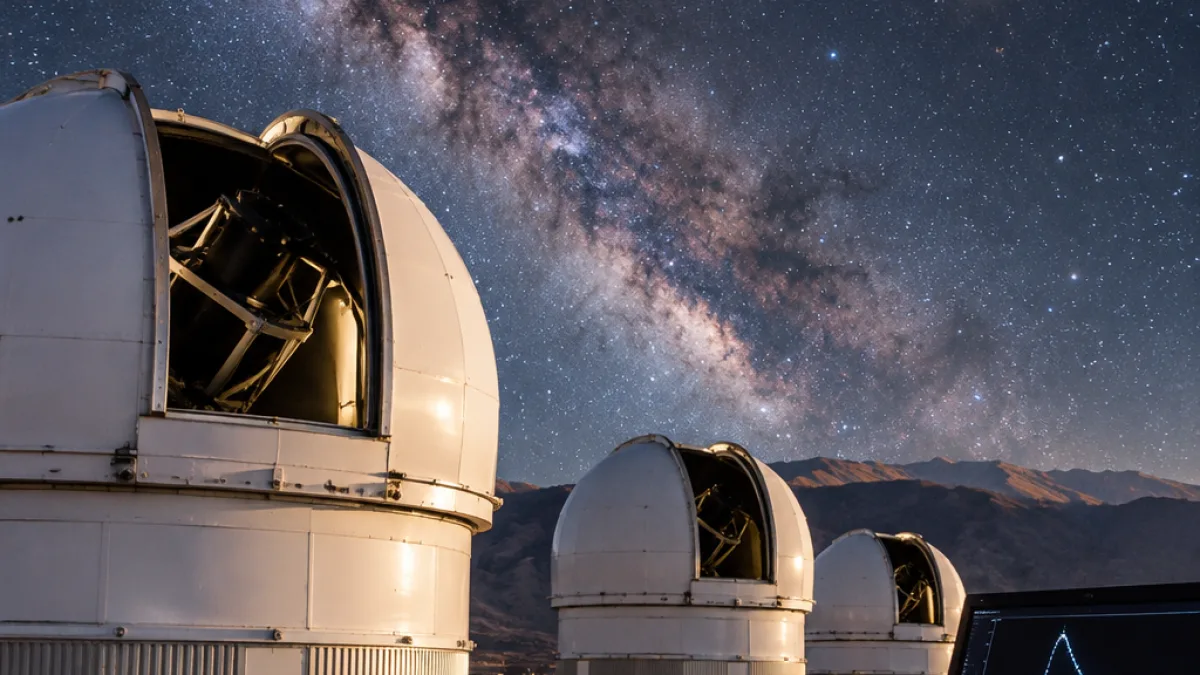
The event, designated SN 2024vjm, occurred about 30 million light-years from Earth. It was detected with BlackGEM, a telescope operating in Chile that surveys the southern sky. Researchers led by the Weizmann Institute of Science followed the explosion as it developed and faded, finding that its behaviour differed sharply from the pattern they had expected.
A sudden point of light
The discovery began when Paul Groot, a professor at Radboud University in the Netherlands and leader of an international astrophysics consortium, noticed a bright point in BlackGEM observations that had not appeared the night before. The sudden change suggested that the telescope had captured a supernova — the violent explosion associated with a dying star.
“The sudden appearance of a bright spot of light 30 million light-years away made us suspect it was a supernova.”
Follow-up work by the Weizmann team revealed an unexpected feature. In a typical supernova, the material expelled by the blast expands at roughly 10,000 kilometres per second. In SN 2024vjm, the expanding cloud was moving at only about 3,000 kilometres per second, according to lead author Erez Zimmerman, a doctoral student at the institute.
| Observation | Reported detail |
|---|---|
| Supernova | SN 2024vjm |
| Distance from Earth | About 30 million light-years |
| Expected expansion speed | About 10,000 km/s |
| Measured expansion speed | About 3,000 km/s |
An observation that resisted explanation
The difference was large enough to raise doubts about the observation itself. Zimmerman said that when he presented the calibration to a professor, he was asked whether the result could be an error. That reaction reflected the central challenge of the finding: the event was not simply dim, but also appeared to involve material moving much more slowly than the speed associated with an ordinary supernova.
Its faintness and unusually slow expansion make SN 2024vjm important for more than the record it may set. The research, published in Nature Astronomy, gives astronomers an opportunity to examine a stellar explosion that does not fit neatly into established expectations. The team’s observations may help clarify the range of ways in which dying stars can produce explosive events.
Better tools for watching the sky
The work also illustrates the value of instruments that repeatedly scan large areas of the sky. BlackGEM’s survey detected a new source by comparing observations made on different nights. That approach allowed researchers to identify a transient event — a source that appeared where none had previously been recorded — and alert scientists in other countries for further study.
Zimmerman said the findings will help researchers develop software for space observation. He added that the resulting tools could eventually be adapted for everyday technologies, creating practical benefits beyond the immediate study of SN 2024vjm. The article’s significance therefore extends in two directions: it offers a rare look at an unusual cosmic explosion while contributing to the methods used to find and interpret events in space.
For now, the researchers describe SN 2024vjm cautiously as possibly the faintest supernova recorded. Its full importance lies in the combination of its low brightness, its slow-moving ejecta and the questions those observations raise about stellar death. A point of light that appeared unexpectedly in a telescope survey has become a test of how confidently scientists think they understand the final explosions of stars.