
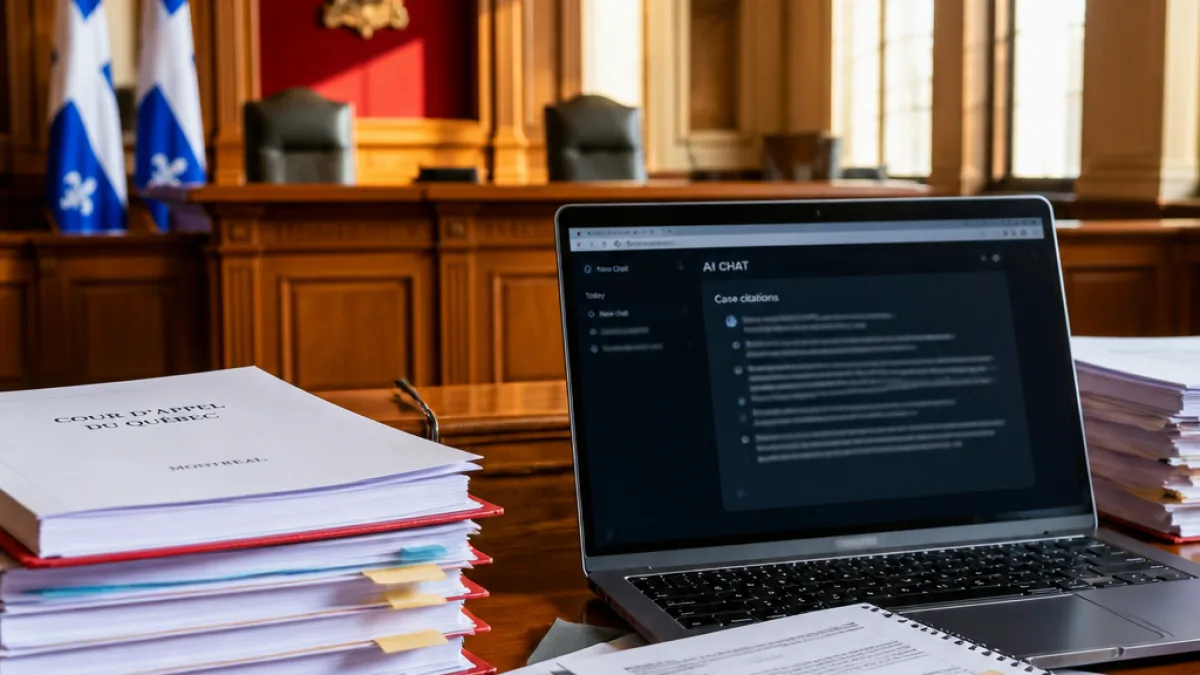
Montreal — A Quebec man has been ordered to pay $1,000 to his former spouse after the Quebec Court of Appeal found he knowingly filed court arguments containing legal decisions that did not exist and that were generated by ChatGPT.
Court finds fabricated cases used in pleadings
In an Aug. 11 decision, the appeal court said the man — who was representing himself in a dispute over the division of assets following his divorce — cited four judicial decisions that could not be located in any legal reporter or database. Two of those purported decisions were attributed to the Supreme Court of Canada, the judges said.
The court noted the man discovered the citations were spurious during a consultation with a lawyer, yet proceeded to file his arguments without removing them. It was only after the panel questioned him during the hearing that he acknowledged the source of the false authorities as ChatGPT.
Judges call conduct a serious breach
The Court of Appeal described knowingly citing invented cases as a serious breach of judicial process that imposed unnecessary work on both the court and on the man’s ex‑wife, who had to respond to the submissions. The $1,000 award to the ex‑wife was ordered in addition to the usual costs of the appeal.
The ruling highlights the tensions courts face as generative artificial intelligence becomes more accessible to the public. While the technology can produce fluent legal‑sounding text, it does not guarantee verifiable or accurate sources.
Practical implications for litigants and the courts
Although the decision deals with one case, it underscores several practical concerns for litigants who use AI tools without legal training:
- AI can fabricate convincing but non‑existent case law or authorities.
- Self‑represented litigants may not have the means to verify citations produced by generative models.
- Court resources may be strained by the need to screen and correct AI‑sourced errors.
The judges’ reaction — penalizing the litigant for time and effort wasted by other parties and the court — signals that tribunals will hold parties accountable for presenting accurate legal authorities, regardless of the source.
Wider conversation about AI and legal practice
The case arrives amid a broader national and global debate about how to regulate and integrate AI into legal practice. Law societies and courts in several jurisdictions have been developing guidance for lawyers and litigants on the responsible use of AI tools, emphasizing duties of competence, candour and verification.
For self‑represented parties, the ruling is a reminder of the limits of relying on unverified AI outputs when preparing legal materials. Courts expect parties to ensure statements of law and authority can be supported by accessible, verifiable sources.
What the decision orders
| Item | Outcome |
|---|---|
| Number of fabricated cases cited | 4 |
| Amount ordered to be paid to ex‑wife | $1,000 (plus appeal costs) |
| Source of fabricated cases (as admitted) | ChatGPT |
The court did not publish a broader sanction beyond compensation for the opposing party’s time and the award of costs, but the judgment serves as precedent for how similar conduct may be treated in other matters.
Advice for litigants
While access to legal help remains uneven, litigants are cautioned to:
- Verify any case law or statutory citations against official reporters or government websites.
- Seek even limited legal advice if unsure about sources or applicable authorities.
- Disclose the origin of non‑traditional research methods if relied upon in court filings.
The appeal court’s ruling is one of the early concrete examples in Canada of judicial response to the misuse of generative AI in litigation. It clarifies that courts will not tolerate presenting fabricated authorities, regardless of whether the error arose from ignorance of technology or deliberate misconduct.
As generative AI becomes more commonplace, this decision is likely to be cited by judges and lawyers navigating the boundary between useful automation and the obligation to provide truthful, verifiable legal material to the court.
— Geneviève Tremblay, Quebec Correspondent