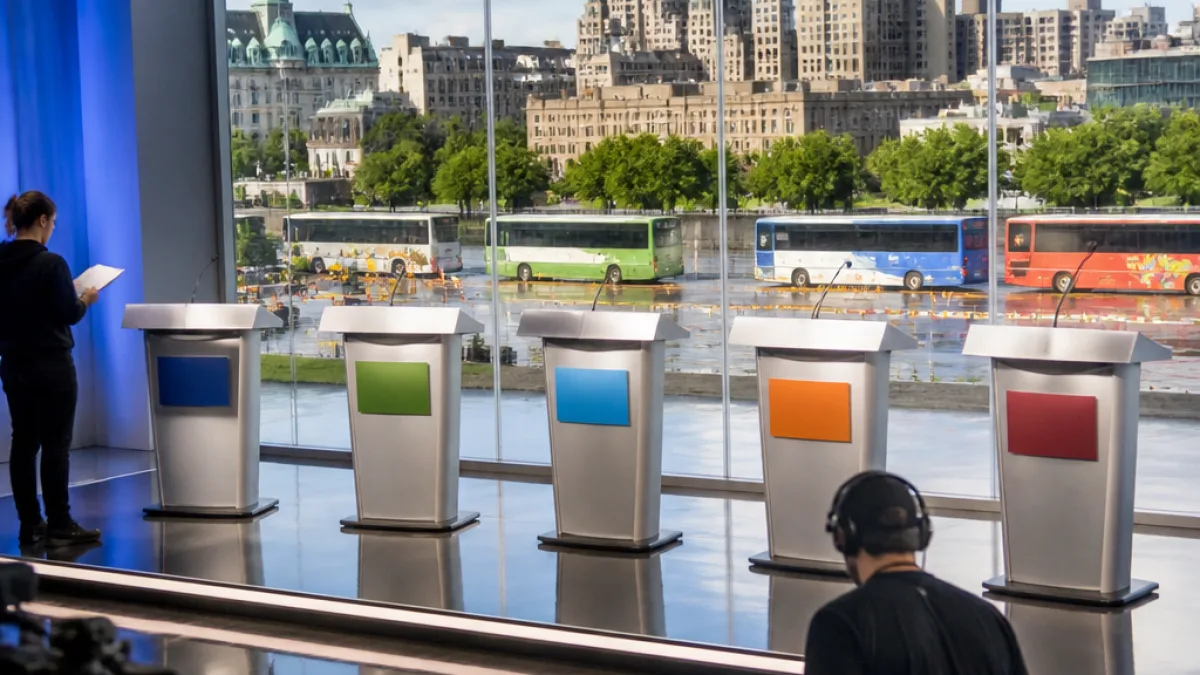
MONTREAL — With the Quebec election campaign roughly halfway complete, party leaders dialled back visible campaign activity Monday as they readied themselves for the first major televised clash among the five principal parties on Tuesday evening.
Debate focus and campaign recalibration
The pause in public appearances underscored how much weight parties are placing on the debate. Two leaders, Élisabeth Fréchette of the governing Coalition Avenir Québec (CAQ) and Paul St‑Pierre Plamondon of the Parti Québécois, temporarily put a hold on public events to concentrate on debate preparation.
Political strategist Daoust offered a short inventory of what each leader must accomplish on stage. For Fréchette, the challenge is to present a refreshed image despite an extensive résumé in government; for Plamondon, the risk is overreaching and appearing arrogant. For other leaders, the debate represents opportunities to broaden appeal or to step away from campaign controversies.
“The party went from being threatened to be completely wiped from the electoral map … to being competitive to form the next government,”
That assessment was used to highlight the transformation of one party’s fortunes over the campaign and the high stakes leaders face as they confront voters and opponents live.
Who still needs to roll out promises
The Parti Québécois is scheduled to release the financial framework of its platform on Tuesday — the last among the five major parties to do so. The publication of a fiscal plan immediately before a major debate can set the terms of economic and spending discussions, giving rivals fresh material to counter or adopt.
Campaign stops and messaging
Although leaders curtailed some activities to prepare for the debate, a number of campaign appearances went ahead Monday that reflect each party’s messaging priorities.
- Charles Milliard (Liberal Party) and Ruba Ghazal (Québec solidaire spokesperson) visited Maisonneuve‑Rosemont hospital in Montreal on Monday morning, signalling continued emphasis on health-care issues.
- Éric Duhaime (Conservative Party) held a press conference in downtown Montreal to address immigration — an issue he has made central to his campaign pitch.
Strategic opportunities and pitfalls
Daoust suggested each leader has a distinct objective for the debates. For the Liberals, there is scope to extend reach beyond traditional anglophone strongholds by engaging Quebec nationalist themes in a way that resonates with francophone voters. For the Conservative leader, the televised format may offer a chance to focus attention on policy rather than on controversial candidates whose past remarks or legal troubles have dogged the party.
Québec solidaire’s challenge, according to the strategist, is one of distinctiveness. Issues that once defined the party — homelessness, housing affordability and cost of living — have been adopted more broadly across the campaign, making it harder for the left‑wing party to stake an exclusive claim on those topics.
What to watch on debate night
Analysts will be watching not only the substance of each leader’s proposals but also their demeanour: whether Plamondon can maintain the competence voters attribute to him without appearing haughty; whether Fréchette can renew her public image despite a long ministerial record; and whether other leaders can translate debate performances into broader electoral traction.
| Item | Detail |
|---|---|
| Event | First televised leaders' debate of the campaign |
| Timing (campaign) | Midpoint — leaders reduced public events Monday |
| Parties represented | Five major parties (including CAQ, Parti Québécois, Liberals, Conservatives, Québec solidaire) |
| Key campaign action | Parti Québécois to unveil fiscal framework Tuesday |
Implications for voters
For Quebecers trying to assess where parties stand on governance, the debate could crystallize options on the economy, public services and the future direction of the province. Releases such as the Parti Québécois’ fiscal framework will provide tangible numbers and commitments for journalists, commentators and voters to scrutinize in the days following the debate.
How leaders handle policy details versus broad vision, and whether they can avoid missteps or gaffes under live scrutiny, may influence undecided voters and shape media narratives through the remainder of the campaign.
As the leaders head into Tuesday’s forum, campaign teams will be working to convert a single night’s performance into sustained momentum — or to limit the damage of a poor showing. For many Quebecers, the debate will be their clearest, side‑by‑side glimpse of the choices on offer ahead of the provincial vote.