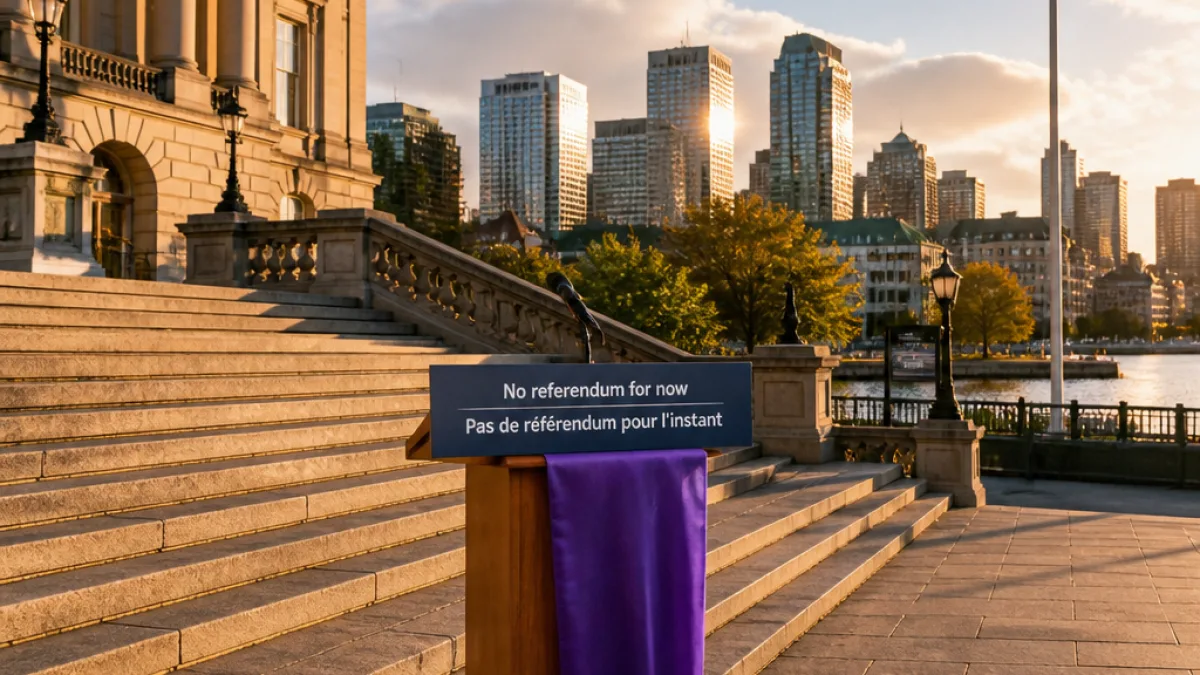
Quebec’s Parti Québécois leader has put a new time horizon on the province’s debate over sovereignty, saying his party will not seek a referendum while U.S. President Donald Trump remains in office. The decision — unveiled last week — is already reshaping political calculations in Quebec and across Canada as parties and voters adjust to the possibility that the next plebiscite is effectively off the table for the remainder of the decade.
What the leader said and why it matters
"Quebec will not have a referendum so long as U.S. President Donald Trump remains in office."
Those words from Paul St-Pierre Plamondon align the Parti Québécois’s referendum ambitions with the uncertain trajectory of U.S. politics. In practical terms, the pledge could push the next possible referendum into the latter part of this decade — as far out as early 2029 if one assumes a standard U.S. presidential term — though no one can be certain where American politics will land.
For Ottawa and provincial capitals, the announcement has immediate implications. A pause on referendum timing reduces the likelihood of an urgent constitutional confrontation in the short term. That relieves some pressure on federal planning and on businesses and markets that worry about political instability. It also alters how Quebec political parties frame their ambitions and platforms as they campaign for municipal, provincial and federal votes.
Political strategy and public opinion in Quebec
The Parti Québécois has long struggled with the tension between its core objective — sovereignty — and voter sentiment. Recent polls show support for independence sitting in the 20s (percent), well below levels that would make a referendum politically viable. By tying referendum timing to the U.S. presidency, Mr. St-Pierre Plamondon both reassures voters uneasy about international instability and preserves his party’s commitment to sovereignty as a long-term project.
Strategically, the move may allow the PQ to prioritise winning seats and building institutional capacity without the immediate pressure to deliver a referendum. It also permits the party to argue that a reunified Canada is a safer economic and geopolitical bet until global uncertainty abates.
- Short-term effect: Lowers the chance of a referendum in the next few years.
- Medium-term politics: Gives the PQ room to rebuild electoral strength while sidelining an immediate constitutional crisis.
- Federal impact: Reduces immediate strain on intergovernmental relations and market concerns about political disruption.
Context: why U.S. politics matters to Quebecers
Quebec’s leaders have not been shy about recognising the influence of U.S. policy and rhetoric on Canadian life. After the 2024 U.S. election, Quebec’s then-premier publicly signalled a desire for unity and for strong federal relationships to protect provincial interests under a challenging international environment. The PQ leader’s new stance reflects that calculation: a referendum campaign launched against a backdrop of heightened U.S. unpredictability could carry greater economic and diplomatic risks for Quebec.
That risk calculation matters to a province whose economy is deeply integrated with the rest of Canada and the United States. Businesses, investors and ordinary households tend to prefer predictability; a referendum introduces uncertainty about trade, regulatory frameworks and citizenship — uncertainties amplified by volatile global politics.
Numbers at a glance
| Item | Current figure/position |
|---|---|
| Public support for independence | ~20% (polls indicate support in the 20s) |
| Earliest practical date for referendum (if tied to end of Trump presidency) | Early 2029 (in theory) |
Responses and implications
Political rivals and commentators are weighing the announcement. Some see it as pragmatic: an admission that the international environment is unfavourable to a push for separation. Others view it as a tactical retreat — a way for the PQ to hold onto the sovereignty mantle without committing to immediate action.
For federal parties, the pause offers breathing room. It reduces the immediacy of a constitutional flashpoint and allows federal and provincial leaders to focus on governance and economic issues that voters routinely prioritise, from health care to the cost of living.
But the longer-term questions remain unresolved. If and when the geopolitical landscape stabilises, the underlying debates about Quebec’s constitutional future will persist. The PQ’s pledge may postpone those battles, but it does not erase the fundamental political disagreement at the heart of Quebec politics.
For now, Quebecers and Ottawa will watch developments in the United States closely. The PQ’s declaration has real short-term consequences, but whether it permanently reshapes the sovereignty movement will depend on electoral fortunes, public opinion and the international context in the years ahead.
Reporting from Montreal.