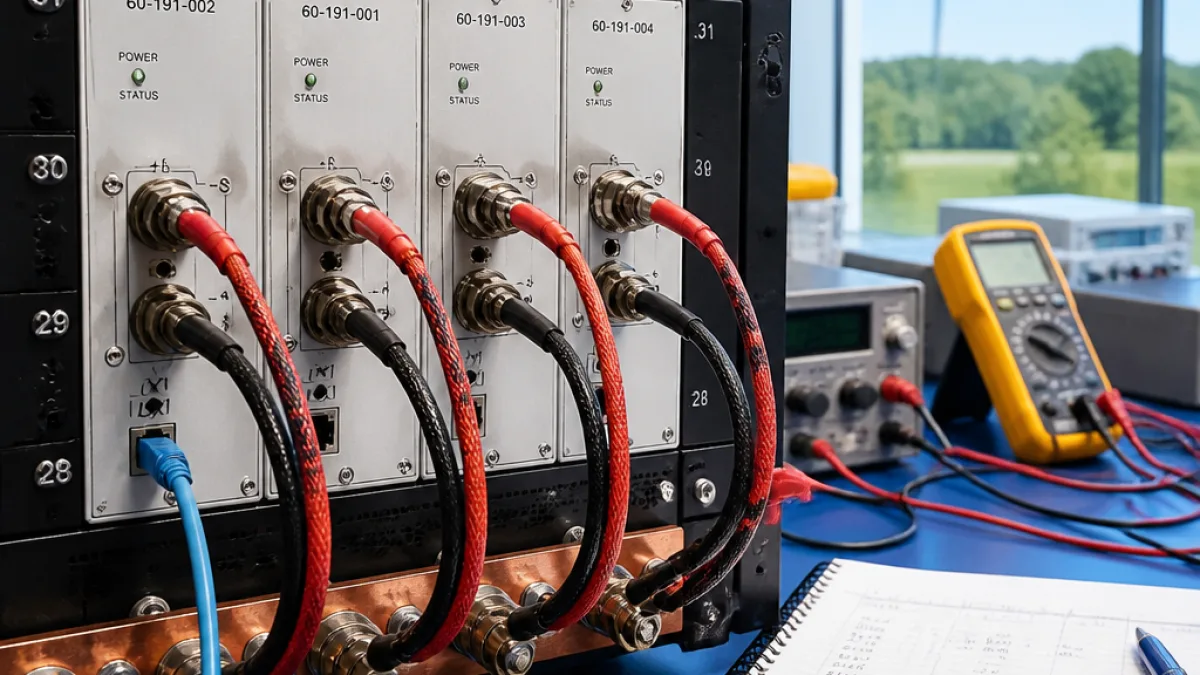
Pickering Interfaces has introduced a new family of high-current switching units aimed at automated test systems that require coordinated control of multiple power supplies. The 60-191 series, announced from Tewksbury, Mass., combines robust power switching with low-current sense-line capabilities and is compatible with LXI control standards.
Design and control features
The 4U rack-mount 60-191 units are built around hermetically sealed single-pole, single-throw normally open contactors for the high-current paths, with 1-amp single-pole, single-throw relays dedicated to the sense lines. According to the manufacturer, the family can switch signals of up to 80 amps and 300 volts, and supports configurations that address multiple supply arrangements.
- High-current capacity: Up to 80 A per channel and 300 V switching capability.
- Flexible configurations: Support for up to ten 40 A supplies or two 80 A supplies with separate switching for positive and negative outputs.
- Sense-line switching: Low-current relays provide switching for high- and low-sense lines tied to each supply.
The product emphasizes coordinated switching for a supply's four connections — positive, negative, high-sense and low-sense — by allowing engineers to control individual relays or group them into a single command. Connections are handled through front-panel screw terminals to simplify wiring in rack installations.
Automation, sequencing and software support
Built-in sequence storage is a notable capability. The 60-191 family can hold up to 5,000 predefined switching sequences, which can be triggered by software or hardware. That lets test engineers preload complex switching operations and execute them without issuing each individual command from a host computer.
For integration, the units use an LXI 1.5-compliant 1000Base-T Ethernet interface and offer control through an application programming interface or a software front panel. The manufacturer lists IVI and direct I/O drivers for Windows and Linux and support for development environments including LabVIEW, Python, C/C++, C#, MATLAB and Simulink — enabling deployment across industry-standard test frameworks.
"The 60-191 family can switch signals up to 80 amps and 300 volts,"
Front-panel LEDs report relay status, while relay cycle counting is included to help monitor usage and plan maintenance intervals. Those features are intended to lower downtime and provide clear indications of component wear in demanding test environments.
Potential applications and industry reach
The product brief highlights several application areas where high-current, sequenced switching is critical. These include:
- Electric-vehicle battery and automotive electronics testing
- Fuel-cell and hydrogen-electrolysis research
- Solar inverter testing and energy-storage systems
- Aerospace development and high-current power-supply testing
Those target markets match broader trends toward electrification, renewable energy integration and advanced propulsion testing — sectors that increasingly demand test equipment able to handle high currents safely and repeatably.
| Specification | Detail |
|---|---|
| Peak switching capacity | Up to 80 A, 300 V |
| Rack size | 4U |
| Sequence memory | Up to 5,000 sequences |
| Interface | LXI 1.5, 1000Base-T Ethernet |
| Software support | IVI, direct I/O drivers; LabVIEW, Python, C/C++, C#, MATLAB, Simulink |
While the announcement originates from Pickering Interfaces' U.S. site, the product's target customers — from automotive test labs to energy researchers — include organisations across North America. For local engineers, technicians and procurement teams in the Durham Region and the Greater Toronto Area, the new family may represent another option when upgrading or expanding test racks for high-current experiments and production validation.
Further technical and purchasing information is available from the manufacturer.