Moon as a long‑term collector of technomaterial
Researchers suggest the Moon’s surface could hold durable, microscopic remnants of alien technology, making lunar regolith sampling a potential new avenue for the search for extraterrestrial intelligence. The idea is set out in a preprint led by Lewis Pinault of the SETI Institute and submitted to the International Journal of Astrobiology. The paper is available on arXiv.
Unlike conventional radio or optical SETI, which looks for signals from currently active transmitters, the team argues that searches for physical, artificially generated particles can integrate information over gigayear timescales. Over those spans, technogenic debris could be transported between star systems and accumulate on relatively unchanged surfaces such as the Moon.
“Whether technological life has ever arisen elsewhere in our Galaxy,” the researchers write, “strengthens the case for systematic, well‑characterized regolith sampling.”
Why the Moon?
The lunar surface is attractive to the idea for several practical reasons. Its airless environment and lack of active geology mean that particles delivered to the Moon can experience far less chemical and physical alteration than material on Earth. That makes the lunar regolith — the loose surface layer of dust and broken rock — a potentially stable archive of material deposited over billions of years.
The paper highlights that even extremely small, micron‑scale grains could be diagnostic if they show anomalous composition or structure inconsistent with natural lunar material. The authors frame this as a form of exo‑archaeology: instead of looking for ongoing transmissions, scientists would be searching for preserved artefacts or technogenic residues left by past technological civilisations.
What to look for and how much to sample
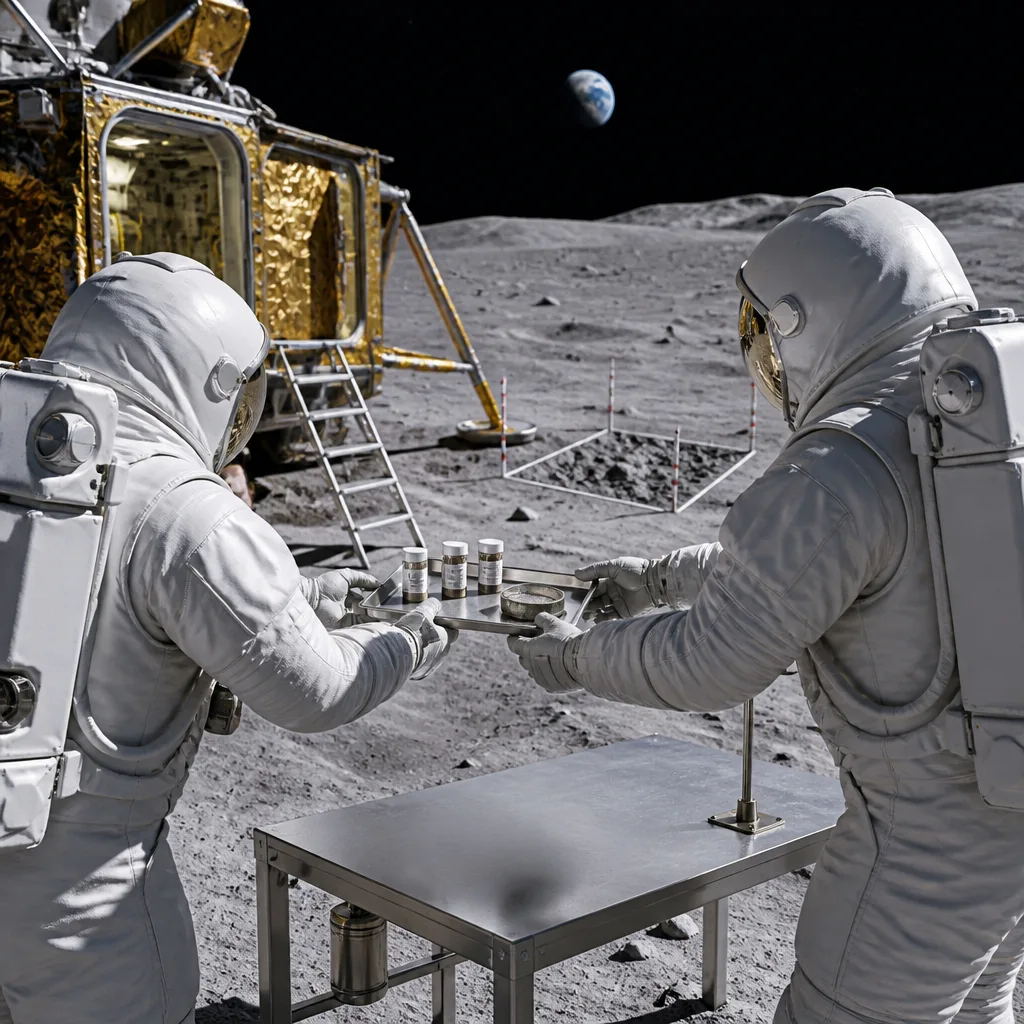
Pinault and colleagues focus on the feasibility of identifying minute technosignatures within a well characterised natural background. They argue that a modest volume of carefully collected regolith — on the order of a cubic metre — could already place meaningful constraints on the number of past technological civilisations in the galaxy.
- Target scale: micron‑scale particles or grains.
- Sample volume noted by the authors: a cubic metre of regolith.
- Timescale sensitivity: integration over gigayears, not just contemporary signals.
The approach requires robust baseline characterisation of lunar materials to distinguish natural anomalies (for example, unusual mineralogy from impacts or solar wind effects) from genuine technogenic signatures. That implies stringent laboratory protocols and precise documentation of sampling location, depth and context.
| Aspect | Paper’s point |
|---|---|
| Scale of evidence | Micron‑scale grains |
| Suggested sample volume | ~1 cubic metre of regolith |
| Temporal reach | Gigayear integration |
Implications for lunar exploration and policy
The proposal comes as multiple national space agencies and private companies prepare to return humans and robotic missions to the Moon. If the Moon truly acts as a long‑term archive for interstellar particulates, collecting and analysing small, well‑documented samples could become an objective alongside geology and resource prospecting.
Implementing a program of systematic sampling would demand international coordination to avoid contamination and to ensure comparability of results. The paper’s authors emphasise the need for controlled sampling, careful cataloguing and laboratory analysis capable of resolving composition and morphology at micron scales.
For the Technology desk, the paper reframes SETI beyond signal detection and into materials science and planetary protection. It places a premium on next‑generation sample return missions and on developing the analytical infrastructure to detect and interpret microscopic anomalies.
Whether the Moon holds definitive evidence of past extraterrestrial technology remains an open question. But the argument that lunar regolith may preserve technogenic particles over vast timeframes gives a tangible, testable objective to future lunar missions: look not only up and out, but down into the dust under our feet.