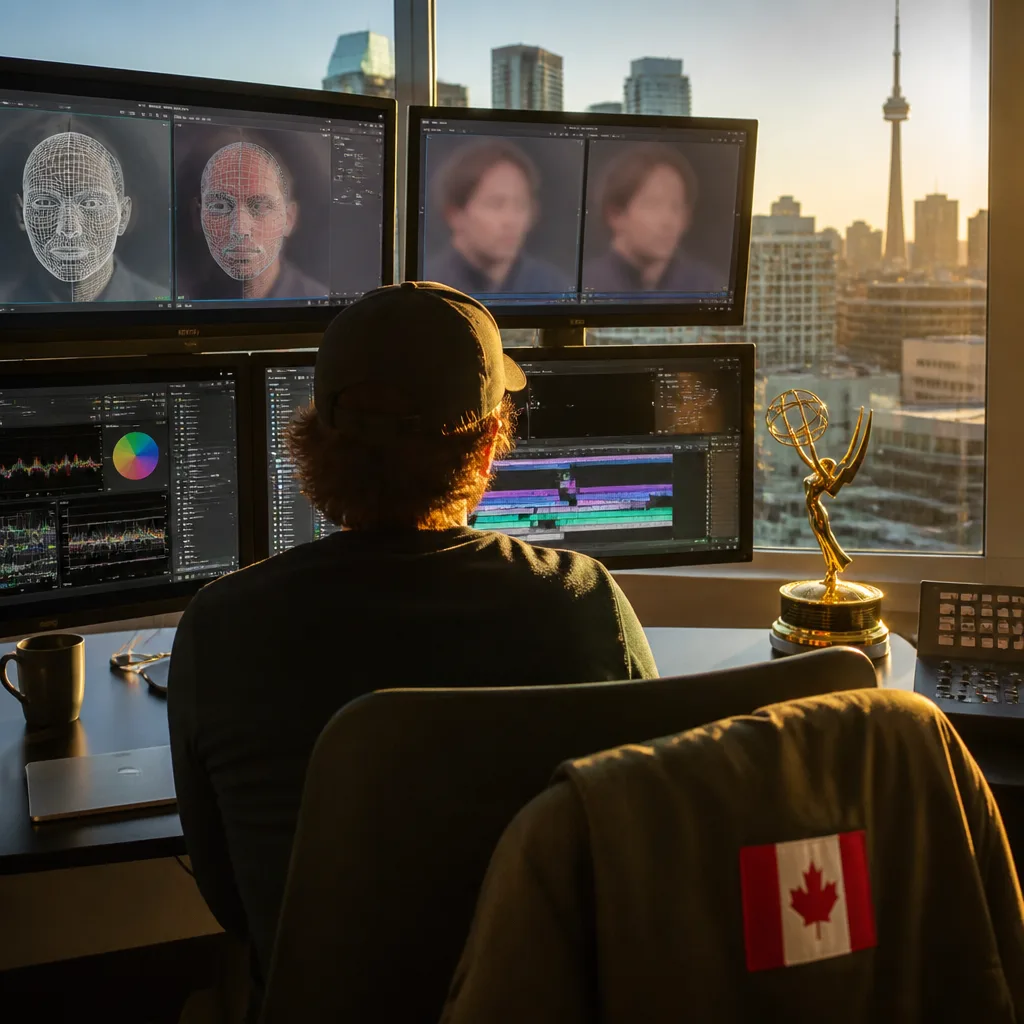
BRAHMA AI has been named a recipient of a 2026 Technology & Engineering Emmy® Award for work in AI-based face replacement and performance-preserving post-production transformation, the company announced.
What the award recognises
The Emmy honours systems that alter a performer’s appearance while maintaining the natural qualities that make a performance believable — timing, gaze, expression, movement, lighting and continuity across sequences. BRAHMA AI’s entry, built around what the company calls its Neural Performance technology, is cited for preserving those human facial performance elements even while enabling controlled changes to age, likeness and identity.
“Human creativity amplified by AI, with the performer and the authenticity of the performance kept at the centre, is the foundation of everything we build at BRAHMA AI,” said Jo Plaete, Chief Technology Officer of BRAHMA AI.
Proven at feature‑film scale
The technology was demonstrated at feature‑film scale on Robert Zemeckis’s film Here. BRAHMA AI says younger versions of Tom Hanks and Robin Wright were visualised on set in near real time, and that the system produced roughly one hour of final 4K transformation for the finished picture. The company also notes subsequent use across feature films, television, live performance and multilingual content, including work on the film Ramayana where its system delivered performance‑preserving English‑language lip‑sync.
Wider industry context
BRAHMA AI was recognised alongside three other recipients: Disney Research, Rising Sun Pictures and Digital Domain. Among the four, BRAHMA AI is the only company described as AI‑native by the announcement, signalling a different development path from traditional visual effects houses that have integrated AI tools into long‑established pipelines.
The award highlights two converging trends in screen production. First, generative and synthetic media tools are becoming capable of meeting demanding creative standards at the scale and quality required by major productions. Second, there is growing emphasis on preserving the authenticity of an actor’s performance — a technical requirement that also speaks to evolving ethical and creative norms about how AI should be applied in storytelling.
- Performance fidelity: The technical challenge is to alter appearance while keeping minute aspects of expression and timing intact.
- On‑set utility: The system’s ability to visualise changes near real time allows directors and performers to respond immediately, rather than discovering alterations in post‑production.
- Cross‑format use: The same methods are being applied across film, television, live production and multilingual localisation.
Recipients at a glance
| Recipient | Described strength |
|---|---|
| BRAHMA AI | AI-native Neural Performance technology for face replacement and performance preservation |
| Disney Research | Recognised for related technical contributions |
| Rising Sun Pictures | Recognised for related technical contributions |
| Digital Domain | Recognised for related technical contributions |
That the Emmy citation specifically calls out continuity across sequences and robustness to changes in pose, lighting and occlusion underscores how demanding this work is. Small mismatches in timing, gaze direction or micro‑expression can break the illusion of a live performance; the Emmy criteria prioritise solutions that hold those qualities steady while enabling visual change.
For filmmakers and production houses, the practical benefits are clear: on‑set visualisation of alterations can reduce rework and help directors judge effects in context, while tools that preserve performance make it easier to use age transitions, likeness adjustments or multilingual dubbing without sacrificing emotional truth. For audiences and critics, the award raises familiar questions about consent, transparency and creative control when synthetic techniques alter an actor’s image — questions the industry has been wrestling with as AI tools move from laboratory demos into mainstream production.
The Emmy recognition places BRAHMA AI’s Neural Performance approach among the technologies that industry peers regard as transformative for visual storytelling. As studios, VFX houses and AI startups converge in the same production pipelines, the practical standards established by work that succeeds at feature‑film quality are likely to set expectations for future tools and the policies that govern their use.
Kevin Nakamura is Technology Editor at WE NEWS. He covers how emerging tools reshape creative industries and the policies that govern them.