
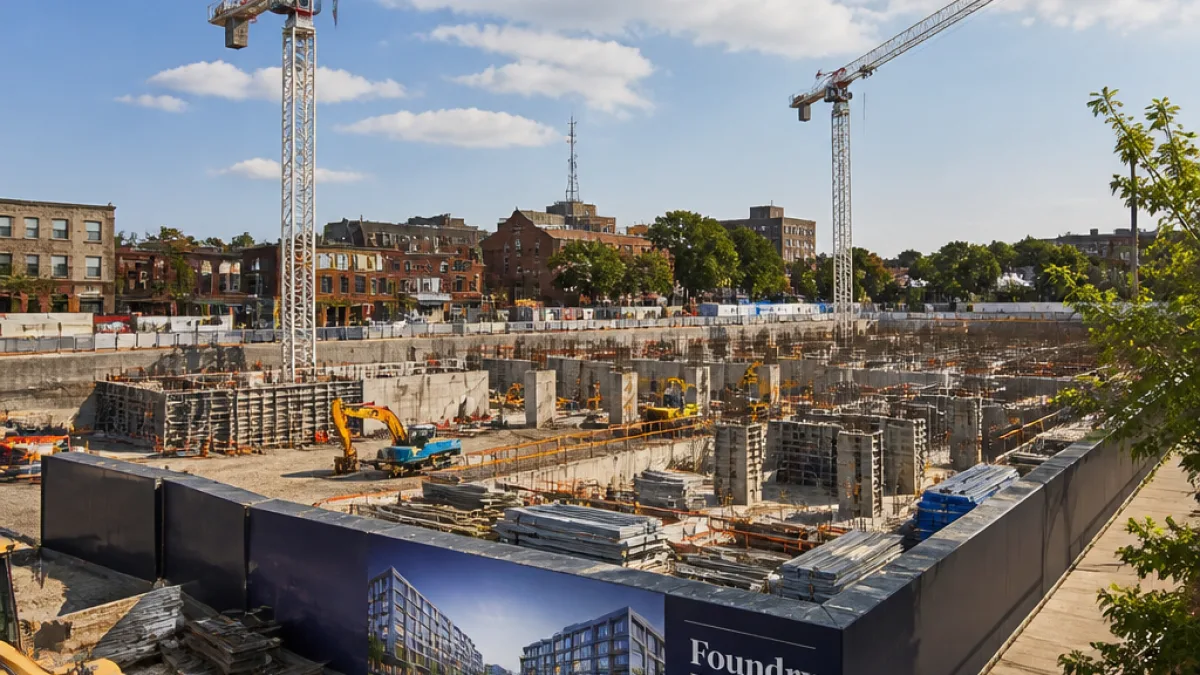
Foundry District construction starts on former Fittings Factory site
Oshawa has taken a decisive step toward reshaping its downtown core with the official groundbreaking of the Foundry District, a 23‑acre mixed‑use project that will replace a long-vacant industrial site with housing, retail and a new public park.
Representatives from Medallion Corporation, the federal government and the City of Oshawa were on hand for the ceremony to mark the start of construction on the first two buildings, a 10‑storey and a 23‑storey tower at 119 and 151 Bruce St. Together those buildings will deliver more than 500 purpose‑built rental homes, including units designated as affordable housing.
Funding for the initial phase is being advanced through a mix of public and private supports. According to a project release, the development has secured $188 million through the Canada Mortgage and Housing Corporation’s Apartment Construction Loan Program, in addition to contributions from the Region of Durham’s Regional Revitalization Program and a grant agreement with the City of Oshawa.
“The long-term vision will transform the 23-acre site into a vibrant mixed-use community, with the opportunity for approximately nine buildings delivering approximately 3,000 rental homes, local retail, restaurants and a new park.”
From cast‑iron works to a new urban quarter
The site has deep industrial roots in Oshawa. For 85 years it was home to the Fittings Factory, whose cast‑iron operations employed hundreds of residents until the plant closed in 1987. The property has sat largely vacant for nearly four decades.
The Foundry District plan centres on turning that dormant footprint into an active downtown neighbourhood. Prominent in early renderings is a proposed new park intended as a gathering place where factory floors once stood, along with ground‑floor retail and dining spaces aimed at activating Bruce Street and adjacent blocks.
Who the project is meant to serve
Medallion’s release describes the development as designed to serve a broad cross‑section of residents:
- families, students and seniors
- young professionals and newcomers
- downsizers looking to remain downtown
The developers also note the site’s proximity to existing amenities, naming restaurants, cultural venues and the Tribute Communities Centre as nearby assets that the new neighbourhood will be integrated with.
Phasing, timelines and scale
The first phase consists of the two towers at 119 and 151 Bruce St. Leasing for those buildings is expected to begin in late 2029. The long‑range plan foresees about nine buildings on the 23‑acre site, delivering an estimated 3,000 rental homes when fully built out.
| Address | Height | Units (phase 1) |
|---|---|---|
| 119 Bruce St. | 10 storeys | More than 500 total |
| 151 Bruce St. | 23 storeys |
Financially, the early stages benefit from a substantial federal loan guarantee program intended to spur apartment construction, coupled with regional revitalization dollars and municipal support. Those combined resources are critical to delivering the affordable units included in the first phase.
Local impact and questions ahead
The Foundry District has the potential to significantly alter Oshawa’s urban fabric, adding dense housing stock in the downtown while creating new public space and street‑level commerce. For a city that saw much of its industrial employment ebb in the late 20th century, the project is being pitched as a long‑term recovery and modernization of underused land.
Still, large‑scale urban redevelopment raises practical questions for residents and municipal planners alike: how new infrastructure demands will be met, the timeline for delivery of affordable units, traffic and parking management, and how the new district will connect with existing neighbourhoods and services. City staff and developers will need to work through zoning details, site servicing and community benefits as later phases move from vision to approvals to construction.
As work begins on the first two buildings, the Foundry District will be watched closely by local residents, businesses and regional officials. If completed as envisioned, the project would be one of the biggest downtown transformations in Durham Region in recent history, reshaping a site once emblematic of Oshawa’s industrial past into a centre for housing and community life.











