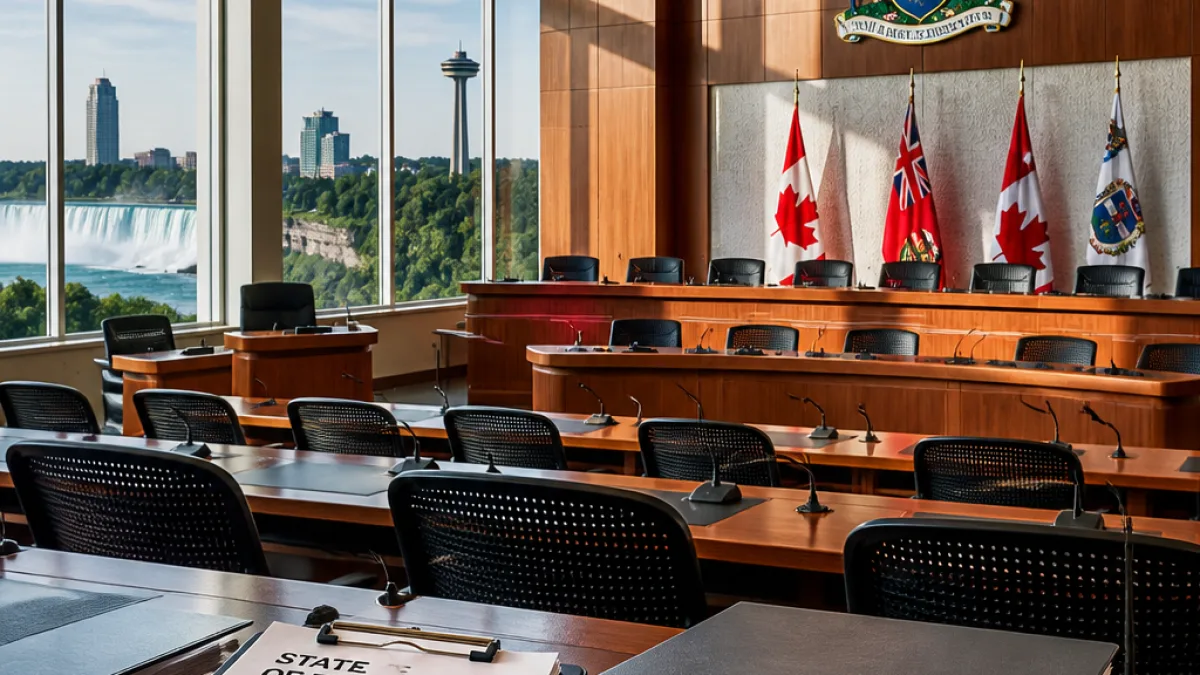
Council oversight at centre of dispute after emergency declared
One day after Mayor Robert Restaino announced a municipal state of emergency — a move he said had taken effect in late July — a Niagara Falls city councillor issued a formal rebuttal to the mayor’s public accusation that council had been derelict in its duties.
Councillor Bridgette Myles released a prepared statement on Sunday morning defending council members’ decision-making around road work and other infrastructure items. Myles said the body had not rejected recent agenda items but instead postponed votes to obtain more information before committing taxpayer dollars.
“I agree that Niagara Falls has serious conditions requiring urgent attention,” Myles wrote, acknowledging residents’ ongoing concerns about deteriorating streets, unsafe and abandoned properties, gun violence, environmental problems and municipal departments stretched thin by staffing and resource issues. She emphasised, however, that many of those conditions pre-date recent council deliberations.
“Council's responsibility is not simply to approve every item placed before us. Our responsibilities include budgeting, legislation and oversight of public funds. Asking questions before voting is not obstruction, it is due diligence.”
Myles outlined specific reasons councillors asked for delays, pointing to outstanding questions about the mayor’s administration’s dealings with unions, and details about lot maintenance contracts and bidders. She framed the inquiry as part of council’s duty to ensure transparency and accountability when public money is at stake.
- Mayor: Declared a state of emergency effective in late July, citing infrastructure and safety issues.
- Council: Postponed votes on contracts to seek additional information about spending, bids and union matters.
- Councillor Myles: Said oversight and asking questions are part of councillors’ responsibilities and not obstruction.
Myles also questioned the timing and framing of the emergency. If poor roads and decaying buildings meet the legal threshold for an emergency, she asked, when did those conditions begin? That line of questioning underscores a broader local debate about proportional responses, the allocation of municipal resources and the balance between urgent action and careful oversight.
In her statement Myles called for cooperation between the mayor’s office and council but made clear cooperation should not come at the expense of scrutiny. “I will support measures that are properly documented and in the best interest of our residents,” she wrote, adding that when documentation is missing or taxpayer funds are being directed, councillors must ask where the money is going and whether public safety is being fully addressed.
The dispute highlights two competing imperatives in municipal governance: the need for swift action to repair visible infrastructure and protect residents, and the obligation of elected representatives to ensure spending is documented, justified and transparent. Council’s procedural choice to pause votes in order to acquire more detail is a common tool in local government but one that can be framed politically as delay or obstruction.
Residents following the exchange can expect further council deliberations on the specific contracts and spending items referenced, as council members continue to press for more information before taking final votes. Until then, the mayor’s emergency declaration remains the chief working framework the administration is using to coordinate responses to the issues named.
| Date | Event |
|---|---|
| Late July | Mayor announces state of emergency, effective immediately |
| Aug. 16 | Councillor Bridgette Myles issues statement explaining council delays |
For residents, the immediate questions are practical: when will roads be repaired, who will address abandoned and unsafe properties, and how will the city ensure money spent now yields tangible improvements? The answers will depend on both the mayor’s emergency measures and council’s oversight work in the coming weeks.