
There is a familiar caution in the Newfoundland and Labrador response to a renewed call to abolish the Indian Act: the law may be deeply damaging, but the ground left behind it cannot be allowed to become uncertain.
Some Indigenous people in the province support Manitoba Premier Wab Kinew’s argument that Canada should move away from the legislation. But support for ending the act is tied to a demand that any new arrangement protect the rights and benefits First Nations people currently receive through it.
That position was outlined by Kevin Coffey, an Inuk knowledge-sharing guide with First Light in St. John’s. His comments place the national discussion in a local frame — one shaped by generations of government policy, cultural loss and the continuing need for Indigenous people to have a meaningful say in what comes next.
“Speaking for First Light, the position is that we hope the First Nations groups are able to work with the government to transition away from the Indian Act to something that they believe represents themselves and their people in a more concrete way, while maintaining the same benefits and rights for the people who are First Nations.”
For Coffey, the question is not simply whether the act should disappear. It is whether First Nations communities will help design the system that replaces it, and whether that system will leave people no less protected than they are now.
A law with a long reach
The Indian Act was adopted in 1876 and remains the federal statute governing much of Canada’s relationship with First Nations. It also gives the federal government authority to determine who qualifies for Indigenous status, a power that has made the legislation reach into identity, community membership and access to rights.
Its history is inseparable from policies intended to suppress Indigenous cultures and languages. An amendment made in 1920 required Indigenous children to attend residential schools, separating them from their families. The policy was part of a broader effort to erase Indigenous identity, rather than support the survival of distinct peoples and traditions.
Coffey described the language behind that objective as stark and unmistakable.
“The language is very clear, like to ‘kill the Indian in the child.’”
That history explains why the idea of abolishing the act can resonate while still prompting serious concern. For Indigenous people and communities, the legislation is not an abstract federal statute. It is connected to the rules that shaped family life, education, culture and recognition by the state.
What a transition would have to protect
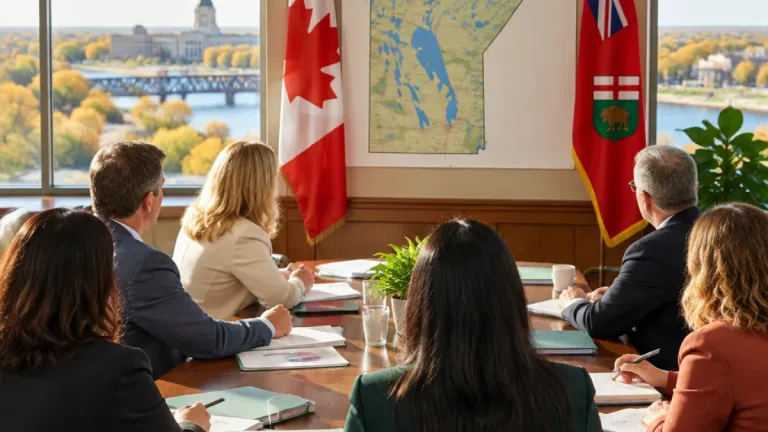
Kinew raised the issue at a late-October meeting in Ottawa involving first ministers and Indigenous leaders. Holding up his own status card, the Manitoba premier argued that the legislation is obsolete and inherently racist.
The debate now turns toward the difficult question of replacement. First Light’s position, as described by Coffey, is that First Nations groups should work with the government on a framework that reflects their own communities more accurately. The transition, he said, should preserve the benefits and rights people hold through the current law.
- First Nations participation: Indigenous groups should have a central role in shaping whatever succeeds the act.
- Continuity of rights: Existing benefits and protections should not be lost during a transition.
- Recognition of peoples: A new framework should represent First Nations communities in a more concrete way than the current legislation does.
Those conditions are at the heart of the cautious support emerging in Newfoundland and Labrador. Scrapping the act may be presented as a break with colonial policy, but replacing it without clear safeguards could create a different kind of uncertainty for people whose rights and recognition have long been controlled by federal law.
A national proposal with local meaning
The proposal comes from Manitoba, but the concerns raised in St. John’s are broader than one province. The Indian Act still defines a central part of Canada’s relationship with First Nations, and its effects have rippled through many generations across the country.
For Newfoundland and Labrador, the discussion also arrives through the work of people and organizations engaged in knowledge sharing and Indigenous community life. First Light’s response does not reject the possibility of change. Instead, it insists that change must be built with First Nations people and must not repeat the pattern of governments deciding Indigenous futures without Indigenous control.
The issue remains at the level of a political call and a response from Indigenous voices, rather than a completed federal plan. No replacement legislation or transition process was identified in the material available. That leaves the central test clearly in view: whether governments can move beyond the Indian Act while preserving the rights it currently provides and creating a relationship that Indigenous communities recognize as their own.
| Development | Significance |
|---|---|
| 1876 | The Indian Act was adopted. |
| 1920 | An amendment made residential-school attendance compulsory for Indigenous children. |
| Late October | Wab Kinew called for abolition at a meeting of first ministers and Indigenous leaders in Ottawa. |
| Nov. 3 | First Light in St. John’s expressed cautious support, with protections required in any transition. |
For now, the message from Newfoundland and Labrador is measured but firm. The old law is associated with cultural destruction and state control, yet its removal cannot be treated as an end in itself. Any new system will be judged by whether it protects people, respects First Nations authority and leaves communities with more control over their own future — not less.