
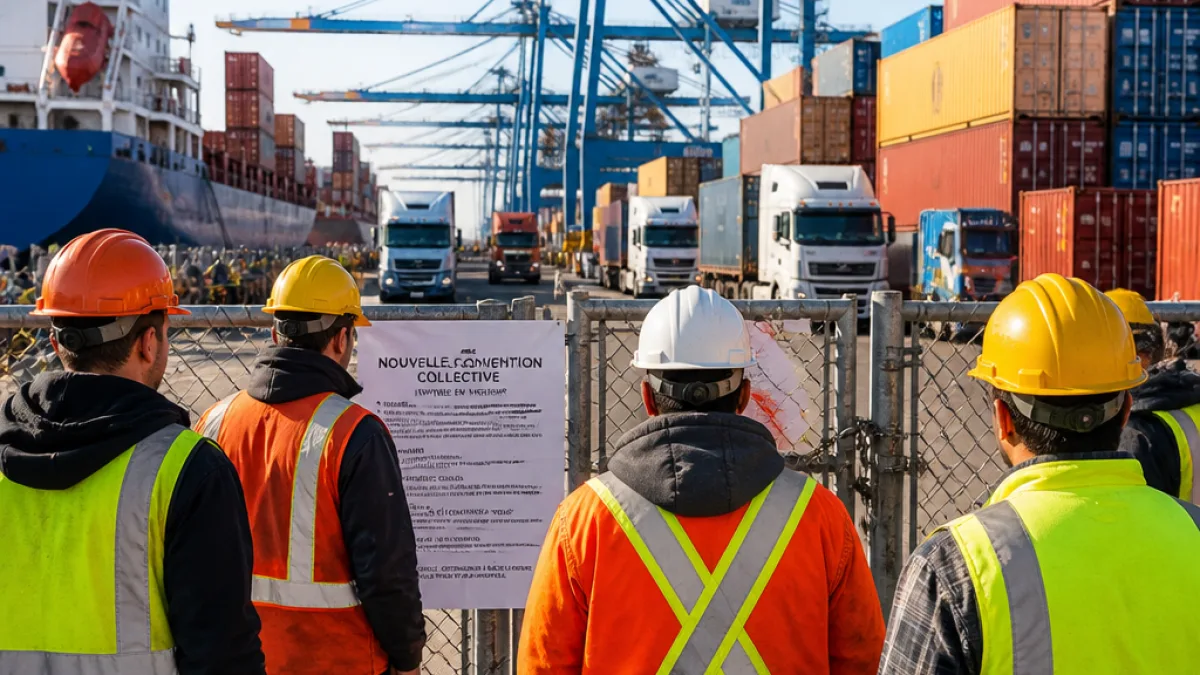
Arbitration ends labour uncertainty at Port of Montreal
The Maritime Employers Association (MEA) announced on Oct. 16 that a new collective agreement now applies to more than 1,200 longshore workers at the Port of Montreal who are members of the Montreal Longshoremen’s Union (CUPE Local 375). The arbitration ruling establishes terms for the period from 2024 to 2028, bringing to a close a dispute that prompted federal intervention after repeated work stoppages.
The agreement was imposed by an arbitration tribunal following a referral from the Canada Industrial Relations Board (CIRB). Federal authorities asked that the long-running dispute be settled through final and binding arbitration after mediation failed to produce a lasting accord.
“This resolution brings an end to a period of uncertainty resulting from deadlocks in difficult negotiations marked by service disruptions, while supporting the continuation of a reliable and competitive port service with significant potential for growth.”
The MEA did not publish the specific terms of the arbitration award, and CUPE Local 375 has not yet issued a public statement detailing its response. What is known is that the arbitration decision sets out working conditions, compensation and other provisions that will govern relations between the MEA and the union for the full five-year term.
Background and local impact
Negotiations to renew the longshore workers’ collective agreement began in 2023 and were punctuated by strikes and intermittent work stoppages that affected port operations and regional supply chains. In mid-November 2024, after a CIRB decision, the union and employers agreed to a 90-day mediation period and workers returned to their posts. Talks continued into March 2025, after which federal mediators ended active mediation and the file was referred to arbitration.
Most longshore workers at the Port of Montreal are represented by CUPE Local 375. A smaller number of workers — including checkers, cargo repair workers and office clerks — are represented by the International Longshoremen’s Association (ILA) Local 1657. The arbitration ruling specifically applies to the CUPE Local 375 membership covered by the MEA announcement.
- Coverage: More than 1,200 longshore workers (CUPE 375)
- Duration: Collective agreement spans 2024–2028
- Mechanism: Final and binding arbitration following CIRB referral
| Item | Detail |
|---|---|
| Number of workers covered | 1,200+ |
| Union | CUPE Local 375 |
| Agreement period | 2024–2028 |
Why Montrealers should care
The Port of Montreal is a critical hub for goods moving into and out of the province and beyond. Labour instability there has ripple effects on retailers, manufacturers, and consumers across Quebec and Canada. The MEA framed the arbitration decision as a way to restore certainty and protect the port’s capacity to grow.
While the arbitration outcome aims to prevent further service interruptions, the absence of publicly available contract details leaves businesses and community observers watching for how the new terms will affect operations, wages and working conditions. The fact that a binding arbitration panel set the terms underlines the federal government’s role in stepping in when negotiations stall on issues with broader economic consequences.
With the new agreement now in force, the immediate prospect is for more predictable operations at the port. However, longer-term labour relations will depend on how both sides implement the arbitration provisions and whether open lines of communication prevent future escalations.
Local stakeholders, from shipping companies to municipal planners, will want to monitor how the settlement influences throughput, scheduling and service reliability as the port moves forward under the five-year framework.