Residents of Blainville in Quebec may recognise the name, but the industrial story of Blainville‑sur‑Orne in Normandy is one of continuous adaptation. Since 1956 the Renault Trucks plant there has transformed from a post‑war industrial site into a European centre for medium‑duty truck assembly and a pioneer in electric truck series production.
From shipyard to truck manufacturing
The site’s industrial roots predate the Renault era. Shipbuilding operations began in 1917 under the Chantiers Navals Français banner and continued until the shipyard closed in 1954. Two years later, in 1956, Saviem — then a Renault subsidiary — set up a plant to build industrial vehicles. Over the decades the facility shifted focus as corporate structures and transport needs changed, joining Renault Véhicules Industriels in 1978 and becoming part of the Volvo Group in 2001.
Industrial reinvention and workforce
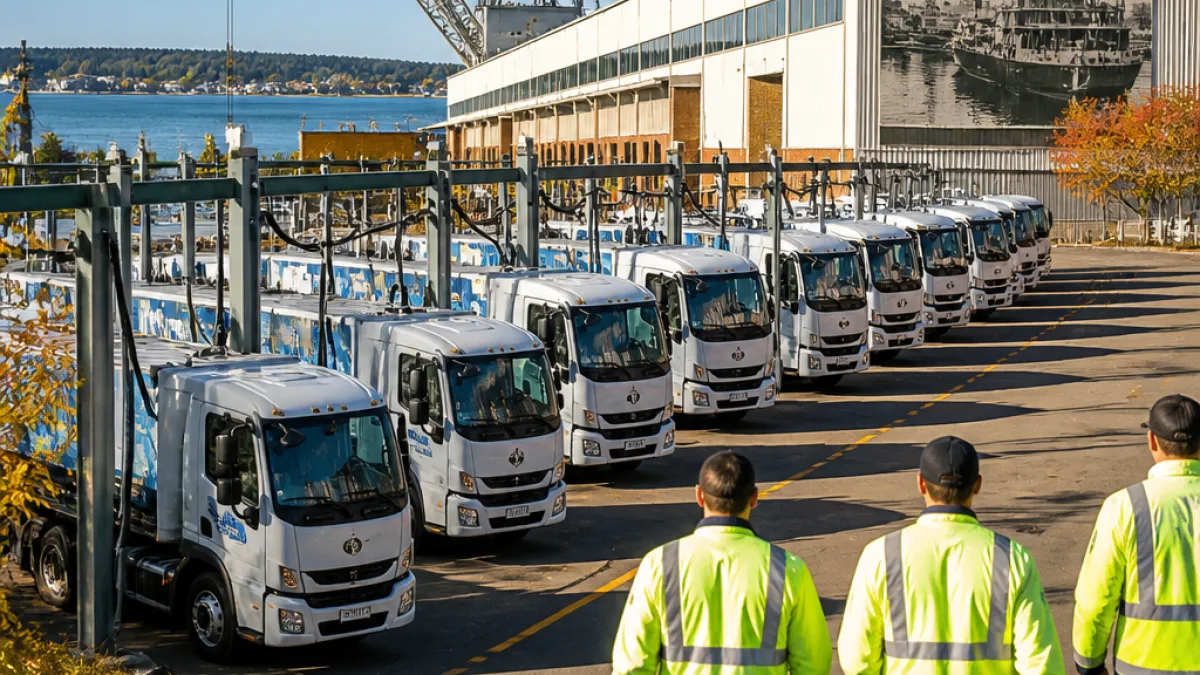
Today the site manufactures cab bodies for the full Renault Trucks range and assembles medium‑duty vehicles in both electric and diesel versions. The plant employs about 2,400 people, making it a major contributor to the local economy in Normandy.
- Manufactures cabs for the entire Renault Trucks range.
- Assembles medium‑duty vehicles suited to urban distribution, waste collection, emergency services and construction access.
- Operates a customer adaptation centre to meet bespoke requirements.
Leading the shift to electric mobility
Blainville‑sur‑Orne reached a notable milestone in 2020, when it became the first plant in Europe to begin series production of Renault Trucks electric models. Since that time the factory has produced more than 3,000 Renault Trucks E‑Tech D vehicles across the 12, 14 and 16‑tonne ranges, and the E‑Tech D Wide models in 19 and 26 tonnes.
“The site has continually expanded its capabilities and developed its expertise,”
The trucks built at the plant are designed for a broad range of real‑world applications, including urban delivery, waste collection, emergency and fire services, and access to construction sites. To support those varied uses, Renault Trucks added a customer adaptation centre in the plant in 2021, enabling factory‑level bespoke fitting and conversions.
Why this matters to local readers
Though the Normandy site is geographically distant from Blainville, Quebec, the story carries practical resonance for local readers interested in employment trends, industrial innovation and the electrification of heavy vehicles. The plant’s transition from shipbuilding to conventional trucks and now to electric vehicles underscores how legacy industrial sites can be repurposed to meet new technological and environmental demands.
| Year | Event |
|---|---|
| 1917 | Shipyard operations commence (Chantiers Navals Français) |
| 1954 | Shipyard closes |
| 1956 | Saviem establishes truck plant |
| 1978 | Integration into Renault Véhicules Industriels |
| 2001 | Plant becomes part of Volvo Group |
| 2020 | First European series production of Renault electric trucks |
| 2021 | Customer adaptation centre opens |
For communities in Quebec with manufacturing or transport interests, the evolution of the Blainville‑sur‑Orne plant offers a concrete example of how production sites can pivot toward electrification while retaining industrial employment. The model also highlights the importance of in‑house adaptation facilities to deliver vehicles ready for municipal fleets and specialised commercial uses.
As municipalities, transit authorities and private fleets in Canada weigh their own electrification plans, the experience of the Normandy plant — a mix of sustained employment and early adoption of electric truck production — may provide useful lessons about the industrial and operational implications of that shift.