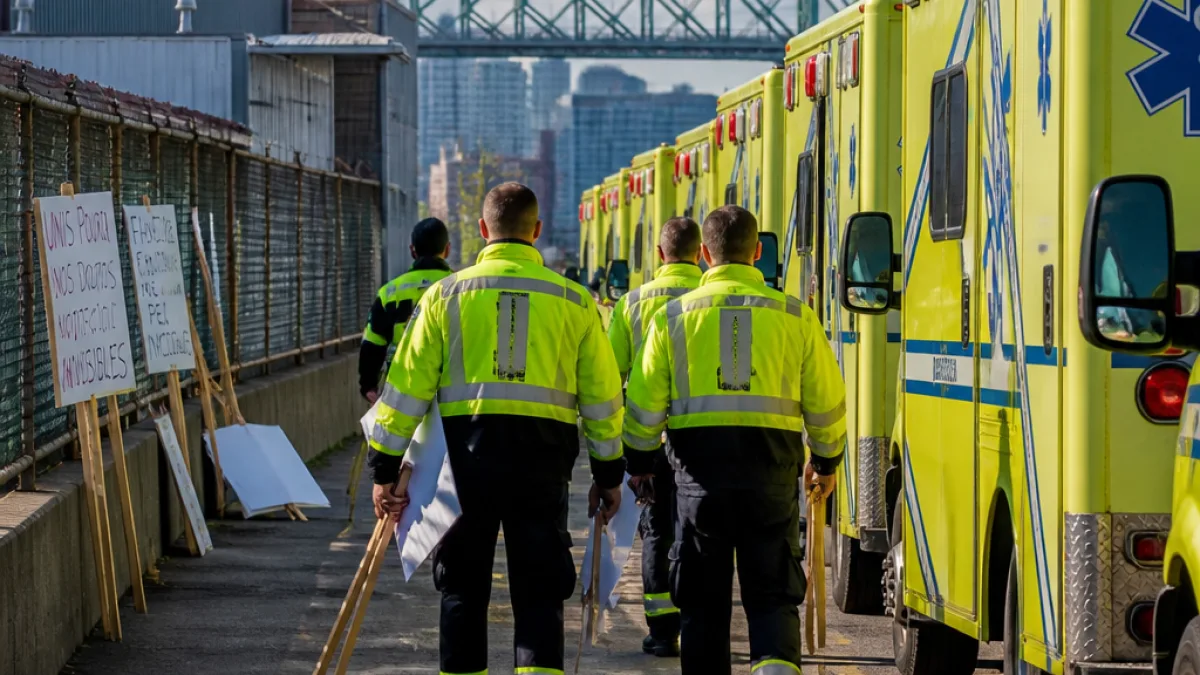
Paramedics serving Montreal and Laval have rejected a tentative agreement with the Quebec government, with members voting roughly 60 per cent against the deal, union officials reported on Sunday.
Where the vote stood and who’s involved
The balloting affects paramedics affiliated with the Syndicat du préhospitalier and its parent federation, the Fédération de la santé et des services sociaux (FSSS‑CSN). The federation represents about 3,500 paramedics across Quebec, including more than 1,000 workers at Urgences‑santé, which provides emergency medical services for Montreal and Laval. Results from other regions remain pending.
| Item | Figure |
|---|---|
| Vote against tentative agreement (Montreal & Laval) | 60% |
| Paramedics represented by FSSS‑CSN | ~3,500 |
| Paramedics at Urgences‑santé | >1,000 |
Context of a protracted dispute
The vote comes after an intense round of negotiations late last month that produced a tentative deal between the union and the provincial government. Paramedics in Quebec have been working without a collective agreement for more than three years, and the dispute has centred primarily on wages and what members describe as excessive overtime.
Over the past year union members have employed a series of escalating pressure tactics, including a strike in July 2025 that involved refusing non‑essential tasks, and a refusal to work overtime in several regions announced last June. The overtime refusal was suspended when the tentative agreement was reached and presented to members for ratification.
What the rejection means
With Montreal and Laval members rejecting the deal, the provincial picture is now uncertain. The outcome complicates efforts to finalise a settlement that would restore long‑term labour stability across the province’s emergency medical services.
Key near‑term questions include:
- Whether other regional votes will approve or reject the tentative agreement, which could influence the bargaining position of both parties.
- Whether the union will resume pressure tactics that had been suspended pending ratification.
- How the employer — including Urgences‑santé and the Quebec government — will respond to the rebuff in the province’s largest metropolitan area.
Impact on public services and patients
Paramedics provide front‑line emergency care and ambulance transport. Any escalation in job action, or prolonged uncertainty, could affect response protocols, scheduling and overtime arrangements, with potential implications for response times and service planning in Montreal and Laval.
Because the union’s results from other regions are not yet available, it is too early to determine whether the rejection in Montreal and Laval will precipitate a broader impasse or spur renewed negotiations to revise the tentative deal.
Where things may go next
The rejection places pressure on negotiators on both sides to return to the table. Past months of talks produced a tentative agreement; now leaders will need to assess which elements of that package were unacceptable to members in Montreal and Laval and whether amendments could secure ratification.
Any path forward must weigh the union’s priorities — notably improved pay and limits on mandatory overtime — against the government’s fiscal and operational constraints. Given the service area and concentration of workers affected, provincial officials and Urgences‑santé will also be mindful of the public interest in maintaining reliable emergency medical services.
As the situation unfolds, further vote results from other regions and official statements from the FSSS‑CSN, Urgences‑santé and the Quebec government will offer greater clarity on whether the rejected agreement can be renegotiated or whether labour actions will resume.
This story will be updated as additional regional results are announced and as parties respond to the Montreal and Laval vote.
Geneviève Tremblay is the Quebec correspondent for WE NEWS, reporting on provincial labour and public‑service issues.