
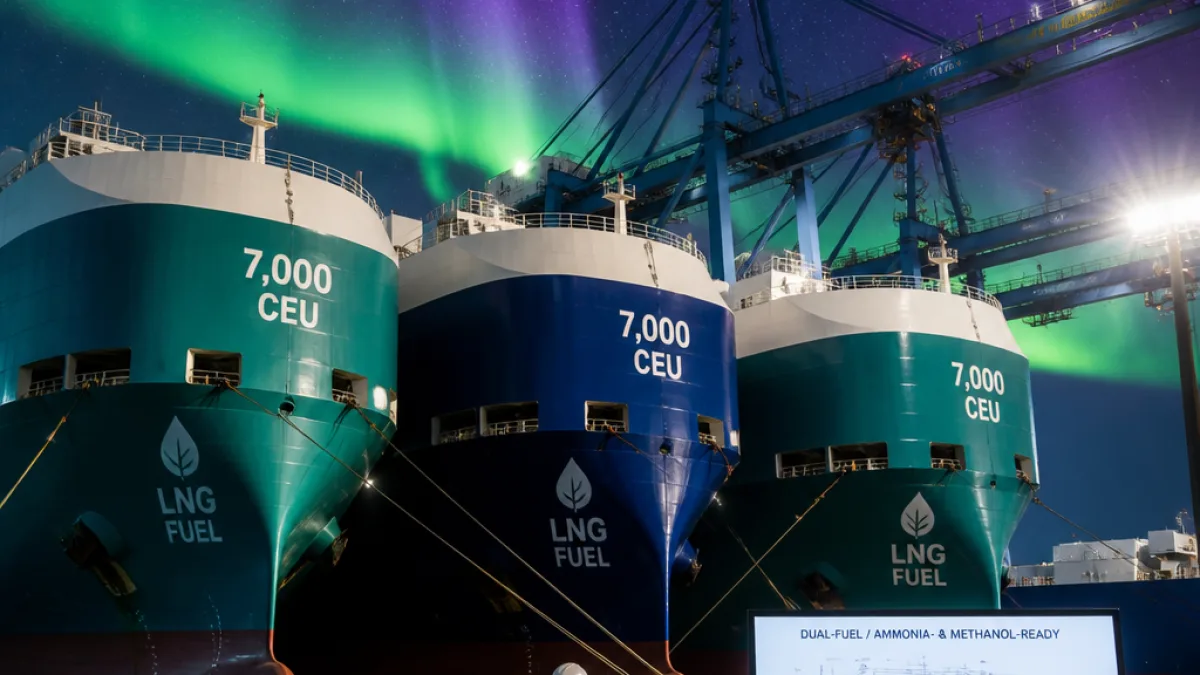
Hoegh Autoliners has increased its Aurora-class fleet renewal programme with an order for six additional vessels, bringing the firm total to 18 ships and creating the potential for an eventual fleet of up to 26 vessels if options and reserved slots are exercised.
Order details and technology
The newbuilds are to be constructed by China Merchants Heavy Industry (Jiangsu) and are slated for delivery between 2029 and 2031. Each Aurora-class pure car and truck carrier (PCTC) is designed for dual-fuel liquefied natural gas (LNG) operation and carries DNV notations for being ammonia-ready and methanol-ready. Hoegh says the vessels will each have a capacity of up to 9,100 cars.
Main engines will be supplied by Everllence, and bridge systems by Kongsberg Maritime. Hoegh Autoliners cites a potential carbon-emissions reduction of up to 58 per cent for the Aurora class compared with conventional PCTCs, while preserving flexibility for a future conversion to ammonia as a fuel.
Fleet growth and optionality
Alongside the firm order for 18 vessels, Hoegh has secured options for four more ships on identical terms, exercisable within six months, and has reserved construction slots for another four vessels at the same yard, with notice required by 31 December 2027. If both the options and the reservations are taken up, the Aurora programme would expand to a total of 26 vessels.
"The Aurora class has demonstrated strong performance and versatility in carrying different cargo types, and further expanding the fleet strengthens our ability to capture growth in the Asian market and meet evolving customer demand," Chief Executive Andreas Enger said.
What this means for shipping and emissions
The additional ships are part of Hoegh's fleet renewal drive and, according to the company, will provide more capacity for future growth while aligning with decarbonization goals by incorporating dual-fuel capability and readiness for next‑generation zero‑carbon fuels. The combination of LNG operation and design allowances for ammonia or methanol conversion reflects a common industry strategy to balance near-term operational emissions reductions with long-term fuel transition options.
- Capacity: Each Aurora-class PCTC can carry up to 9,100 cars, increasing roll-on/roll-off capacity for vehicle logistics.
- Emissions: Hoegh projects as much as 58% lower carbon emissions compared with conventional PCTCs when operating in their designed modes.
- Fuel flexibility: Ships are dual-fuel LNG and carry notations for future ammonia and methanol readiness.
| Item | Detail |
|---|---|
| Firm Aurora-class vessels | 18 |
| Options | 4 (exercisable within 6 months) |
| Reserved slots | 4 (notice by 31 Dec 2027) |
| Potential total | Up to 26 |
| Capacity per vessel | Up to 9,100 cars |
| Delivery window | 2029–2031 |
For Ontario readers watching the freight and automotive logistics sectors, the Aurora-class programme underlines two ongoing industry dynamics: the steady replacement of older tonnage with vessels designed around lower‑carbon fuels, and the commercial bet that a flexible design—able to run on LNG now and convert to ammonia or methanol later—will be attractive to customers and regulators over the coming decade.
Hoegh's statement also linked the expansion to commercial opportunities in Asian markets, emphasising the programme's role in long-term fleet renewal and capacity planning. Suppliers attached to the programme — including Everllence for main engines and Kongsberg Maritime for bridge systems — further indicate the industrial partnerships that underpin large newbuild programmes.
As shipowners navigate shifting fuel regulations and customer expectations on emissions, orders such as these show how the maritime sector is balancing immediate emissions reductions with the technical and economic uncertainties of future zero-carbon fuels. Hoegh's Aurora-class expansion is a concrete example of that strategy.











