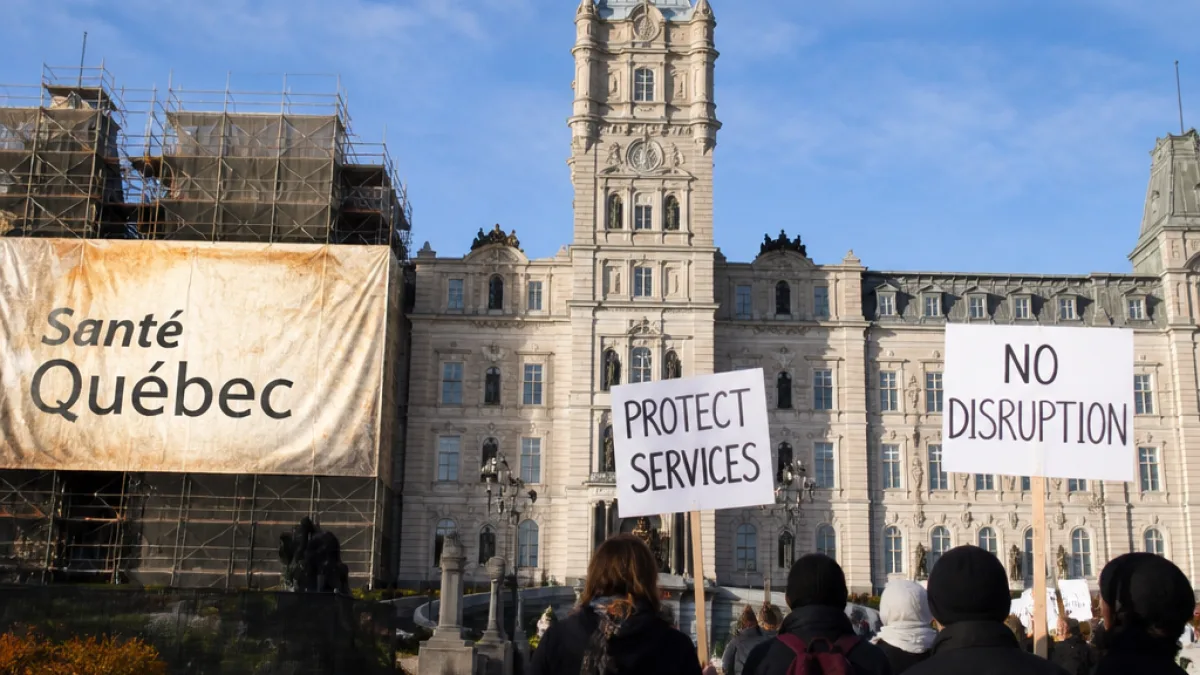
Quebec’s health minister dismissed the Parti Québécois proposal to dismantle Santé Québec as “not realistic,” arguing that undoing the agency would reverse negotiated workforce transfers and destabilize recent progress in the health network.
Short-lived agency drawing heavy scrutiny
Santé Québec was created in 2024 to separate high-level policy from day-to-day administration, leaving the Ministry of Health and Social Services to set direction while the new agency focuses on implementation. The Parti Québécois has said it would abolish the body if it forms government after the Oct. 5 election, part of a drive to reduce the size of government.
On Wednesday at the National Assembly, Health Minister Sonia Bélanger described the PQ proposal as impractical and warned of operational disruption if the province attempted to return to the former structure.
“It’s not realistic at all,”
She pointed to the administrative changes already carried out, saying a significant portion of staff were transferred from the ministry to Santé Québec under negotiated terms that could not simply be reversed.
Numbers the parties are using
The PQ leader, Paul St‑Pierre Plamondon, has argued the agency has ballooned the public payroll and cost taxpayers more. The party points to a reported 70 per cent increase in civil servants within the agency and an additional annual cost of about $40 million, figures cited in a recent media account.
| Item | Detail |
|---|---|
| Creation | 2024 |
| Reported staff increase | 70% |
| Reported additional cost | $40 million per year |
| Election date | Oct. 5 |
Bélanger, who is running again for the Coalition Avenir Québec (CAQ) in Prévost, said Santé Québec has already produced concrete improvements and that reverting to the former arrangement would be a step backward.
“We’ve shown a lot of courage, and we’ve worked hard. Santé Québec is really taking off, so there’s no way we’re going back to the old system,” she told reporters, pointing to recent declines in surgical waiting lists and expanded home-care services as evidence of progress.
Promises versus practicalities
The PQ has framed the move as part of a broader effort to focus on “the essentials” in health care and to streamline government. The party has indicated it will unveil details of its plan later this week. For now, the public-facing argument centres on cutting administrative layers and putting more resources back into frontline care.
But ministers and health-system managers caution that structural changes carry transition costs and operational complexity. Bélanger emphasised that the initial transfer of staff required negotiations, implying that reversing those agreements would be legally and logistically fraught.
What abolition would mean — and what is still unknown
Questions remain about the mechanics of any proposed abolition: how responsibilities would be reassigned between the ministry and local health organisations, the fate of employees transferred to the agency, and short- and medium-term effects on service delivery. Those operational details have not been published by the PQ.
- When created in 2024, Santé Québec was intended to separate policy from operations.
- The PQ says the agency increased staff by about 70% and costs by roughly $40 million annually.
- The CAQ government says Santé Québec has contributed to reductions in surgical wait times and improved access to family doctors and home care.
The debate comes as health services remain a top voter concern ahead of the provincial election. Any plan to alter the architecture of the health system would be judged not only on potential savings but also on the likely effects for patients and for the thousands of health workers who operate the system daily.
As both parties prepare to sharpen their platforms in the coming days, the practicalities of undoing a recently created agency will be central to how voters assess the credibility of competing promises.
Geneviève Tremblay, Quebec correspondent