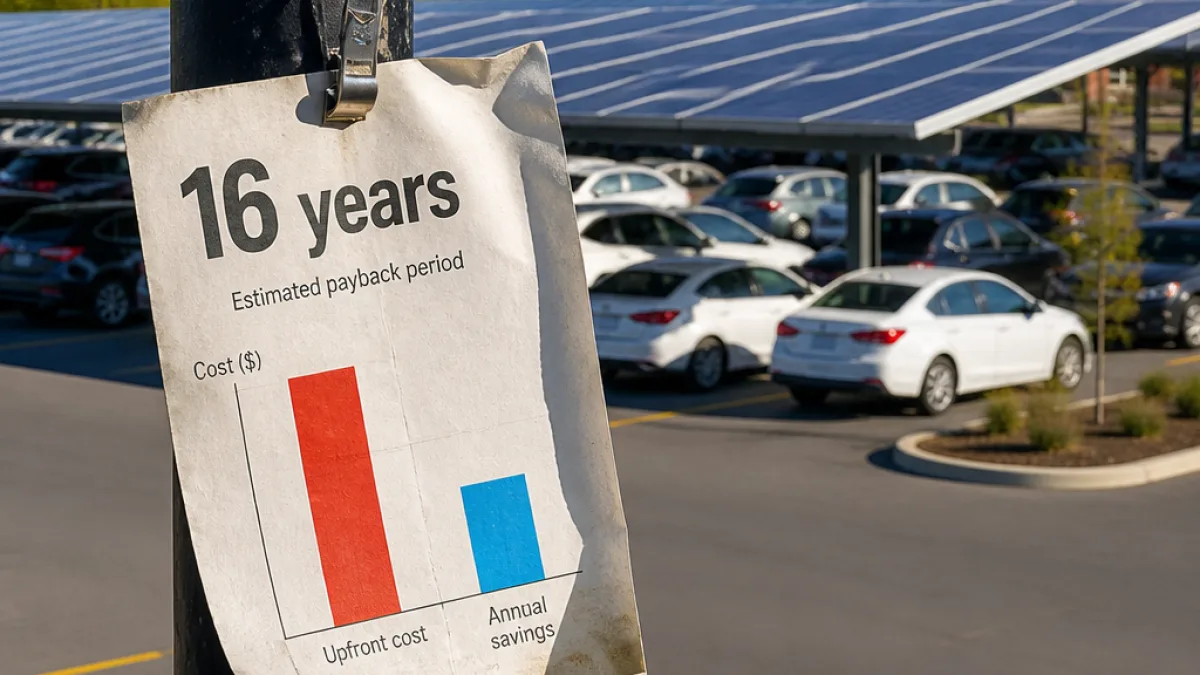
Municipalities considering parking-lot solar canopies should take a close look at the fine print. A preliminary financial assessment in Granby, Connecticut, finds that a private developer model for rooftop-like canopies would cost the town more than buying conventional power during the first eight years and would not recover those initial shortfalls until roughly year 16.
What the Connecticut study found
The analysis, prepared by Titan Energy and reviewed by an intra-board advisory committee on Sept. 14, examined two canopy systems: a 123-kilowatt system serving municipal buildings and a 105-kilowatt system for schools. Together, Titan estimated the installations would generate about 285,000 kilowatt-hours in the first year.
Under the developer-owned, developer-operated model Titan recommended, the town would not own or maintain the equipment. Instead, a private company would build, operate and maintain the canopies and sell the electricity back to the town under a power‑purchase agreement (PPA).
Titan’s financial model assumes the town would pay a fixed 18 cents per kilowatt-hour for solar electricity across a 20-year contract. By contrast, the starting grid price used in the model was 15.5 cents per kilowatt-hour (an Eversource rate), with an assumption that that rate would rise by 2 per cent annually.
“Under those assumptions, Granby would spend $7,125 more on solar electricity during the first year,” Titan concluded, with projected cumulative losses of about $30,900 over the first eight years.
When savings appear
As the modelled Eversource price creeps up and approaches the fixed solar price, the annual losses shrink. Titan’s projection shows the systems would start producing small annual savings in year nine — roughly $440 that year — growing to nearly $11,869 by year 20. Even so, the early deficits mean the town would not fully recoup its initial shortfalls until about the 16th year of the contract.
- System sizes evaluated: 123 kW (municipal), 105 kW (schools)
- Estimated first-year production: 285,000 kWh
- Assumed PPA price: 18 ¢/kWh (fixed for 20 years)
- Starting grid price in model: 15.5 ¢/kWh, 2% annual escalation
Why this matters to municipal decision‑makers
Although the study concerns a U.S. municipality and uses U.S. utility rates, its findings highlight points that municipal councils in Quebec should weigh when evaluating similar projects:
- Contract structure: developer-owned PPAs can shift upfront capital and maintenance responsibilities off the town, but they also fix a per-kilowatt-hour price that may be higher than current grid rates.
- Assumptions matter: small changes in the assumed escalation rate for grid prices or in the PPA price can materially affect the payback timeline.
- Timeline and budgets: even projects that eventually save money can produce years of additional cost to municipal operating budgets before savings accrue.
| Metric | Modelled value |
|---|---|
| Combined system output (year 1) | 285,000 kWh |
| PPA price | 18 ¢/kWh |
| Starting grid price (Eversource) | 15.5 ¢/kWh |
| Projected break-even | ~16 years |
For Quebec municipalities, where electricity is delivered by Hydro-Québec and where rates, incentives and regulatory rules differ from those in Connecticut, the absolute numbers will change. But the overarching lesson is familiar: municipal leaders must scrutinize contract terms, escalation assumptions and the trade-offs between capital outlays and operating costs.
Town staff in Connecticut identified that under the model examined, Granby would be paying more for solar than for conventional grid electricity for the first eight years, with modest savings appearing only after year nine and small cumulative savings building slowly thereafter. That trajectory — a period of increased costs followed by eventual savings — is the kind of outcome municipal councillors should be prepared to justify to taxpayers.
Municipalities pursuing renewables often cite objectives beyond short-term budget impacts, including greenhouse-gas reductions, resilience and community leadership. The Connecticut study does not assign values to those goals; its focus is financial. Local decision-makers must therefore balance fiscal prudence with broader policy aims when structuring any agreement for solar infrastructure.
As more municipalities across Canada and Quebec explore solar canopies, parking-lot arrays and rooftop systems, careful modelling and transparent public discussion about contract terms and timelines will be essential. The Granby, Connecticut analysis offers a clear reminder: the headline of a renewable project may be attractive, but the contract details determine whether it is a near-term cost or a long-term investment.