
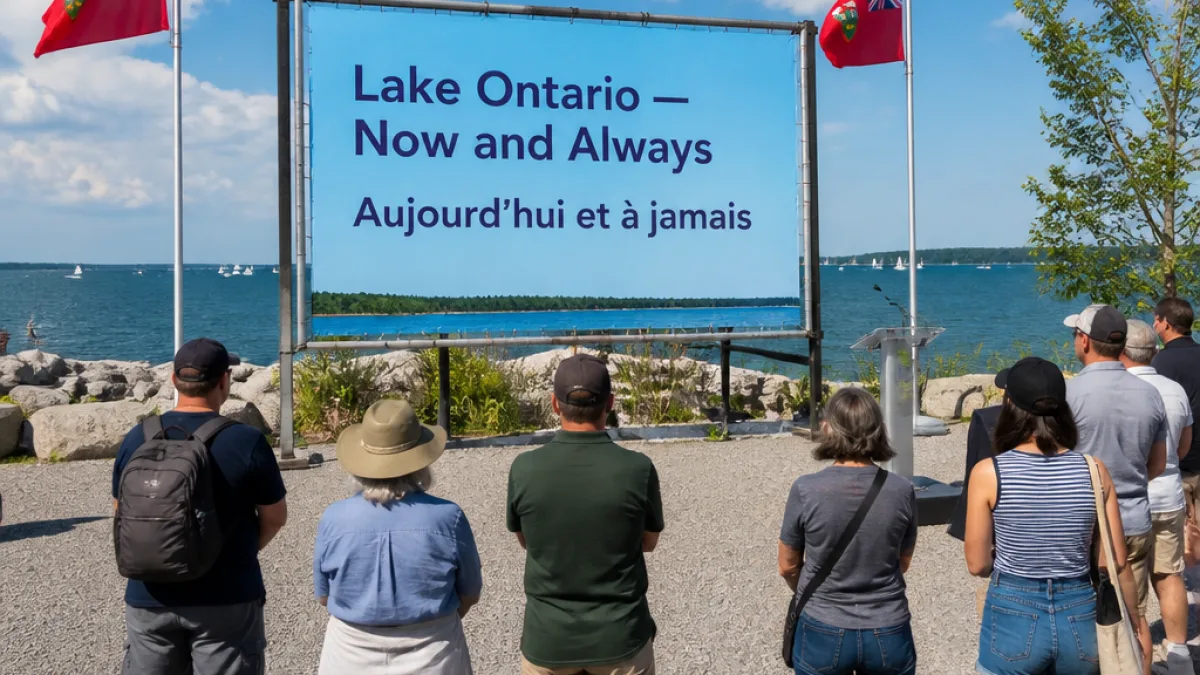
WINONA, Ont. — Ontario Premier Doug Ford staged a public rebuttal to an American executive order on Saturday, unveiling a billboard-sized sign at Fifty Point Conservation Area that reasserts the name of the Great Lake that borders the province.
Provincial pushback on an international row
The sky-blue sign, erected in the small lakeside community on the outskirts of Hamilton, reads "Lake Ontario — Now and Always" and includes the message in French as well. Ford told reporters the installation was intended to send a message about Canadian resolve after U.S. President Donald Trump signed an order renaming the body of water "Lake America."
"President Trump can call it whatever he wants but I can tell you that the rest of the world will always call it Lake Ontario," Ford said. In the Canadian context the premier framed the sign as a symbolic defence of provincial and national identity.
"We're resilient and we're strong Canadians."
Where this fits into wider relations
The unveiling comes as relations between Canada and the United States have deteriorated in recent weeks following the collapse of trade negotiations on Aug. 21. Both Ottawa and Washington have accused the other side of seeking last-minute changes, and federal authorities have publicly outlined retaliatory measures that are due to take effect on Sept. 8.
Federal commentary in coverage of the dispute has been pointed. The source material reports that Prime Minister Mark Carney had said the agreement became untenable — an unusual attribution given Mr. Carney's public profile — and the federal government has announced countermeasures in response to the breakdown in talks.
Local optics and political theatre
The sign is a continuation of Premier Ford's unapologetic, often theatrical approach to political confrontation. His social-media recording from the lakeshore emphasised continuity: the lake bore the name long before the current U.S. president and will continue to do so long after.
Locally, residents and visitors to Fifty Point were confronted with a clear, visible symbol of the diplomatic spat. The choice of Winona — small, lakeside and within the Hamilton area — touches on the urban-rural dynamic that often shapes Ontario politics, where provincial leaders stage symbolic gestures outside of Toronto to signal alignment with suburban and rural communities.
Practical implications remain centred on trade
While the sign is ceremonial, the underlying dispute has concrete consequences. Trade talks that broke down in August have prompted federal retaliatory measures set to start in early September. Those measures, and any countermeasures from the U.S., could affect industry and commerce across Ontario — particularly sectors that depend on cross-border supply chains.
- Aug. 21: Trade negotiations collapsed.
- Late August: U.S. president signs executive order renaming Lake Ontario to "Lake America."
- Aug. 29: Premier Ford unveils the "Lake Ontario — Now and Always" sign at Fifty Point in Winona.
- Sept. 8: Federal retaliatory measures from Canada are scheduled to take effect.
Timeline
| Date | Event |
|---|---|
| Aug. 21 | Trade negotiations collapsed between Canada and the U.S. |
| Late Aug. | U.S. president signed an order changing U.S. federal references to the lake to "Lake America." |
| Aug. 29 | Premier Ford unveiled the "Lake Ontario — Now and Always" sign at Fifty Point, Winona. |
| Sept. 8 | Canadian retaliatory measures are scheduled to begin. |
What to watch next
Observers will be monitoring whether the federal retaliatory steps proceed as planned on Sept. 8 and whether the diplomatic rhetoric cools or escalates further. For Ontarians, the immediate practical concerns will be the impact on trade-sensitive industries and whether supply-chain disruptions emerge as a result of tit-for-tat measures.
For now, the sign stands as a visible assertion of provincial identity on the shore of one of Canada's Great Lakes — a reminder that much of the fallout from high-level negotiations plays out in local communities that rely on cross-border commerce and shared waterways.
Reporting from Winona and Hamilton.















