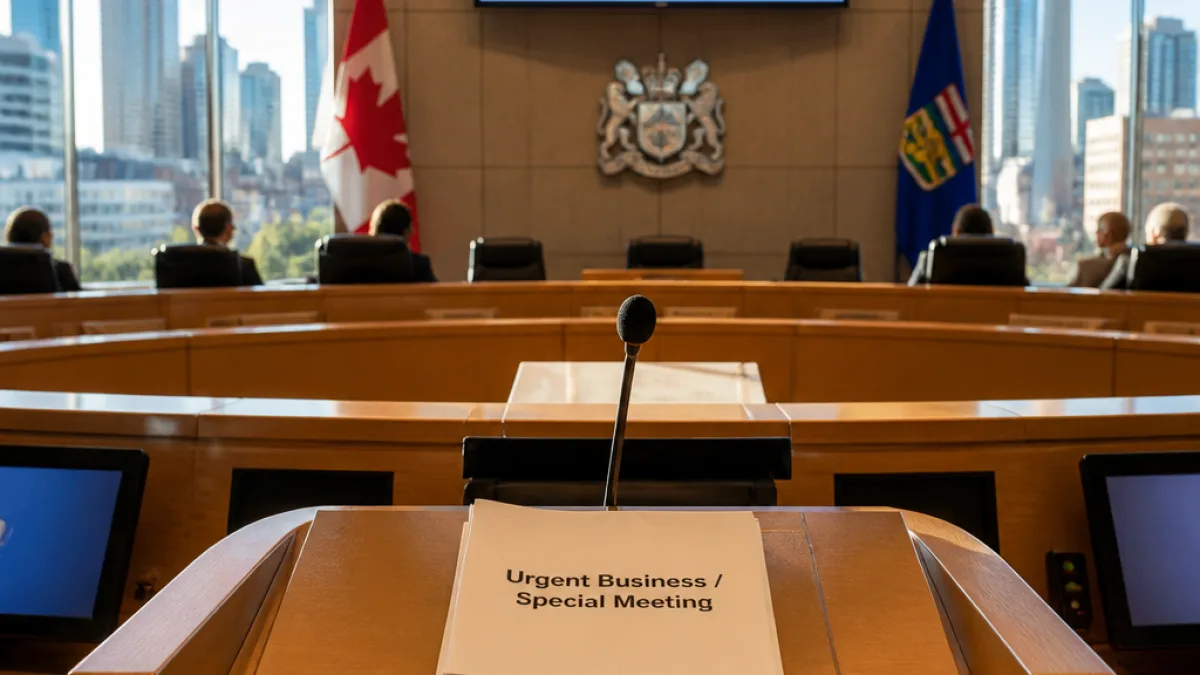
Calgary's mayor has signalled he will press city council to take a formal position on this fall's Alberta independence referendum, setting up a debate over the proper role of municipal government in a provincial constitutional matter.
Mayor to ask council for urgent business or special meeting
Mayor Jeromy Farkas said he “anticipates bringing urgent business or calling a special meeting” for council to consider a motion endorsing Calgary's continued membership in Canada. The move follows a University of Calgary School of Public Policy report that estimates separation could cost Alberta up to $170 billion over five years.
The proposal has exposed divisions on council about whether a city should weigh in on the referendum. Some councillors back the mayor's plan and say a voice from Canada's largest Alberta city matters. Others argue the issue lies outside municipal jurisdiction and that council's resources should remain focused on local services and priorities.
Legal and practical limits on municipal action
Municipalities in Alberta are barred from raising money or publicly advertising in support of either side of the referendum, but they are permitted to take a position. That narrow allowance has become the legal framework for the conversation on Calgary council.
Supporters of a formal council stance point to the scale of the economic risks identified by the University of Calgary report and say an official municipal voice could influence public discussion. Critics say council motions risk politicizing city hall and may not change the course of a province-wide campaign.
Local precedent and mixed council sentiment
Edmonton's council already endorsed remaining in Canada; a motion by Edmonton Mayor Andrew Knack was backed by his council earlier this year. In Calgary, a number of councillors have signalled support for the mayor’s idea, while others remain unconvinced.
- Mayor Jeromy Farkas: expects to bring urgent business or call special meeting
- University of Calgary report: separation could cost Alberta up to $170 billion over five years
- Municipal limits: cannot fund or advertise for either side but may take a position
“I anticipate bringing urgent business or calling a special meeting,”
Ward 3 Coun. Andrew Yule has said he was clear about his support to remain in Canada while campaigning last fall, signalling at least some councillors are prepared to be explicit about their views before a council vote.
What Calgary residents should expect
With roughly a month to go before Albertans vote in the referendum, council will need to decide whether to add the matter to its agenda through urgent business or convene a special meeting. If council agrees to a formal endorsement, the motion would be symbolic rather than fiscal: municipalities cannot legally campaign with funds or advertising.
| Item | Status |
|---|---|
| Referendum date | This fall (provincial) |
| University report on separation cost | $170 billion over five years (School of Public Policy) |
| Possible council action | Urgent business or special meeting to debate a formal endorsement |
The debate taps into broader questions about municipal roles during provincial or national political crises. For civic leaders, the calculation involves weighing the council's mandate to represent local interests against the risk of diverting time and attention from pressing municipal files such as transit, housing, infrastructure and public safety.
Whatever path council chooses, the discussion will be closely watched in Calgary and beyond. A motion from the city's council, even if purely symbolic, would add a prominent urban voice to a high-stakes provincial conversation about Alberta's future and the economic risks identified by academic analysts.
Calgary voters expecting council meetings to focus on day-to-day municipal services can anticipate a public debate on the referendum question in the weeks ahead, with possible consequences for how civic leaders position themselves during one of the province's most consequential political moments in recent memory.