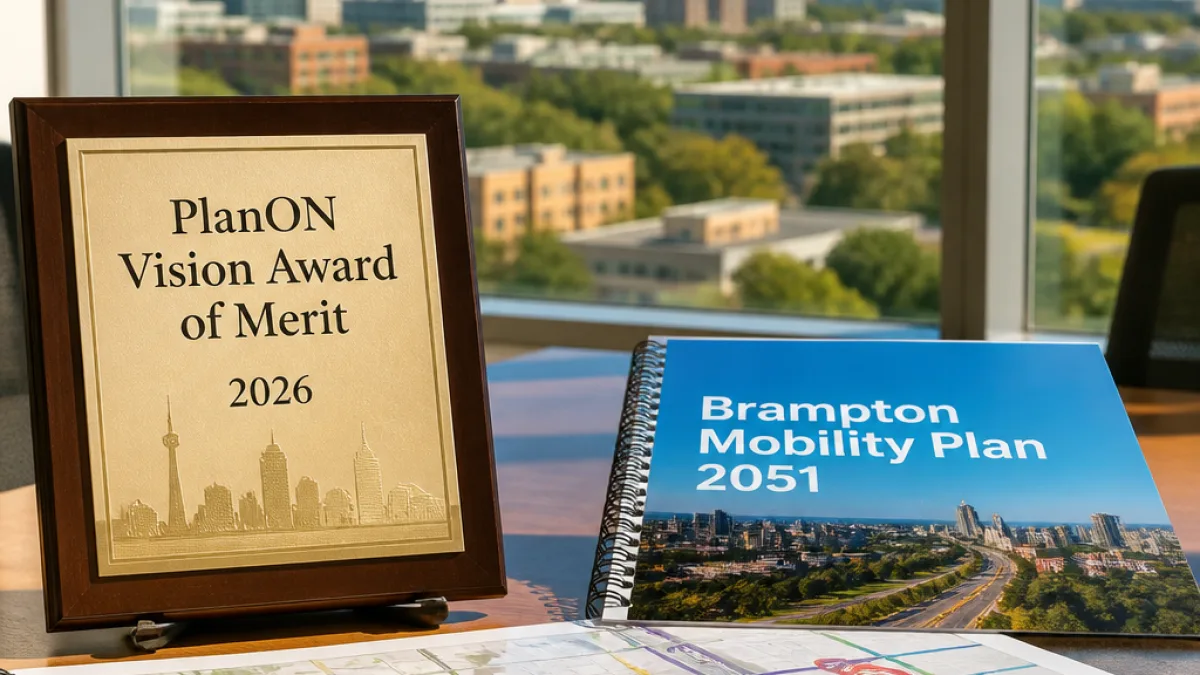
The City of Brampton’s long-range transportation framework has been recognised provincially after receiving a 2026 PlanON Vision Award of Merit from the Ontario Professional Planners Institute, the city announced on Sept. 18.
Recognition for a framework, not a construction schedule
The award highlights the Brampton Mobility Plan as a planning document intended to guide where and how the city invests in streets, transit and active modes over the next quarter-century. City officials stressed that the announcement is recognition of a planning framework rather than the launch of specific projects, timetables or openings.
Council endorsed the mobility plan on Sept. 24, 2025, after which it entered a 30‑day public review under the Municipal Class Environmental Assessment process. The plan replaces the 2015 Transportation Master Plan and was developed using public engagement, technical analysis and alignment with the Brampton Plan and the Brampton 2040 Vision.
What the plan covers and why the horizon extends to 2051
The Mobility Plan is a long‑range transportation master plan covering infrastructure, services and operating practices through 2051. The document uses planning projections to anticipate significant growth: roughly one million residents and 355,000 jobs by 2051 — an increase of about 300,000 people and 130,000 jobs compared with 2021.
Those figures are planning projections intended to inform network design and investment choices rather than a count of current population or employment. The plan is therefore a starting point for understanding the city’s broader objectives; individual infrastructure proposals will still require project‑level design, delivery and timing details.
Designing streets for different users
At the core of the plan is the Complete Streets approach. Brampton’s Complete Streets Guide emphasises streets that consider safe, comfortable travel for people walking, cycling and taking transit, while recognising that roads serve multiple purposes in a growing city. The approach calls for dedicated space and design attention for vulnerable road users and integrates the street’s role within the wider network.
"Complete Streets"
The mobility plan positions Complete Streets as a guiding principle for how projects are shaped, though those projects will still need their own environmental assessment and design phases before construction.
Local implications and next steps
- Residents can treat the Mobility Plan as a roadmap for where transportation investments may be prioritised as Brampton grows.
- Specific roadworks, transit service changes or cycling facilities still require separate project approvals and public consultations under environmental assessment rules.
- Planners and councillors will use the document to align future capital budgets and policy decisions with the city’s projected demographic and employment growth.
| Item | Date / Horizon |
|---|---|
| Council endorsement | Sept. 24, 2025 |
| Public review (Municipal Class EA) | 30 days after endorsement |
| Plan horizon | Through 2051 |
| Projected population (2051) | ~1,000,000 residents |
| Projected jobs (2051) | ~355,000 jobs |
For residents, the award may raise expectations that future neighbourhood designs, commuter corridors and active‑transport links will better reflect safety and multimodal access. At the same time, each corridor, bus route modification or bike lane will require its own timeline, funding and statutory approvals before becoming reality.
The provincial planning honour places Brampton alongside five other projects recognised this year, signalling that the Mobility Plan’s concepts have resonated with professional planners. For city leaders, the challenge now is to translate those concepts into deliverable projects that match community needs and the municipality’s fiscal capacity as the city continues to grow.