
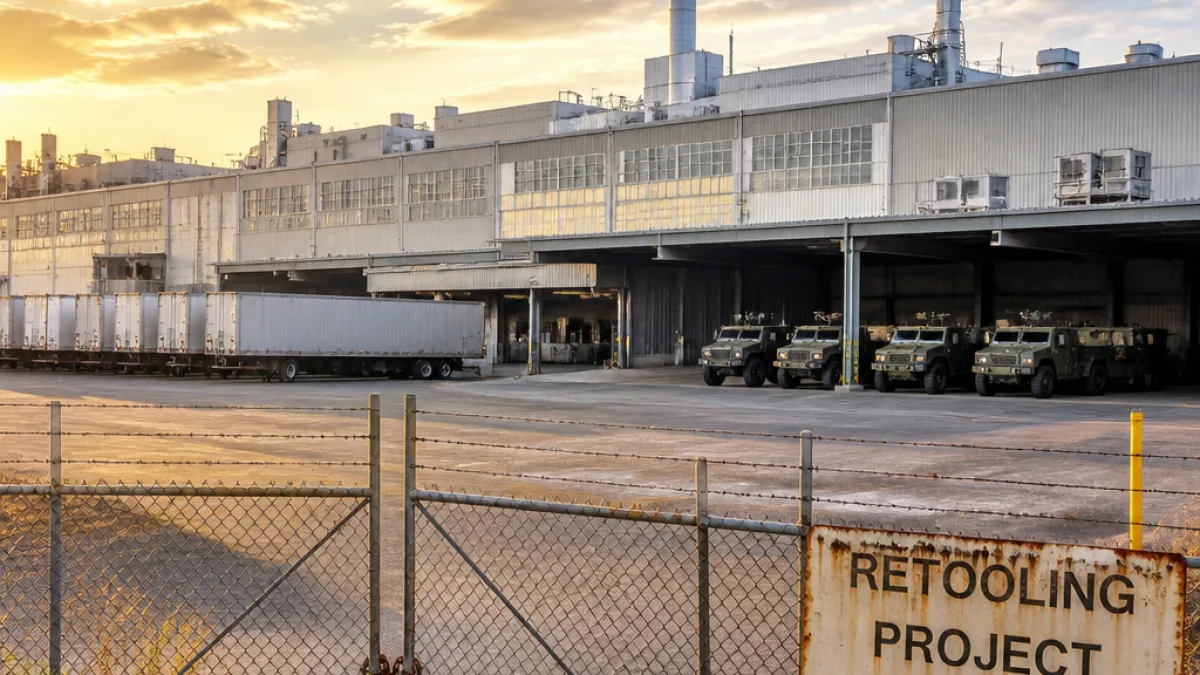
Labour leaders and industry analysts are warning that a proposed sale of the idled Stellantis assembly plant in Brampton could have wide-reaching consequences for workers and for Canada’s auto sector if approved.
Union balks at sale to Roshel; contract talks stall
The dispute intensified after Unifor said contract negotiations with Stellantis NV collapsed on Sept. 11, a day the union says it was told the company had signed a memorandum of understanding to sell the Brampton facility to armoured-vehicle maker Roshel Inc. The plant currently has about 2,200 workers on its payroll, and has been idle since production changes were announced.
Roshel has argued the firm could restart production quickly if it secures a Canadian military contract to build light utility vehicles. Unifor, however, has opposed the potential transfer of the facility to an armour-maker, saying the move undermines broader bargaining positions and long-term manufacturing commitments in Canada.
“The big fear for Unifor, and the fear that I share, is that watching one of the major automakers leave Canada would send a signal to all the rest of the industry that this can happen,” said Jim Stanford, economist and director at the Centre for Future Work.
Experts warn of a cascading effect
Analysts say allowing Stellantis to reduce its manufacturing footprint in Brampton could create pressure on other automakers to follow suit, or to reassess their production commitments to Canada. Charlotte Yates, president of the Automotive Policy Research Centre and former president of the University of Guelph, warned permitting a scale-back would have a “cascading effect” across the sector.
The concern centres not just on jobs at the Brampton plant but on the signalling effect to global manufacturers who sell into Canada. Observers note Stellantis had earlier received substantial public support — provincial and federal governments put forward hundreds of millions of dollars to help retool the Brampton facility in exchange for production promises. Those public investments are now in question, they say, if the company moves to sell the site rather than meet its previously stated commitments.
Local and national implications
For Brampton residents, the issue is immediate: the city risks losing industrial capacity and the high-paying manufacturing jobs that anchor many families’ livelihoods. Beyond the municipal boundary, the debate touches on how Canada balances attracting investment from multinational automakers while protecting domestic employment and the public funds used to secure production.
Stellantis told workers last week it did not see a “long-term business case” for producing vehicles at the Brampton plant, a message that fuelled criticism from labour and policy experts. Supporters of the sale point to Roshel’s potential to bring some workers back if it wins defence contracts, but Unifor and watchers caution that short-term job recovery under a different owner may not replace the long-term value of original production commitments.
- Workers affected: about 2,200 at the Brampton assembly plant
- Key date: contract talks reportedly broke down on Sept. 11 after notification of an MOU
- Public investment: provincial and federal governments committed hundreds of millions of dollars to retool the plant under earlier agreements
| Item | Detail |
|---|---|
| Plant location | Brampton, Ontario |
| Owner proposing sale | Stellantis NV |
| Potential buyer | Roshel Inc. |
Legal and policy analysts say the dispute could also prompt calls for clearer conditions on future government assistance to multinational firms, tying funding more tightly to enforceable production benchmarks. That would aim to prevent similar outcomes where public money is used to secure jobs and capacity that could later be transferred or wound down.
As the situation develops, Brampton’s civic leaders, provincial officials and Ottawa will face pressure to clarify what protections exist for workers and whether contractual or legislative tools can be deployed to enforce prior commitments. For many workers and suppliers in Brampton, the outcome will determine whether the city remains a significant hub for auto manufacturing or shifts toward different industrial uses.
With negotiations paused and uncertainty high, the next steps will hinge on whether Stellantis proceeds with the sale, whether Roshel secures defence contracts that justify reopening the facility, and whether labour, government and the company can reach an enforceable resolution that protects jobs and public investments.











