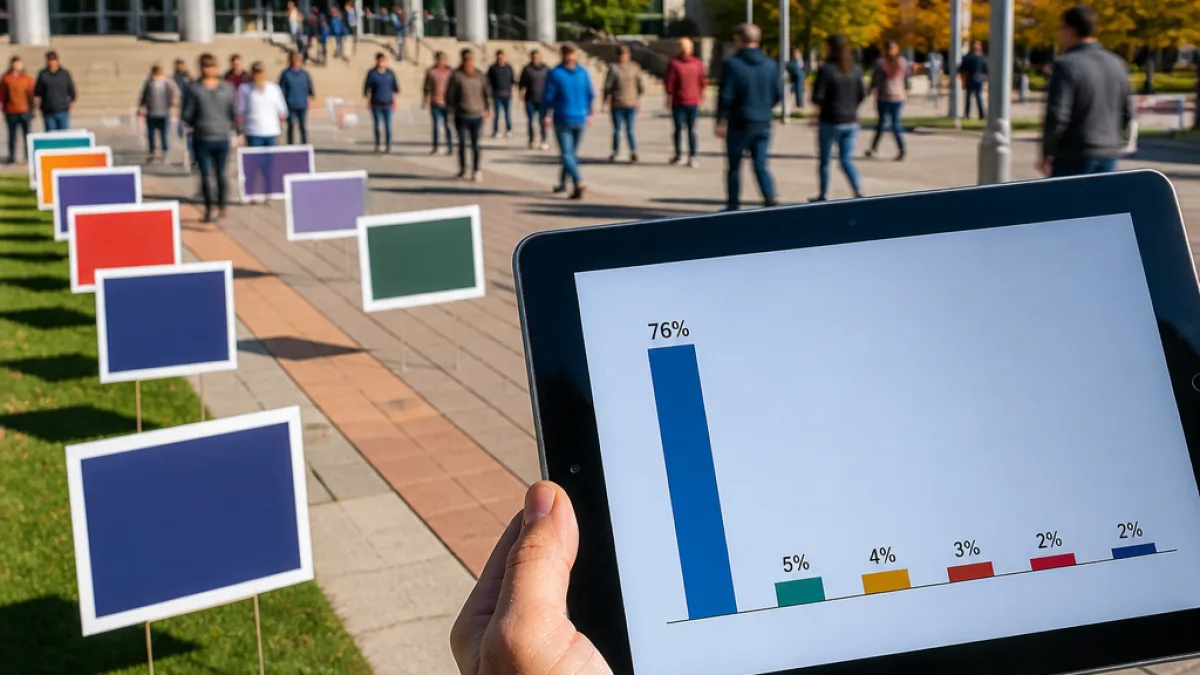
Incumbent holds a dominant position in late‑September polling
A recent Bramptonist community poll of 5,700 responses shows incumbent Mayor Patrick Brown with a substantial lead as Brampton moves toward its Oct. 26 municipal election. The informal online survey recorded Brown at 76 per cent of respondents’ support, with his nearest rival trailing by a wide margin.
How the numbers stack up
The same poll put Vidya Sagar Gautam at 7 per cent and Jagruti Bhatt at 4.4 per cent; no other certified candidate reached 2.5 per cent. The size of the sample—5,700 people—yields a small statistical margin of error if the sample were random, but the poll was conducted online among Bramptonist readers who chose to take part, which affects how representative the results may be.
| Candidate | Poll share |
|---|---|
| Patrick Brown | 76% |
| Vidya Sagar Gautam | 7% |
| Jagruti Bhatt | 4.4% |
| Others | <2.5% each |
Can Brown break Brampton’s modern record?
Discussion among political watchers has turned to whether Mr. Brown could not only win re‑election but also eclipse Brampton’s modern record for vote share and winning margin. That benchmark belongs to former mayor Susan Fennell, who in 2006 received 74.85 per cent of the vote, a margin of roughly 60.79 percentage points over the runner‑up.
"A closed Bramptonist community poll of 5,700 responses put Brown at 76 per cent."
By the poll’s numbers, Brown would need to exceed Fennell’s 74.85 per cent vote share and finish more than 60.79 points ahead of the second‑place candidate to claim either modern record. His 2022 result, while decisive, fell short of that mark: he won with 59.65 per cent of the vote and a roughly 34.10‑point margin over the runner‑up.
Context and caveats around online polling
Analysts caution that open, voluntary online polls reflect the views of participants rather than the electorate as a whole. The Bramptonist poll was open to readers who opted in; while the sample size is large, the method shapes how the results should be interpreted. Separate market indicators have also shown high expectations for Brown’s re‑election: a recent Polymarket contract implied an 85 per cent probability of his return to office, though that reflects market traders’ views rather than voter intention.
- Sample size: 5,700 respondents to the Bramptonist community poll.
- Brown in the poll: 76 per cent support.
- Historical benchmark: Susan Fennell’s 2006 vote share of 74.85 per cent.
With the Oct. 26 election date approaching, the poll adds fuel to conversations about turnout and voter engagement across Brampton’s diverse neighbourhoods. A large early lead may influence campaign strategy for challengers, who must consider where to concentrate resources if they hope to narrow a significant gap. For residents, the figures highlight the potential for continuity in municipal leadership and the relative strength—or weakness—of opposition campaigns as election day nears.
Municipal elections determine local priorities ranging from transit and housing to neighbourhood services. As the campaign advances, more formal, randomized polling and the actual vote will determine whether the late‑September lead holds and whether Brampton will see a record‑setting result in the coming weeks.