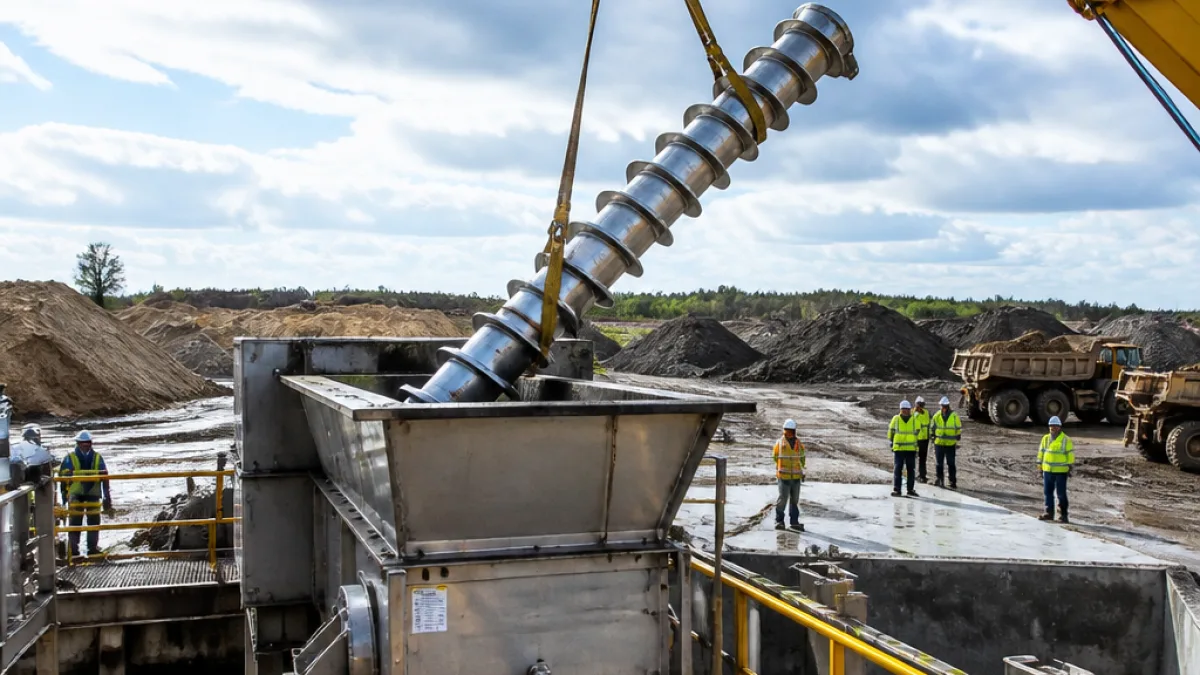
Engineering replacement chosen over repair to restore throughput
Ajax Equipment has supplied a new screw — a complete auger replacement — to UK Remediation to improve solids handling and restore desired throughput at the remediation specialist’s Exeter washplant.
UK Remediation, which provides contaminated land remediation, soil disposal and waste-management services, initially approached Ajax Equipment seeking new flights for an existing auger. After inspecting the equipment, Ajax’s engineering team concluded that producing a full screw would be more economical, quicker to manufacture and deliver higher performance and longer service life than repairing individual flights.
The decision aligns with a practical approach often adopted in heavy-wear, high-throughput applications where partial repair can be a short-term fix but not the most cost-effective long-term solution.
- Supplier: Ajax Equipment (Bolton, BL2 2AR)
- Client: UK Remediation (Exeter washplant)
- Solution: Complete replacement screw (auger)
“Our new screw from Ajax is fantastic. It has made a big improvement in the efficiency of the feeder, and we are now able to maintain the throughput desired. Thanks to Ajax’s team for their insight and helping us find the most effective solution for our feeder and plant,”
The comment came from Bret Clark of UK Remediation, who said the new screw allowed the Exeter operation to maintain the throughput required. Lewis Shaw, senior technical sales engineer at Ajax Equipment, explained that while flight-only refurbishment can be beneficial in many circumstances, demanding applications often warrant full-screw replacement:
“In many cases Ajax’s flights only service can help improve the performance of damaged screws, however, for demanding applications such as UK Remediation’s it can be more effective to replace the whole screw. By taking the time to understand the needs of each process and material, Ajax’s engineering team is able to develop the most appropriate solution for each customer.”
Implications for waste handling and remediation operations
The episode highlights several practical considerations for operators of washplants and soil-remediation facilities. Wear is intrinsic to auger and screw conveyors handling abrasive, contaminated or heterogeneous soils. Operators routinely weigh the trade-offs between shorter interruption and lower upfront cost of flight refurbishment versus the longer-term benefits of a new screw: improved efficiency, reduced downtime and extended service life.
For firms such as UK Remediation, which must balance regulatory obligations, environmental controls and commercial throughput, equipment reliability is a central factor in maintaining project schedules and controlling operating costs. The decision to replace the screw suggests the Exeter facility’s engineers prioritised sustained performance and faster turnaround over incremental, local repairs.
Small but telling example of industrial engineering choices
The case also illustrates how specialised engineering suppliers add value through process understanding, not just component supply. Ajax Equipment’s assessment of the auger and recommendation for replacement demonstrates the role of diagnostic inspection and application-specific engineering in modern recycling and remediation sectors.
While the news concerns businesses and facilities in the United Kingdom, it is a useful case study for plant operators, consultants and municipal managers here in Ontario and across Canada who oversee soil remediation, construction-site management and municipal-waste systems. The principles of wear management, lifecycle cost analysis and rapid restoration of throughput are equally relevant to facilities from city transfer stations to rural aggregate operations.
| Company | Location | Role |
|---|---|---|
| Ajax Equipment | Bolton (BL2 2AR) | Supplier / engineering |
| UK Remediation | Exeter (washplant) | Client / remediation operator |
Equipment choices such as this can reduce cumulative downtime and operating cost across a site’s life. For municipalities, contractors and private operators, the lesson is clear: rigorous inspection and an engineering-led assessment can identify when replacement, not repair, is the most prudent investment.
Local operators looking to extend asset life or improve plant throughput may find value in engaging specialized suppliers that combine hands-on inspection with tailored engineering recommendations, as demonstrated in this exchange between Ajax Equipment and UK Remediation.