
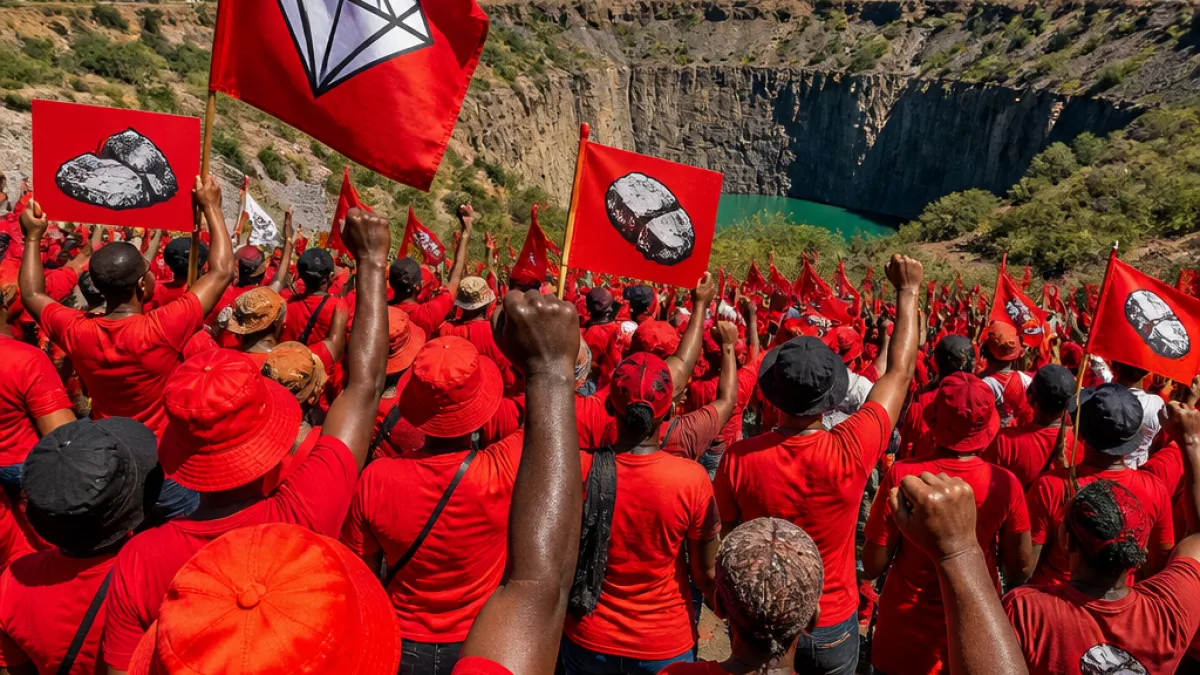
Kimberley — Economic Freedom Fighters (EFF) leader Julius Malema used the party’s Northern Cape manifesto launch to argue that the province’s mineral riches — notably diamonds and manganese — have failed to benefit local people and must be transferred into public ownership, according to reporting by SABC News on 13 September 2026.
The launch in Lerato Park drew members and supporters of the EFF as the party prepares for the 2026 local government elections. Addressing the crowd, Malema framed Kimberley as both a historic centre of extraction and a symbol of continued economic exclusion for many residents.
“Kimberley, the place of diamonds. Kimberley, a symbol of exploitation. Let the struggle for economic freedom start here and spread all over South Africa. Economic freedom has arrived in Kimberley and in the Northern Cape. In this province, that manganese belongs to us, the diamond belongs to us, all the minerals here belong to us; this is our land,”
Claim of resource ownership and local grievances
Malema told supporters that the province’s mineral endowment has not translated into broad-based prosperity, and reiterated the EFF’s long-standing call for state or public control of strategic resources. He positioned the Northern Cape as central to the party’s campaign on economic emancipation.
He singled out diamonds and manganese — two minerals historically associated with the Northern Cape economy — as examples of wealth that should be reclaimed for the people. The EFF has consistently campaigned for nationalisation or expropriation without compensation of key sectors, and this address reaffirmed that stance at a provincial level.
Local context and implications
The Northern Cape is South Africa’s largest and most sparsely populated province, with mining an important but often contested part of local economies. Kimberley’s diamondfields are a key symbol of South Africa’s mining history, and concerns about how mining benefits are distributed remain a persistent political issue.
Calls for resource ownership or greater community benefit raise a range of legal, economic and policy questions, including the structure of mining rights, fiscal arrangements and the roles of national and provincial government. Any move towards public ownership would involve national legislation and complex negotiations with current rights holders.
What was announced at the launch
The event in Lerato Park was the staged launch of the EFF’s Northern Cape manifesto ahead of local government elections. SABC News reported that Malema addressed party members and supporters, using Kimberley’s mining heritage as the setting for his economic message.
Key themes highlighted by Malema included:
- Resource ownership: a call for minerals to be owned by the people rather than private interests.
- Economic freedom: positioning Kimberley as the starting point for wider transformative demands.
- Election mobilisation: using the manifesto launch to rally support ahead of the 2026 local government vote.
Snapshot of minerals mentioned
| Mineral | Reference in speech |
|---|---|
| Diamonds | Named as emblematic of Kimberley’s extraction and inequality |
| Manganese | Highlighted as a provincially important resource that should "belong to us" |
These mentions underline the EFF’s strategy of tying national economic demands to local histories and grievances.
Responses and next steps
The SABC report did not include immediate responses from other political parties, provincial government, mining companies or community groups. As campaigning intensifies ahead of the local elections, expect competing parties to set out positions on mining rights, community benefits and local economic development.
Residents and stakeholders in Kimberley and across the Northern Cape will be watching how the debate over resource ownership translates into practical policy proposals and what that might mean for jobs, municipal revenues and investment.
For now, the EFF has used Kimberley’s symbolic history to headline its Northern Cape manifesto launch and to sharpen its message on economic redistribution in a province where mining remains central to both identity and controversy.