
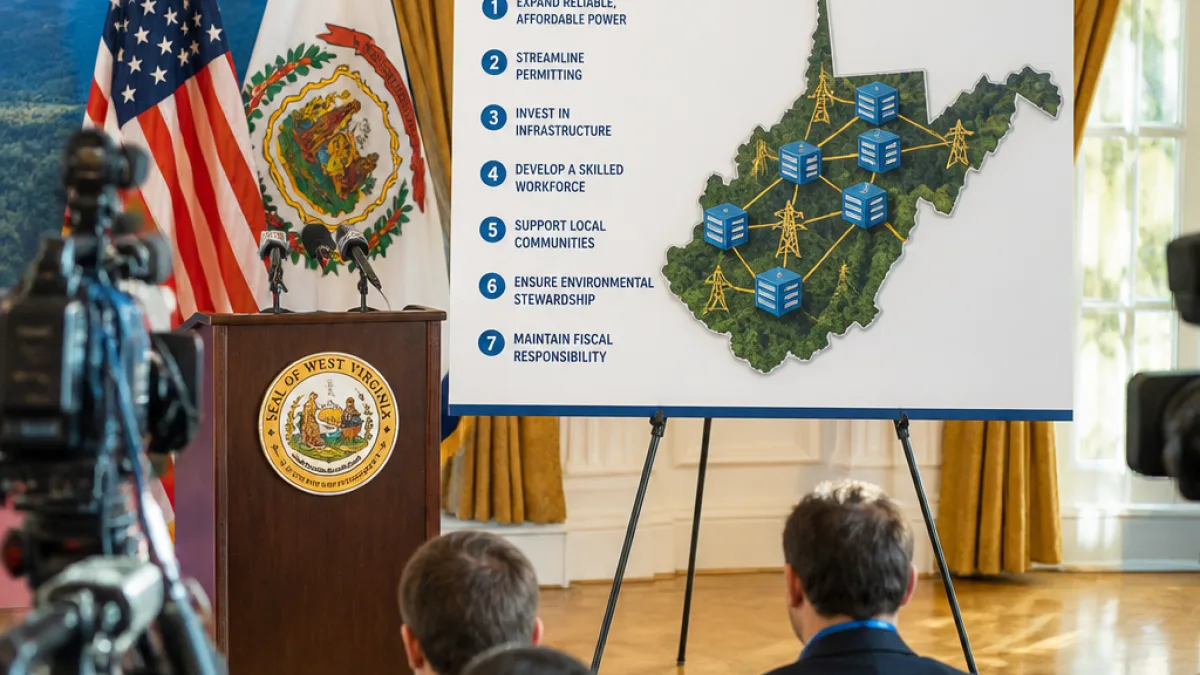
CHARLESTON — West Virginia’s executive and legislative leadership on Tuesday laid out a seven-point framework intended to shape how large-scale data centers are developed across the state, pledging measures aimed at protecting ratepayers, preserving natural resources and ensuring projects deliver clear benefits to host communities.
Gov. Patrick Morrisey, Department of Commerce officials and leaders from both chambers of the Legislature gathered in the Governor’s Reception Room to present the West Virginia Responsible Data Center Development Plan, a policy outline that officials say will steer the state’s approach to data center siting and the related expansion of electric generation and microgrid infrastructure over the next 20 years.
The plan is intended to complement last year’s House Bill 2014, the Power Generation and Consumption Act, which state lawmakers passed to make West Virginia more attractive to data center operators. That law created incentives and a regulatory framework to streamline projects and offered new tax and electric grid mechanisms intended for high-impact facilities.
Principles prioritize oversight, financial assurances
Among the principles unveiled, the first emphasizes comprehensive planning and oversight of proposed projects. Under the guidance announced Tuesday, developers seeking to build data centers in the state would be required to demonstrate financial capacity, submit estimated power load figures and provide binding capital investment commitments before advancing.
"I think it marks a defining moment for the future of the great State of West Virginia," Morrisey said. "Today, as the world stands on the cusp of a new digital and economic frontier, West Virginia is once again stepping forward to be a technology leader."
Officials stressed that projects would only receive approval if the projected benefits to both the state and local communities outweigh anticipated infrastructure and environmental costs. Morrisey said the state is seeking to avoid what he described as "fly-by-night" operations and instead attract “responsible hyper-scale data centers.”
How this builds on HB 2014
State leaders framed the plan as part of a coordinated effort tied to HB 2014. That law, supporters say, streamlines development for data centers and associated microgrids while providing tax and regulatory incentives. Elements noted by officials include regulatory exemptions in designated microgrid districts and a new property valuation approach for qualifying facilities.
| HB 2014 provisions | Purpose |
|---|---|
| Streamlined project development | Speed permitting and approvals for data center and microgrid projects |
| Regulatory exemptions in microgrid districts | Facilitate innovative energy deployment within designated zones |
| Special property valuation | Offer tax treatment to attract high-impact facilities |
| New tax distribution framework | Allocate revenue expected from large data centers |
| Fund for grid stabilization | Help manage electric system impacts of new load |
Official priorities and local concerns
State leaders framed the plan as a balance between economic development and community protections. They said the intention is to make sure local governments, ratepayers and the environment are not left bearing undue costs from increased electricity demand or infrastructure expansion.
The announcement comes amid growing national attention on the pace of data center construction. Some states have moved to slow or more tightly regulate projects, citing concerns about water use, land impacts and strained power grids. West Virginia’s approach focuses instead on setting upfront conditions for projects and enacting safeguards within state law.
What to watch next
Details about the other six principles were not fully described at Tuesday’s event. Legislative and Commerce Department officials indicated the plan will guide future rulemaking and project review, and that additional specifics will be released as proposals advance.
Residents and local officials in potential host communities should monitor forthcoming guidance for how project approvals will be evaluated — particularly on how projected benefits will be weighed against infrastructure and environmental costs. Developers will be expected to provide clear, verifiable data about investment levels and expected power consumption to proceed.
- Requirement for developers: proof of financial capacity and estimated power loads.
- Approval standard: benefits to state and local communities must exceed costs.
- Connection to HB 2014: tax, valuation and grid-stabilization measures intended to support data center growth.
As West Virginia positions itself to compete for large technology investments, the state’s newly outlined principles aim to create guardrails that state leaders say will protect ratepayers and local communities while promoting economic opportunity.

















