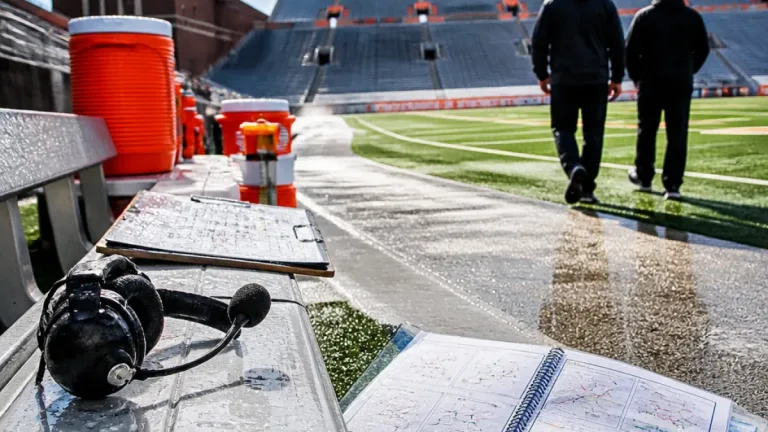

SALT LAKE CITY — For the first time in several years, local media were permitted limited in-person access to Utah football's fall camp, giving reporters a chance to watch position drills, observe small-group competitive periods and gather fresh impressions about player development ahead of the 2026 season.
What the access showed
Monday's viewing window did not include extended team scrimmage work, nor did it allow media to see full-play installations. Still, the opportunity to watch players in pads and on sleds offered tangible observations, especially along the offensive line.
A number of linemen appeared to have added size and strength during the offseason. Observers singled out Zereoue Williams as looking noticeably larger, with Alex Harrison and Keith Olson also showing increased bulk that could be useful when chipping away at past protection concerns. Isaiah Garcia drew attention for looking more physically refined, while Solatoa Moea’i continued to stand out for his already imposing frame. Kelvin Obot was described as an intriguing developmental piece — still early in his career, but with clear athletic traits when working alongside other linemen.
"Watched a lot of position drills. Good to hear the pads & sleds popping."
That observation, posted by a local beat reporter on social media during Monday's session, captured the most immediate takeaway from the limited on-field viewing: the sense that players are physically prepared to begin the season's work.
Limits on reporting and what remains unknown
Utah continues to enforce reporting restrictions for fall camp. Those constraints prevent the sharing of depth-chart movements, personnel combinations and schematic specifics. Because the media window did not include long periods of full-team work, the session did not produce enough information to make firm declarations about how the Utes will execute on Saturdays or what exact roles individual players will occupy.
Coaches and program officials have said in prior seasons that limited access preserves installation integrity and competitive advantage. For fans and analysts, that requires tempering any early impressions — improvements in size and athleticism are encouraging, but they do not by themselves resolve questions of cohesion, technique under game-speed pressure or in-game decision making.
Why the offensive line matters
The offensive line has been a focus of attention for Utah in recent seasons. Protection and run-game performance affect both the passing options and the rushing attack, and the unit's development is often a bellwether for offensive stability. Observers noted that while size gains are visible and important, they are only the beginning of a multi-step process that includes technique refinement, communication and live-game reps.
Coaches historically use fall camp to marry physical progress with schematic clarity. Until the Utes allow longer team sessions to be observed or until the season begins, evaluation must remain provisional.
What fans should know and watch for next
Fans hoping for an early peek at how Utah will look in the Big 12 should keep three things in mind:
- Media access remains limited: depth-chart shifts and detailed scheme information will likely be withheld until public games or official releases.
- Physical improvement is necessary but not sufficient: size and strength gains among linemen create potential, but on-field execution requires cohesion in live play.
- Upcoming opportunities: more extensive observations will come during later camp windows, preseason games and the season opener — those will provide firmer evidence of roles and effectiveness.
| Player | Observed change |
|---|---|
| Zereoue Williams | Noticeably bigger |
| Alex Harrison | Added useful size |
| Keith Olson | Added useful size |
| Isaiah Garcia | More refined physically |
| Solatoa Moea’i | Maintains imposing frame |
| Kelvin Obot | Young, athletic developmental piece |
Monday's practice viewing provided a welcome return to watching football preparation in person. It supplied more concrete notes than what reporters sometimes must gather from interviews or short highlight clips. Still, the full picture of how the Utes will perform in the Big 12 will depend on further camp evaluation and, ultimately, on game action.
Expectations should be measured: incremental physical progress is a positive sign, but the season's answers will arrive only after the team has faced live opponents under the pressure of competition.
Spencer Holloway is a state correspondent covering Utah sports for WE NEWS.