
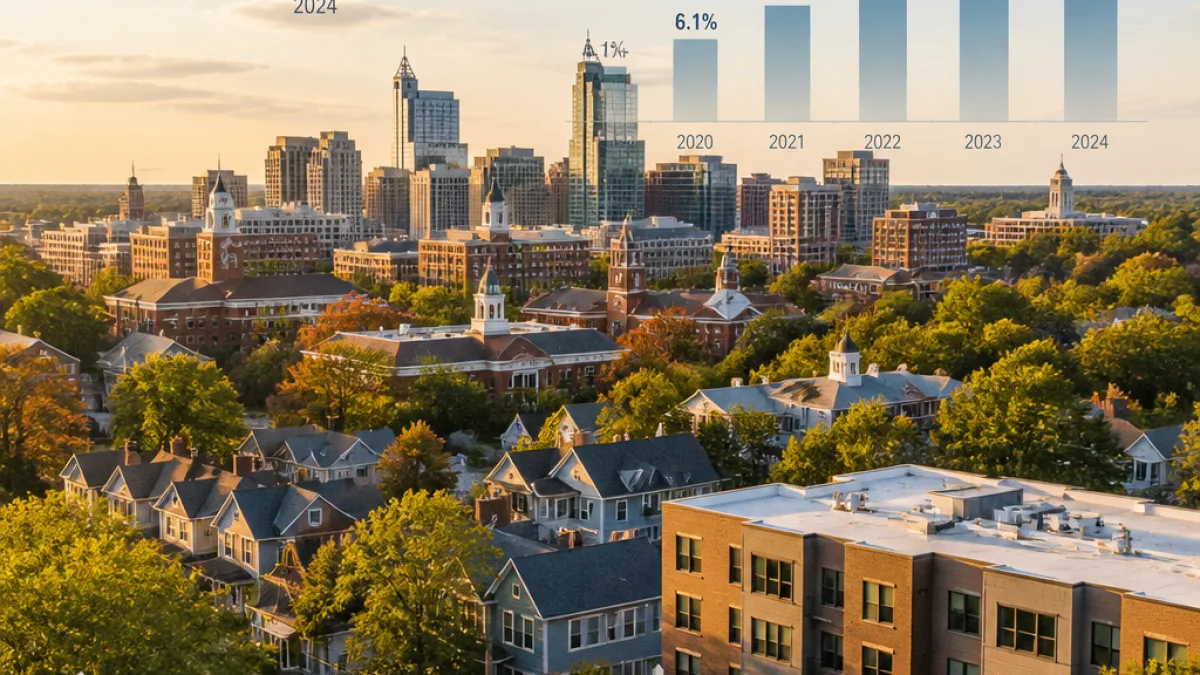
Forbes’ recent profile of Raleigh underscores the city’s role as a regional economic engine while laying out metrics that will influence local households, employers and policymakers in the months ahead.
Research, higher education and growth
The piece emphasizes Raleigh’s position inside North Carolina’s Research Triangle — a concentration of high-tech and biotech activity that feeds the region’s labor market and business ecosystem. Forbes cites the presence of major universities surrounding the capital, stating that institutions such as Duke, North Carolina State and the University of North Carolina at Chapel Hill have a meaningful economic impact on the area.
Forbes lists several headline figures: a gross metro product of $81.7 billion and a broader metro population of about 1.4 million. For the city proper, the profile notes a population figure of 517,000 and highlights Raleigh’s rapid growth as both a state capital and a college town.
Income, housing and cost of living
Economic indicators in the profile paint a mixed picture for residents. Median household income is listed at $74,177, which sits alongside a median home price the story reports in two ways: a city median of $434,000 (noted as of October 2019) and another figure for the broader Raleigh-Cary area of about $283,000. Forbes also places Raleigh’s cost of living slightly above the national average — the report cites both a 1% and 6% figure in different sections, reflecting the difference between metro-area comparisons and more recent assessments.
Unemployment in the profile is recorded at 3.6%, and projected annual job growth is presented as 1.3%. Forbes ranks Raleigh favorably on several lists, including employment and education, while noting the city’s appeal to businesses and retirees in other compilations.
- Gross metro product: $81.7 billion
- Metro population (Forbes): 1.4 million
- City population (Forbes): 517,000
- Median household income: $74,177
- Median home price (city, Oct. 2019): $434,000
- Unemployment: 3.6%
| Indicator | Forbes figure |
|---|---|
| Gross metro product | $81.7 billion |
| Median household income | $74,177 |
| City population | 517,000 |
| Unemployment | 3.6% |
Forbes describes Raleigh as part of "one of the country's largest and most successful research parks," reflecting the area's strength in high-tech and biotech research.
What the numbers mean locally
For Raleigh residents, the figures are more than statistics: they help explain pressures on housing, commuting and municipal services. A rising median home price amid modest job-growth projections signals continued demand for housing in an economy anchored by universities and research firms. The presence of major colleges and research institutions supports high-skilled employment, but also can contribute to upward pressure on rents and home values, especially in neighborhoods near campus and research parks.
Policymakers and business leaders will likely use metrics such as unemployment and projected job growth in planning workforce development and infrastructure investment. Local health and quality-of-life indicators — noted briefly in the profile — also matter to employers recruiting talent to the Triangle.
Strengths and challenges
Forbes highlights several strengths for Raleigh: a robust concentration of higher-education institutions, a notable gross metro product, and recognition on multiple business lists for job growth and education. At the same time, the profile flags drawbacks that resonate locally: a cost of living above the national average and a housing market that already shows elevated median prices.
Residents and city officials will be watching how these economic indicators evolve, particularly as demand for housing, transportation and services continues to rise. The Forbes snapshot provides a data-driven baseline for those conversations but leaves room for more localized analysis — including up-to-date housing inventory, neighborhood-level affordability and the direct economic contributions of Raleigh’s colleges — that city leaders and community groups will need to address.
As Raleigh continues to expand as a hub for research and higher education, the balance between growth and affordability will remain a central issue for households and businesses across the city and the wider Triangle region.
















