
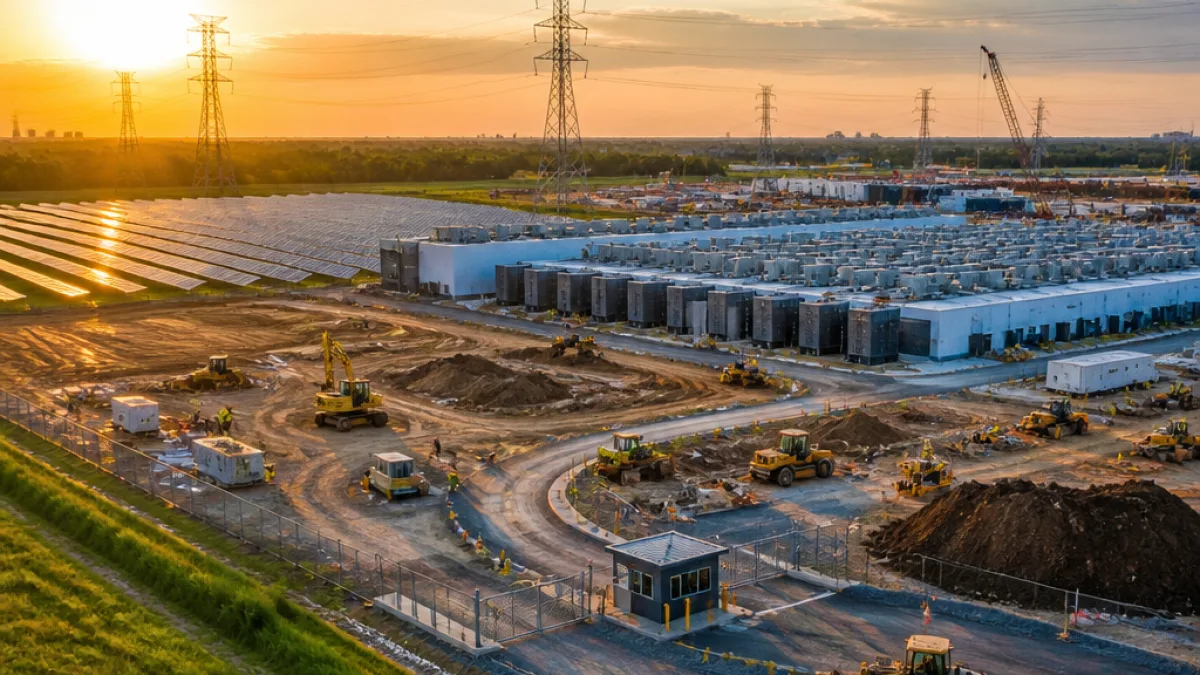
OpenAI announced a 10-year lease for a large-scale data center campus in central Ohio that will be developed and owned by SoftBank’s SB Energy, a move officials say will require unprecedented computing and power capacity and reshape parts of the regional energy landscape.
Project scale and jobs
The companies said the site will host 8 IT-gigawatts of computing capacity and be supported by 10 gigawatts of new energy generation. OpenAI and its partners projected the build will create roughly 35,000 construction jobs and about 2,500 permanent operating positions.
SB Energy will develop the campus on a combination of private land and federal property that was formerly used for uranium enrichment. The land, power and ownership arrangement reflects a growing trend of repurposing Cold War-era sites for energy- and data-intensive projects.
Financing and corporate guarantees
One of the most striking financial details disclosed in public filings is Nvidia’s agreement to act as the exclusive chip provider for the site and to guarantee up to $105 billion in conditional lease and power payment obligations to SB Energy, according to an SEC filing made public with the announcement. Nvidia also said it is investing $1.5 billion in SB Energy to support the company’s expansion as an AI infrastructure developer.
“land, power and shell”
The partners described the arrangement as a “land, power and shell” deal structure, designed to allow multiple upgrade cycles for future generations of compute infrastructure at the campus.
Energy mix and federal context
U.S. officials and the companies involved framed the development against a broader federal push to site large natural gas–fired data center campuses at former nuclear and uranium sites. The Ohio project contains plans for substantial new gas-fired generation — federal documents have referenced as much as 9.2 gigawatts of new gas-fired power ultimately envisioned for related projects — and the partners say they will build at least 10 GW of new energy generation overall.
Federal and international trade ties also surfaced in the announcement: U.S. officials said Japan is helping fund aspects of the project through a 2025 trade and investment agreement.
Why it matters locally
For Ohio communities, the project carries immediate and long-term effects. Construction activity at the scale projected would drive demand for skilled labor, materials and logistical support, while the addition of multi-gigawatt generation capacity could require upgrades to regional transmission and distribution systems. The use of formerly federal, uranium-related property adds a layer of regulatory and environmental oversight.
- Jobs: 35,000 construction; 2,500 permanent operations
- Compute: 8 IT-gigawatts planned
- Energy: 10 GW of new generation announced
- Finance: Nvidia guarantee up to $105 billion; Nvidia investing $1.5 billion in SB Energy
Questions and scrutiny ahead
Despite the scale and private commitments, analysts and industry watchers have raised concerns about concentrated financial relationships among customers, suppliers and investors in the AI sector. The deal revives debate about whether tightly interlinked arrangements could create systemic financial risks if market expectations for AI growth slow.
Local and state regulators will face decisions about permitting, environmental review and grid interconnection. The development’s reliance on large volumes of new generation — including planned natural gas capacity — will intersect with Ohio’s energy policy priorities and emissions goals. The reuse of federal land that was part of the Cold War uranium enrichment program introduces additional oversight by federal agencies.
National context and comparables
The Ohio announcement comes as part of a broader national push by federal officials to place energy- and compute-intensive campuses at former nuclear or uranium sites. Similar early-stage plans were disclosed last month for the Paducah Site in Kentucky, where NextEra Energy and Brookfield signaled interest in development with the Energy Department. Collectively, these projects illustrate how AI infrastructure needs are reshaping energy and land-use planning at a national scale.
| Element | Figure |
|---|---|
| Lease length | 10 years |
| Projected construction jobs | 35,000 |
| Permanent jobs | 2,500 |
| IT capacity | 8 GW |
| New energy generation | 10 GW |
| Nvidia guarantee | $105 billion (conditional) |
State and local officials have not released a detailed permitting timeline. The announcement signals a multi-year, capital-intensive effort that will require coordination across corporate partners, energy regulators and federal authorities. For Ohio residents, the project represents both a major economic opportunity and a series of planning and oversight challenges that will play out publicly in the months and years ahead.