
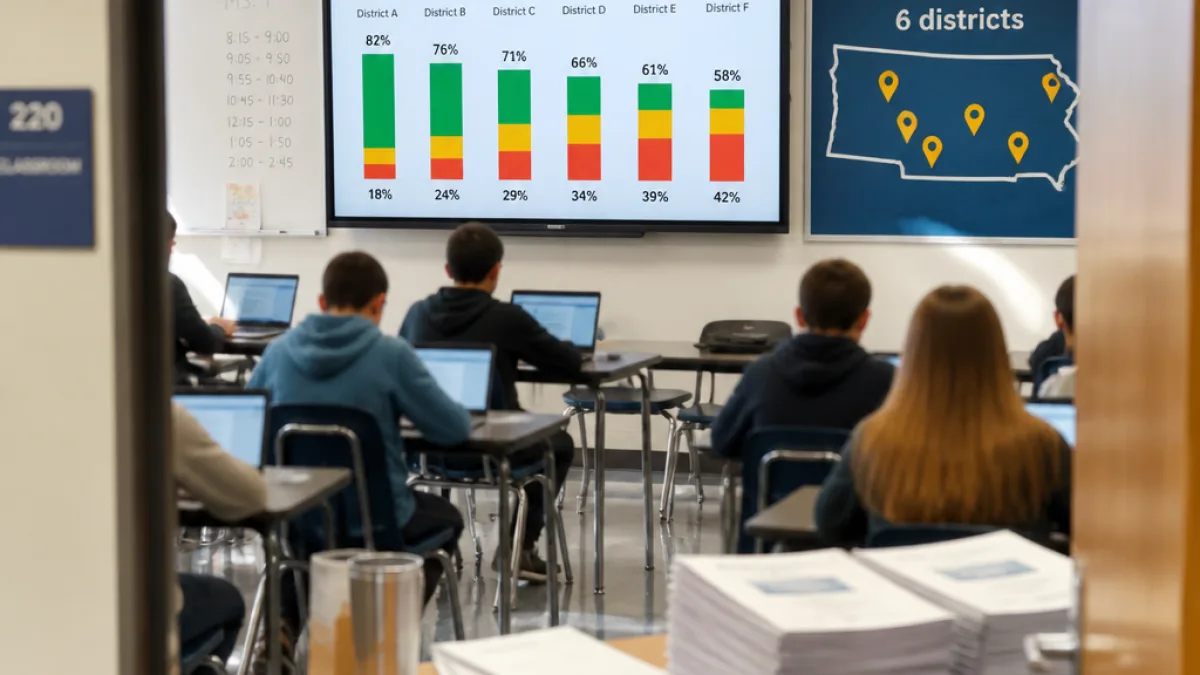
OLATHE, Kan. — Olathe is one of six Kansas school districts selected to pilot a new standardized testing program that promises to return student results within days rather than months, district and state officials said.
Faster results intended to change classroom practice
The program — developed in Olathe — will provide testing results within three days and be administered four times a year, rather than relying on a single end-of-year report, according to local school officials. The faster turnaround is intended to give teachers more immediate insight into which lessons are working and which students need additional support.
District leaders say the pilot aims to move assessment from a primarily summative role to a more formative tool that can inform instruction during the school year. Officials contend that more frequent, timely data allows for quicker adjustments to lessons, targeted interventions and individualized study plans.
"results will be reported within three days four times a year, as opposed to getting reports back once at the end of the year."
How the pilot will operate in Olathe
Details released so far indicate that Olathe will use the district-developed assessment instrument as part of a controlled pilot during the upcoming school year. The district is coordinating with the Kansas Department of Education and with five other participating districts across the state to evaluate the program’s effectiveness and scalability.
- Frequency: Four testing windows per school year
- Turnaround: Results available within three days of assessment
- Scope: Pilot in Olathe and five other Kansas districts
School officials say the pilot will focus on providing actionable, student-level information that teachers can incorporate into lesson planning and intervention strategies immediately after results are returned.
Local implications and questions
For Olathe classrooms, the pilot could mean a notable shift in how teachers use assessment data. Instead of waiting until the end of the academic year to review summative results, educators could adjust instruction mid-course, potentially reducing learning gaps before they widen.
However, several practical questions remain unaddressed in the initial announcements: whether the pilot will cover all grades and tested subjects, how the district will ensure the assessments align with state standards, what technical and training supports will be provided to teachers, and how parents will receive and be guided to interpret the more frequent reports.
District administrators have emphasized that the program was created locally and that one of the goals of the pilot is to determine whether the process can be adopted broadly across Kansas. The state’s participation with a limited set of districts will allow policymakers to examine outcomes, implementation challenges and resource needs.
Evaluation and next steps
Officials said the pilot will be evaluated on a range of factors including data accuracy, teacher uptake, impact on instruction, student outcomes and logistical feasibility. If the pilot demonstrates positive effects and can be implemented reliably, the model could be considered for wider adoption.
| Area | Reported Detail |
|---|---|
| Turnaround time | 3 days |
| Frequency | 4 times a year |
| Origin | Developed in Olathe |
| Pilot partners | Olathe and five other Kansas districts |
As the school year begins, Olathe families and educators will be watching how the pilot affects classroom practice and whether the promise of near-immediate testing feedback leads to measurable improvements in instruction and student progress. District and state officials have not released a full calendar of test windows or detailed implementation guidance; those materials are expected to be shared with participating schools ahead of the pilot’s first administration.
The pilot represents a local effort to retool assessment timelines and make test results a more timely tool for teachers and students. For a district that built the program, the upcoming year will test whether rapid assessment can be scaled without sacrificing validity, reliability or instructional coherence.















