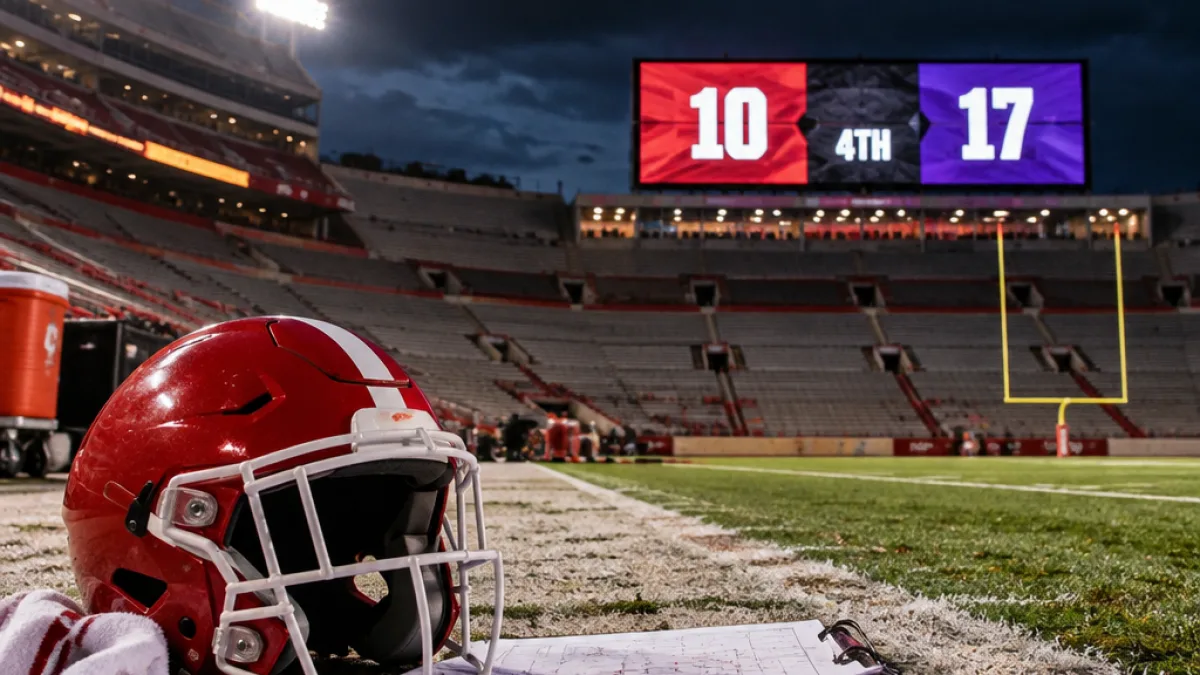
Nebraska’s football team is searching for answers after another fourth-quarter breakdown, this time a 17-10 loss to Washington that turned a defensive success into the Huskers’ third consecutive defeat.
The result leaves Nebraska at 5-3 overall and 2-3 in Big Ten play. Washington also improved to 5-3, including a 2-3 conference record. For Nebraska, the latest loss is especially difficult because the team controlled much of the contest and appeared positioned to win until the closing minutes.
A strong defense was not enough
Nebraska’s defense held Washington to only three points for 58 1/2 minutes of Saturday’s game, according to the game analysis. The Huskers limited the visitors to 32 rushing yards and stopped Washington on 10 of 15 third-down opportunities.
Those numbers ordinarily would provide a foundation for victory. Instead, Nebraska’s defense was placed in a position where one late Washington scoring drive could change the outcome. The unit had spent most of the night restricting the Huskies, but the offense and special teams did not produce enough to create a margin that could withstand a late swing.
The performance also underscored the progress made by defensive coordinator Rob Aurich during his first eight games in the role. Nebraska’s defensive improvement has been one of the clearest positive developments of the season, even as the team’s record has moved in the opposite direction.
The offense remains the central concern
Nebraska scored only 10 points overall and seven on offense. That output was not enough to support a defense that had kept Washington out of the end zone for most of the evening.
The offensive struggles are particularly notable because expectations entering the season were substantially higher. The offense was viewed as a potential team strength, but eight games into the 2026 season it has instead become the source of much of the frustration surrounding the Huskers.
Saturday’s result reflected that imbalance. Nebraska’s defense gave the team repeated opportunities to remain in control, while the offense could not turn that field position and defensive work into enough points. The inability to finish drives left the Huskers vulnerable to a single late sequence from Washington.
| Category | Nebraska | Washington |
|---|---|---|
| Final score | 10 | 17 |
| Overall record | 5-3 | 5-3 |
| Big Ten record | 2-3 | 2-3 |
| Washington rushing yards | 32 |
A pattern that has become impossible to ignore
The Washington loss followed two earlier defeats that also came after Nebraska had built a fourth-quarter lead. The repeated nature of those results has transformed what might have been viewed as an isolated late-game failure into a season-long issue.
Just weeks ago, Nebraska was undefeated and led the defending national champions by 17-6 with approximately 12 minutes remaining. Since then, the Huskers have lost three games in succession, each in a different way but with a similar final impression: Nebraska has been unable to close out games it had put itself in position to win.
That slide has erased much of the momentum created by the team’s early-season start. A 5-3 record still reflects a team with a winning mark, but the recent direction is the more immediate concern. Nebraska has moved from the confidence of an unbeaten start to the uncertainty of a team attempting to stop a losing streak before it defines the season.
What Nebraska must address
The numbers point to two separate tasks. The defense must preserve the progress it has made, particularly against the run and on third down. At the same time, Nebraska’s offense must find a way to generate more than isolated points when the defense is controlling the game.
- Protect the defensive gains made during Aurich’s first season as coordinator.
- Improve offensive production after scoring just seven points on offense against Washington.
- Finish games in which Nebraska carries a lead into the final quarter.
The loss also raises questions for offensive coordinator Dana Holgorsen, whose unit has not matched the talent and expectations attached to the team before the season. The immediate challenge is not simply to produce more yards or isolated big plays, but to sustain enough offense to prevent strong defensive performances from becoming wasted efforts.
Nebraska’s latest defeat therefore carries significance beyond the standings. It showed that the Huskers can still defend at a level that keeps them in a Big Ten game, but it also showed that defensive excellence alone has not been sufficient. Until Nebraska converts that strength into points and late-game wins, the team’s three-game skid will remain the defining story of its season.