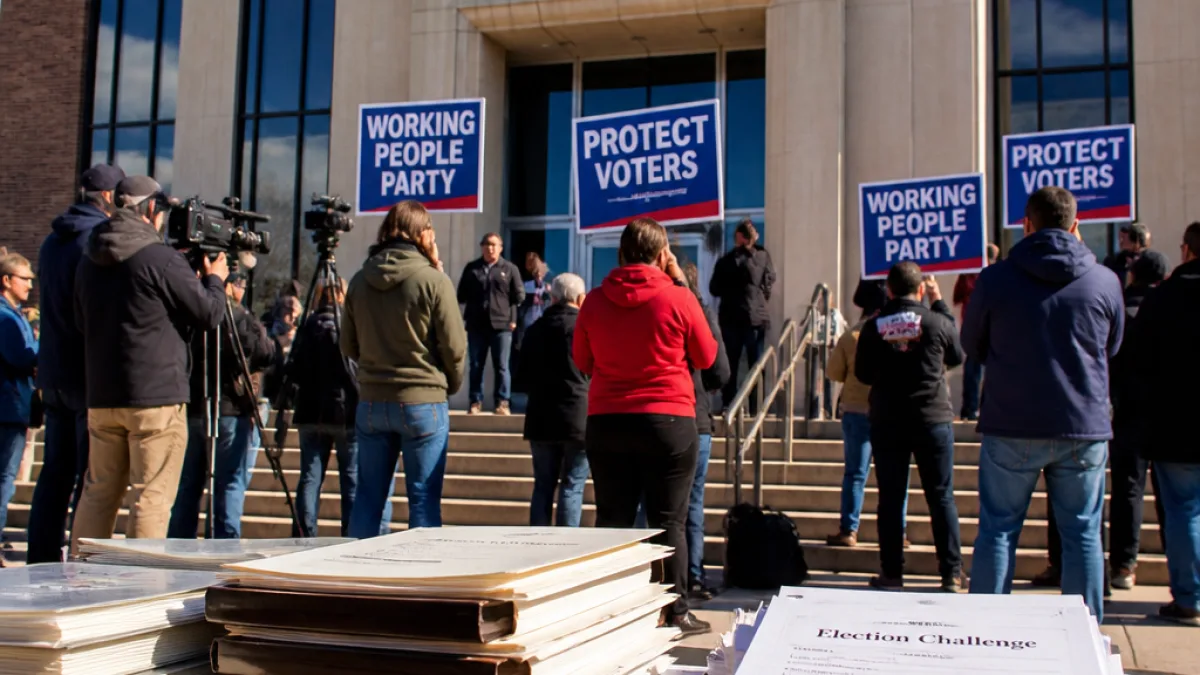
The Nebraska Democratic Party filed a lawsuit Monday asking a Lancaster County court to prevent candidates of the newly formed Nebraska Working People Party from appearing on the Nov. 5 general election ballot, saying the party’s creation and name violate state election law and risk confusing voters in close contests.
What the complaint alleges
The lawsuit names Secretary of State Bob Evnen as the defendant and challenges his recent certification of petition signatures that cleared the way for the Working People Party to obtain official party status in Nebraska. Party organizers gathered petition signatures across the state over the summer and, according to the complaint, submitted enough to meet statutory thresholds.
In its filing, the Nebraska Democratic Party argues the party’s name is intended to create a false association with other candidates and organizations and that the organizers include individuals with partisan histories tied to Democratic nominations.
The complaint specifically identifies Robin Richards as a leader of the Working People Party and characterizes her as a “sore loser former candidate who has serially sought and failed to obtain the NDP’s nomination for the state legislature.” The Democrats say that association and the party name could mislead voters, particularly in the contest for U.S. Senate.
"The name of a newly formed political party ‘shall not be or include the name of any political party then in existence or any word forming any part of the name of any political party then in existence.'"
The lawsuit cites that provision of Nebraska election law in arguing the Working People Party’s name conflicts with the established Working Families Party — a progressive organization based in New York that is not registered in Nebraska but has joined the Democrats’ legal action.
Parallel Republican challenge
The Democratic suit comes days after the Nebraska Republican Party filed a similar lawsuit seeking to block the new America First Party from the ballot. Both major parties have traded accusations that the new parties were organized to serve as spoilers in competitive races, while organizers of the new parties deny being created or controlled by either major party.
| Item | Detail |
|---|---|
| Signatures gathered | About 2,200 in each of Nebraska’s three congressional districts |
| Certification | Completed by Secretary Evnen last week |
| Primary participation | Too late; parties may, however, place candidates on the general ballot |
Legal and electoral implications
Nebraska law allows newly formed parties that meet petition thresholds to place their own candidates on the general election ballot, even if they missed the primary. That provision is central to the Democrats’ complaint, which contends the law’s prohibition on party names that duplicate existing party names should block the Working People Party from appearing under a name that shares the word "working."
The complaint also flags concerns about voter confusion in the U.S. Senate race. Independent candidate Dan Osborn is running in a close contest against incumbent Republican Senator Pete Ricketts, and the Democrats assert the Working People Party’s name could create a misleading affiliation with Osborn.
Who has joined the suit and what’s next
The national Working Families Party joined the Nebraska Democrats in the lawsuit, lending its organizational interest to the legal challenge. The case will proceed through the state courts, and the timeline for any resolution is not yet clear. The secretary of state’s office certified the petitions last week, which is the action the Democrats are now asking the court to overturn or restrict.
- Both major parties accuse the new parties of being spoiler operations; organizers deny those accusations.
- Each new party collected about 2,200 signatures in each of Nebraska’s three congressional districts to qualify.
- Nebraska law permits new parties to field general election candidates even if they do not participate in the primary.
The litigation follows a series of legal disputes this election cycle related to party formation and candidate access. Democrats also face separate litigation over their decision not to field a candidate in the U.S. Senate general-election race. That matter remains unresolved.
The outcome of the Democrats’ suit could shape the ballot options Lincoln-area and statewide voters see this fall and may influence several competitive races. The courts will determine whether the Working People Party can remain on the ballot under its chosen name or whether state law requires a different outcome.
Reporting for this article relied on the Democratic Party’s filing and public statements about petition certifications; the secretary of state’s certification occurred last week, and both the Republican and Democratic parties have mounted legal challenges to recently formed parties that were certified to place candidates on the general election ballot.