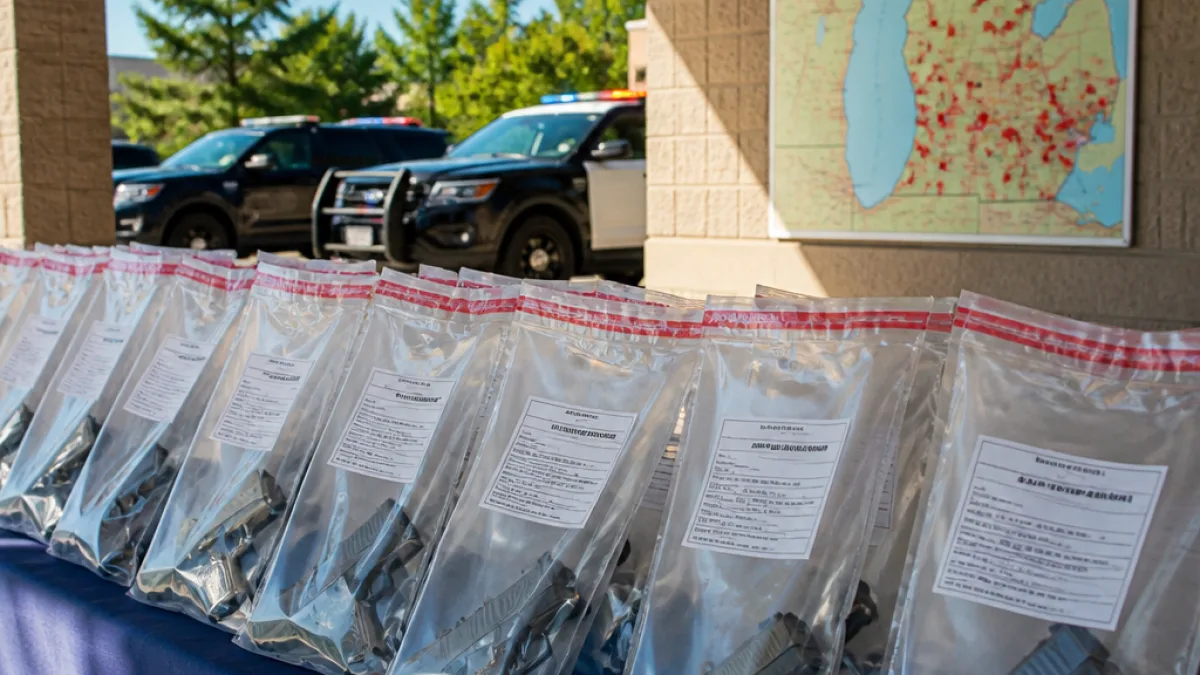
LANSING — Michigan officials said Monday that a statewide anti-violence effort led to the removal of more than 1,000 illegal firearms from communities across the state as part of Operation Safe Neighborhoods, a program targeting high‑risk individuals on parole and probation.
Program targets those at highest risk for weapons offenses
Launched to reduce gun violence and keep weapons out of the hands of people prohibited from possessing them, Operation Safe Neighborhoods focuses on people the state identifies as high risk, including convicted felons with prior weapons offenses. According to the governor’s office, Michigan has roughly 32,000 people on probation and about 8,600 on parole.
More than 1,000 Michigan Department of Corrections parole and probation agents supervise those individuals, the governor’s office said, and those agents have participated in coordinated compliance efforts with local and state law enforcement.
Enforcement activity and additional findings
Since Operation Safe Neighborhoods began, officials said law enforcement has conducted more than 11,000 compliance checks with felony offenders. During some of those checks, officers encountered illegal drugs and ammunition in addition to firearms.
“Operation Safe Neighborhoods is reducing violence in our communities and helping every Michigander feel safe,” Gov. Gretchen Whitmer said. “I’m proud of the partnership between state and local law enforcement to get more than 1,000 illegal firearms off our streets. Our investments in public safety have helped drive violent crime down 11% over the last five years.”
State officials framed the effort as a collaborative partnership between the Michigan Department of Corrections and local law enforcement agencies. The program emphasizes supervising people with prior weapons convictions more closely and checking compliance with the terms of parole or probation.
- Illegal firearms seized: More than 1,000
- Compliance checks conducted: More than 11,000
- People on probation: Roughly 32,000
- People on parole: About 8,600
- Parole and probation agents: More than 1,000
Context and local impact
The state’s figures position Operation Safe Neighborhoods as an enforcement-focused element of Michigan’s broader public-safety strategy. Officials cited a decline in violent crime of 11% over five years as evidence that the administration’s investments in public safety are producing results.
For residents, the operation means increased contact between supervising agents and people on community supervision, including home visits and compliance checks intended to ensure legally required conditions are upheld. Officials say those checks have led to arrests or additional charges when agents discover illegal weapons, ammunition or controlled substances.
What officials are not saying
The governor’s office did not release a detailed breakdown of where the firearms seizures occurred, the number of arrests tied directly to the operation or the specific types of weapons recovered. Nor did the office provide an account of how many compliance checks led to seizures of drugs or ammunition versus firearms.
Law enforcement agencies traditionally weigh the public interest in transparency against investigative confidentiality and privacy concerns. Local departments may provide more granular information when operations conclude or through formal public records requests.
What to expect next
Officials said the program remains active. Residents interested in public-safety updates can follow communications from the governor’s office and local police departments for notices about ongoing operations, community meetings and resource information related to crime prevention and reporting.
| Metric | Reported figure |
|---|---|
| Illegal firearms removed | More than 1,000 |
| Compliance checks | More than 11,000 |
| People on probation | ~32,000 |
| People on parole | ~8,600 |
| Parole & probation agents | More than 1,000 |
As the state continues its enforcement campaign, officials and community leaders will likely face questions about transparency, the allocation of law enforcement resources, and how best to measure the operation’s long-term impact on gun violence and community safety.
For now, Michigan’s government points to the number of firearms removed and the scope of compliance activity as indicators that the initiative is identifying and disrupting unlawful weapons possession among those supervised in the community.