
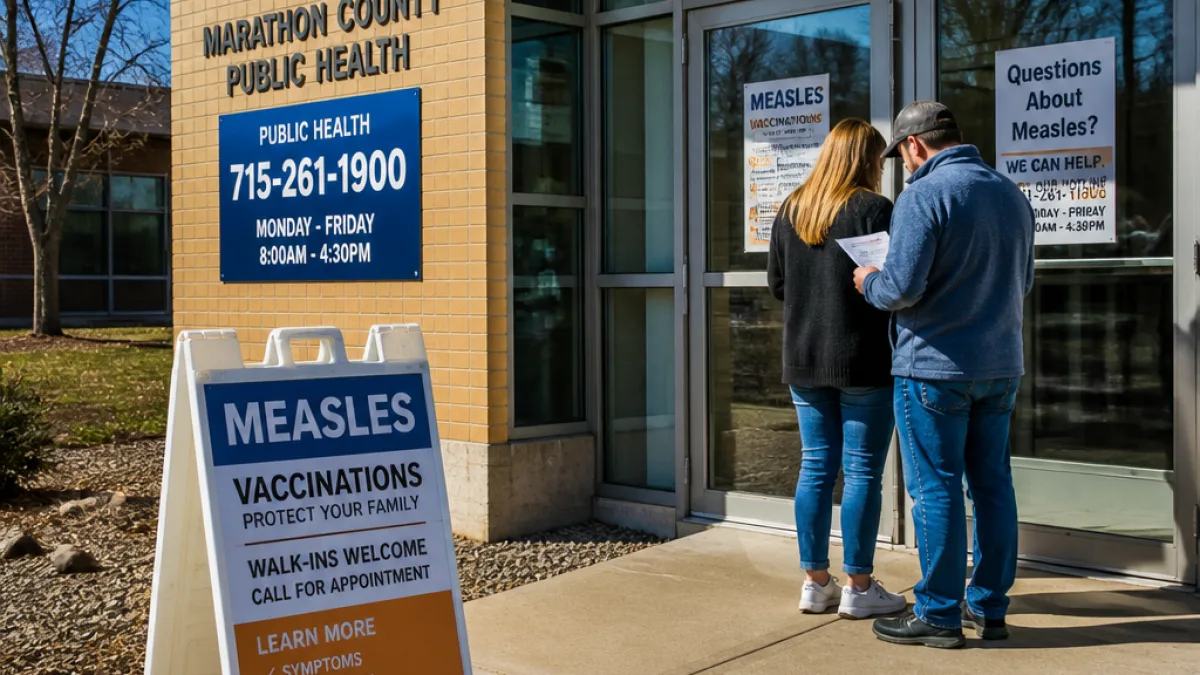
State health officials announced Sept. 15 that a measles case has been confirmed in Marathon County. The department said the infection resulted from exposure during travel outside Wisconsin and is not connected to the larger outbreak that has affected communities in the state's southwest.
What officials are saying
"There are currently no places where the public may have been exposed to the disease unknowingly,"
the state health department said in a news release. Beyond that statement, officials declined to provide additional details about the individual patient.
The Marathon County report expands the map of measles activity within Wisconsin this year, though it appears to be an isolated importation rather than evidence of new local spread tied to the southwest outbreak.
How the state's outbreak compares nationally
Public health data cited by the state show that measles is circulating widely across the country. The Centers for Disease Control and Prevention reports roughly 3,300 cases nationwide this year. Some states are reporting much larger outbreaks: Pennsylvania has recorded more than 600 cases and has reported four deaths linked to the disease.
Within Wisconsin, most cases this year have been concentrated in Iowa, Lafayette and Grant counties, where an outbreak produced more than 160 infections and prompted federal assistance. That outbreak prompted a response team from the CDC; officials said the team has since left as the number of new cases has declined.
Local clinical impact and vaccination status
State reporting indicates that all but one of Wisconsin's measles patients this year were unvaccinated. At least five people in the state required hospitalization due to measles complications.
Health officials reiterated standard guidance for people who believe they may have been exposed or who develop symptoms: avoid contact with others and call a doctor's office or clinic before arriving for care to reduce the risk of exposing additional people.
Recognizing measles
Measles symptoms typically begin about one to two weeks after infection. Early signs include high fever, cough, runny nose and red, watery eyes. A rash usually appears a few days after initial symptoms, beginning on the face and spreading across the body. Tiny white spots inside the mouth may appear a few days into the illness.
- Key early symptoms: fever, cough, runny nose, red/watery eyes
- Rash development: begins on face/hairline, spreads outward
- When to seek care: call ahead to a clinic or doctor if you suspect measles
Public health authorities emphasized that the Marathon County case was linked to travel outside Wisconsin rather than local transmission connected to the larger southwestern outbreak. Still, the presence of measles in more counties underscores ongoing risk as the virus continues to circulate nationally.
| Measure | Count/Status |
|---|---|
| Wisconsin counties with concentrated outbreak | Iowa, Lafayette, Grant |
| Southwest Wisconsin outbreak cases | More than 160 |
| U.S. measles cases (year to date) | About 3,300 |
| Pennsylvania cases | More than 600 (4 deaths) |
| Wisconsin hospitalizations this year | Five |
Health officials recommend that people check their vaccination records and consult their health care provider about measles, mumps and rubella (MMR) immunization if they are unsure. The state did not identify any public locations where exposure to the Marathon County patient occurred, and local residents should remain alert for symptoms after travel or contact with travelers.
The Marathon County confirmation illustrates how international and interstate travel can seed isolated infections even as local outbreaks are brought under control. Public health authorities continue to monitor the situation and to provide updates if additional exposure sites or cases are identified.
— Peter Vandenberg, State Correspondent

















