ROCKVILLE, Md. — Maryland students made slight progress in math on this year’s Maryland Comprehensive Assessment Program, but the improvement was limited and continues to lag behind gains in English language arts, according to the newly released statewide results.
Small statewide increase, long-term lag
The state’s MCAP summary shows just a modest uptick in math proficiency statewide. Only 27.1% of Maryland students scored at the proficient level in math — a change of 0.6 percentage points above last year. That increase, while positive, represents slow growth and leaves most students below proficiency.
Education analysts have noted that math proficiency for elementary and middle school students remains under pre-pandemic levels. In contrast, English language arts scores have recovered more strongly, widening a performance gap that educators say requires targeted interventions.
County differences: Montgomery leads, Prince George’s trails
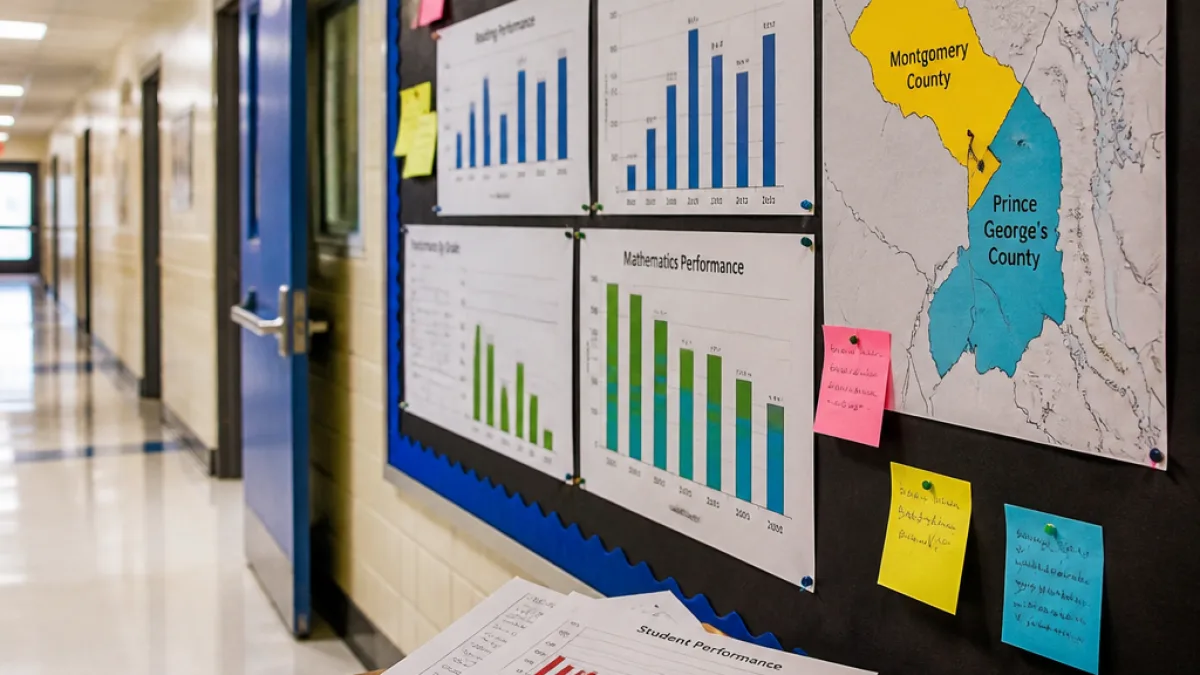
Performance varied substantially across Maryland’s school systems. Montgomery County Public Schools continued to outpace the state average: MCPS reported that 35.7% of its students were proficient in math last year, rising to 36.9% this year. Local officials described the change as modest but meaningful for some grade bands.
By contrast, Prince George’s County’s overall math results remain far below both the state and Montgomery County averages. Countywide proficiency was described in the results as roughly "one in seven" students meeting the proficient standard, with little change from the previous year.
| Jurisdiction | Math proficiency (most recent) | Year-over-year change |
|---|---|---|
| Maryland (statewide) | 27.1% | +0.6 points |
| Montgomery County | 36.9% | Increase from 35.7% last year |
| Prince George’s County | About one in seven students proficient | Essentially unchanged from prior year |
District responses and instructional changes
Montgomery County is moving to revise elementary math instruction in response to the data. Beginning this fall, the district plans to place fourth-grade students into cluster groups for part of the school day so pupils with similar needs can receive targeted instruction. MCPS is also introducing the Amplify Desmos Math curriculum, which emphasizes conceptual understanding, problem-solving and computation.
“It’s not every component, every day, somebody’s doing something different. It’s not two different classes in the same room. and those are some of the strategies and practice that our coaches and the Amplify Desmos coaches are going to need to help teachers with as they are taking on this new approach,”
The comment came from Sheila Berlinger, supervisor of elementary mathematics, during a recent MCPS work session. District leaders say the approach is intended to support teachers as they adopt new grouping strategies and curriculum materials, and to strengthen coaching and professional development.
What the numbers mean locally
For parents and educators, the results underscore persistent challenges in math instruction across the state. While some districts are testing new structures and curricula, others face steeper hurdles. In Prince George’s County, where proficiency remains low, educators and county officials will likely face pressure to accelerate interventions that reach the students furthest from proficiency.
Policy advocates and school leaders say progress will require sustained investment in teacher training, materials that build conceptual understanding, and targeted support for students who fell behind during the pandemic.
Practical information for families
- Parents should check their local district’s score reports and open communication from schools about curriculum changes and interventions.
- Families can ask about targeted math supports such as small-group instruction, math coaches, after-school programs and summer learning options.
- Educators recommend focusing on problem-solving and number sense at home in addition to practice with computations.
State and local leaders are expected to discuss these results at upcoming school board meetings and work sessions as districts refine plans to improve math outcomes. The modest statewide increase offers a starting point, but the disparities across Maryland’s counties highlight how much work remains before most students reach proficiency.
— Priya Chandrasekaran, State Correspondent