
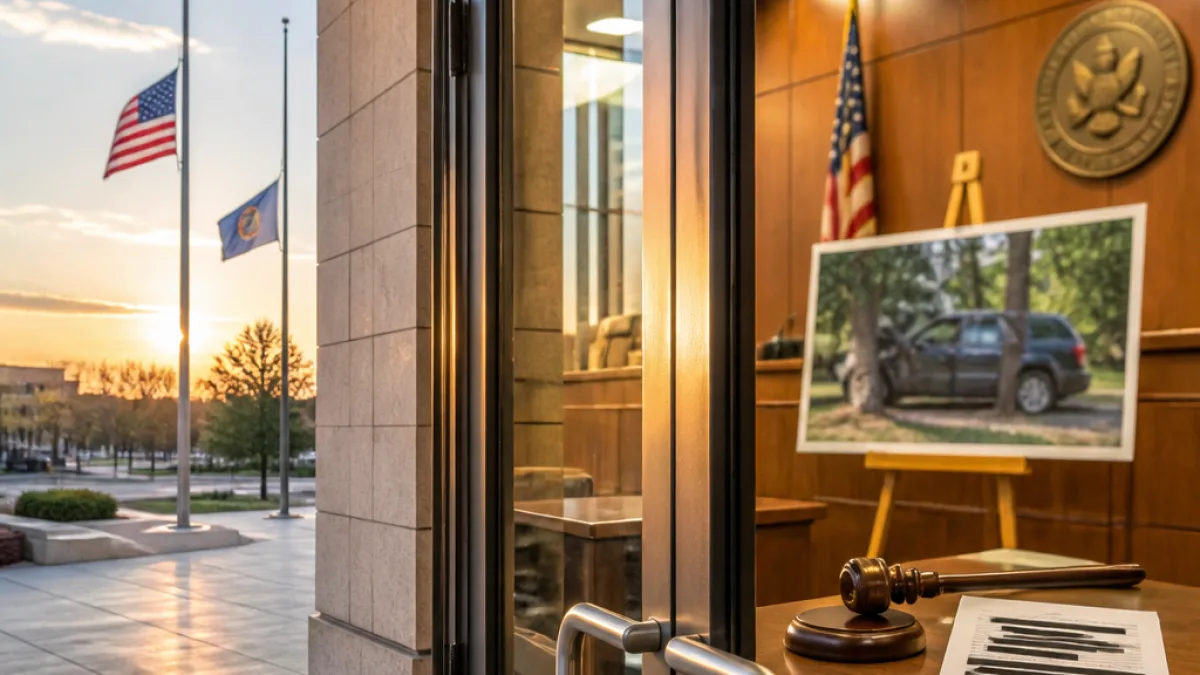
A Second Judicial Circuit judge on Thursday reduced the prison term for Damion Laurelez, who pleaded guilty in connection with a high-speed crash that killed two people in April 2024. The court set the new sentence at 30 years without the possibility of parole, down from an earlier 40-year term.
Background of the crash and convictions
The collision occurred in April 2024 when a Dodge Durango driven by Laurelez left the roadway and struck a tree near the intersection of East 18th Street and South Second Avenue in Sioux Falls. The crash resulted in the deaths of Milana Reeves and Eric Hopkins and injured six other people.
Laurelez, who was 17 at the time of the crash, later pleaded guilty to two counts of first-degree manslaughter as part of a plea agreement reached in February 2026. Toxicology testing previously reported a blood-alcohol concentration of 0.047% and trace levels of Delta-9 THC and Carboxy THC.
Initial sentence and reasons for modification
In April 2026, Judge Douglas Barnett imposed a 40-year sentence — 20 years for each manslaughter count — describing the case as one of the most angering of his career. During sentencing, the judge cited what he saw as a lack of remorse by Laurelez. Barnett said a recorded phone call in which Laurelez admitted he felt no remorse prompted him to impose the harsher punishment.
“Where is the line between punishment — which (Laurelez) deserves — and vengeance — what I cannot do,”
At the modification hearing on Aug. 13, Barnett said he had reflected on whether his original decision had been driven by anger rather than strictly by the law and the appropriate limits of punishment. After reconsideration, the judge adjusted the sentence to match the state’s recommendation.
New sentence and specifications
The court changed the sentence to 30 years without parole, with no portion of the term suspended. Under South Dakota law, each first-degree manslaughter count carries a maximum of 15 years, and the new sentence reflects the statutory maximum recommended by the state: 15 years for each count.
| Item | Previous | Revised |
|---|---|---|
| Total sentence | 40 years (20 + 20) | 30 years (15 + 15) |
| Parole eligibility | None indicated | None |
| Counts | Two counts of first-degree manslaughter | Two counts of first-degree manslaughter |
Victims and community impact
The crash that claimed the lives of Reeves and Hopkins also produced serious injuries for six others, leaving family members and the Sioux Falls community to cope with loss and long-term recovery. The change in sentence may offer differing perspectives for victims’ relatives — some may see the modification as a recognition of judicial restraint and adherence to statutory limits, while others may view it as a reduction in punitive accountability.
Judge’s reflection on sentencing
Judge Barnett said during the modification hearing that he had “searched (his) soul” over whether the original sentence crossed the line into retribution. He told the court he wanted to ensure the punishment aligned with the law rather than an emotional response.
Legal context and next steps
The state initially recommended the 30-year cap as the appropriate sentence in the plea agreement. The revised ruling conforms to that recommendation and to the statutory maximum available for each manslaughter count. There was no indication at the modification hearing that further appeals or motions were pending.
- Defendant: Damion Laurelez, 17 at time of crash.
- Charges: Two counts of first-degree manslaughter (pleaded guilty).
- Sentence: 30 years without parole after modification (15 years per count).
The resentencing closes a chapter in a case that drew intense emotions in court and the community. As the families and others directly affected continue to recover, the ruling underscores the balance judges seek between statutory limits and the demands for accountability in fatal traffic cases.
Reporting from Sioux Falls. — Hannah Steele
















